Era 6 · The First Kings1 Samuel
Adullam and the Massacre at Nob
"I have occasioned the death of all the persons of thy father's house"
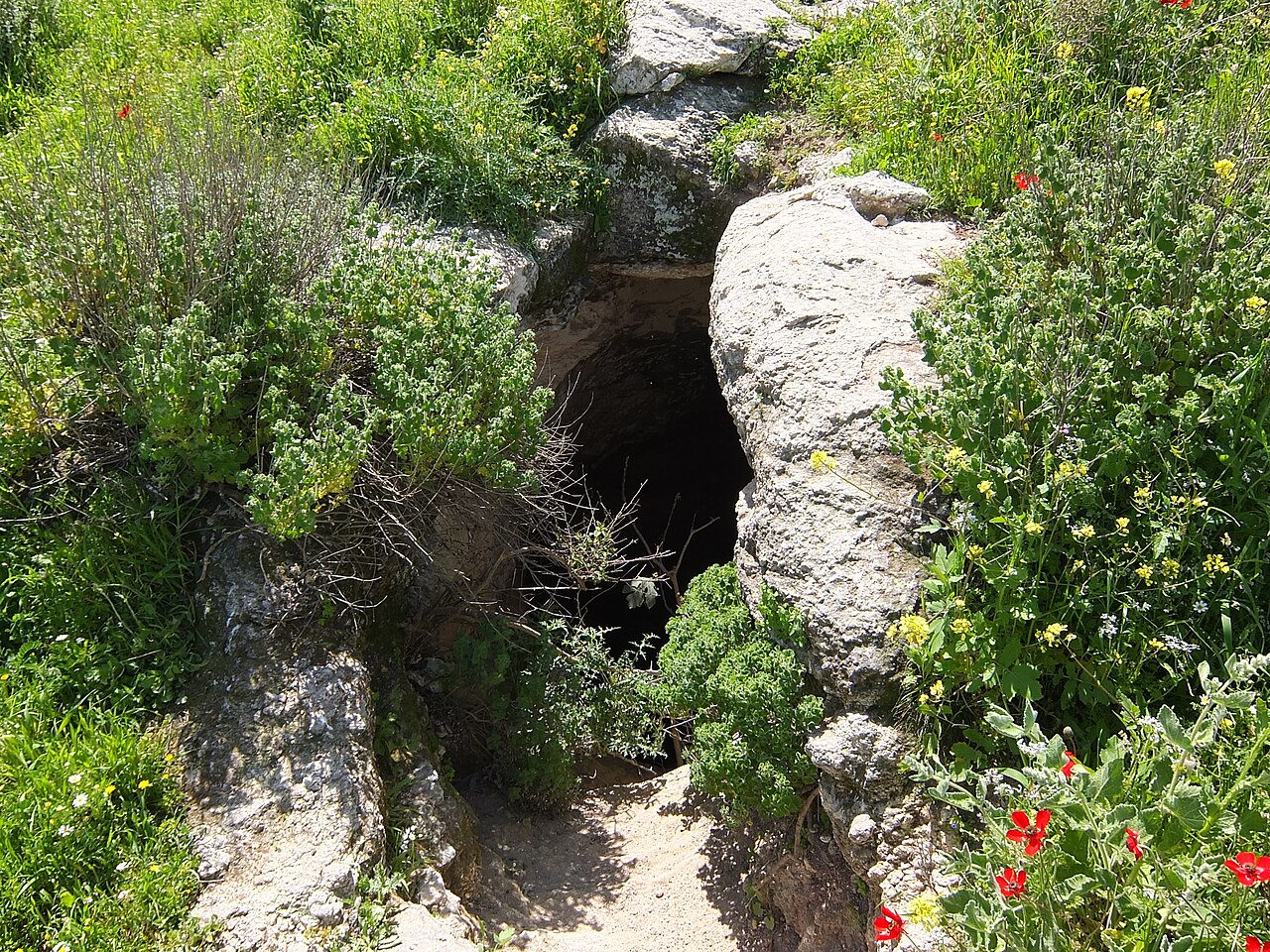
"David… escaped to the cave Adullam… And every one that was in distress, and every one that was in debt, and every one that was discontented, gathered themselves unto him; and he became a captain over them: and there were with him about four hundred men." He brings his father and mother to the king of Moab at Mizpeh of Moab. The prophet Gad tells him to go into Judah.
Saul, under the tamarisk at Gibeah, complains that no one tells him anything. Doeg reports what he saw at Nob. Ahimelech answers: "who is so faithful among all thy servants as David?" "Thou shalt surely die, Ahimelech, thou, and all thy father's house." Saul's footmen "would not put forth their hand to fall upon the priests of the LORD."
"Turn thou, and fall upon the priests." Doeg kills eighty-five men who wore the linen ephod, "and Nob, the city of the priests, smote he with the edge of the sword, both men and women, children and sucklings, and oxen, and asses, and sheep." Abiathar escapes to David. "I knew it that day, when Doeg the Edomite was there… I have occasioned the death of all the persons of thy father's house. Abide thou with me, fear not."
Royal atrocity
The narrator states the massacre plainly. Saul's own guards refuse an unlawful order; a foreigner obeys. The killing of Eli's priestly line fulfils the word of chapter 2, yet the text does not excuse Saul or Doeg.
The cave of Adullam
Adullam is identified with Khirbet esh-Sheikh Madhkur (Tel Adullam) in the Shephelah, near the Elah valley; caves in the area are traditionally associated with David. No particular cave is identified.
Bands of outcasts
Groups of displaced men living by raiding or as hired fighters appear in Judges (Jephthah, Abimelech) and in the Amarna letters, where Canaanite rulers complain about the 'Apiru. David's band fits that world.
David's parents in Moab
David entrusts his parents to Moab. Ruth, David's great-grandmother, was a Moabite (Ruth 4:17); the text does not draw the connection.
The Case for the Biblical Account
Scripture's account
David's band at Adullam; Saul's massacre of Nob (1 Samuel 22).
What evidence would we expect?
Outlaw bands in the hill country; a Judahite site of Adullam.
The discoveries
'Apiru in the Amarna letters; Tel Adullam in the Shephelah.
Testing the discoveries
The social world is attested; the massacre is known only from Samuel (and Psalm 52's title).
The strongest reconstruction
A tradition of Saul's violence against the priesthood that sided with David.
What remains possible
How much of the account reflects pro-David storytelling.
What the evidence shows
- Bands like David's are known from the Amarna letters.
- Tel Adullam is biblical Adullam.
- The massacre at Nob is attested outside the Bible.
Continue the journey
Connected elsewhere in ScripturePsalm 52: The Boaster and the Olive TreePsalm 52: Titled "when Doeg the Edomite came and told Saul."More from this lesson
On the map
Location securely identified Probable identification Proposed or debated location Biblical route (roads schematic) Scholarly proposal
- David's years as a fugitive. Gibeah → Ramah → Nob → Gath → Adullam → Keilah → the wildernesses of Ziph and Maon → En-gedi → Carmel → Gath → Ziklag. Several sites are proposals (Ramah, Nob, Ziklag); order and lines are schematic.
Why this matters to the rest of Scripture
- Titled "when Doeg the Edomite came and told Saul."
- Psalm 57; 142Titled "when he fled from Saul in the cave."
- The word against Eli's house.
- David's Moabite great-grandmother.