Era 6 · The First Kings1 Samuel
Investigation: David and Goliath in Two Ancient Editions
A shorter Greek story, a longer Hebrew one, and a giant who grew
Read the Hebrew of 1 Samuel 16–18 straight through and some things are puzzling: Saul knows David well (16:21–23), yet asks who he is (17:55–58); David is Saul's armor-bearer, yet arrives as an unknown shepherd with food for his brothers (17:12–31). In the oldest Greek these puzzles mostly disappear, because the verses that cause them are not there.
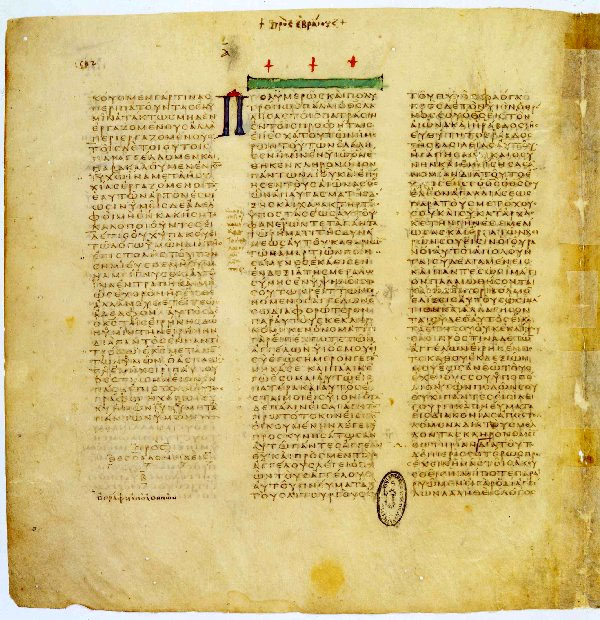
What the short Greek lacks
| Verses | Content |
|---|---|
| 17:12–31 | David brings food to his brothers; Eliab's anger; the reward offered |
| 17:41, 48b, 50 | Goliath approaching; David running; a summary of the victory |
| 17:55–18:5 | Saul asks whose son David is; Jonathan's covenant |
| 18:10–11 | Saul's first spear-throw |
| 18:17–19 | Merab promised and given to another |
| 18:29b–30 | Saul's lasting enmity; David's success |
These were checked in the library's Greek (Giguet, a Vaticanus-type text). Later Greek manuscripts (such as Codex Alexandrinus and the Lucianic group) add the missing verses, translated from Hebrew like the Masoretic Text.
Explanations
Emanuel Tov, Johan Lust and others: the Greek translated an earlier, shorter Hebrew story; the Masoretic Text added a second story of David's introduction, producing the tensions.
Dominique Barthélemy, David Gooding and others: the translator or his Hebrew source shortened the story to remove contradictions.
Many traditional readers accept the long Hebrew text as one narrative: Saul's question in 17:55 concerns David's family (to reward his father, 17:25), not his identity.
Goliath's height
4QSam-a, a Hebrew scroll of the 1st century BC, reads "four cubits and a span" at 17:4, with the Greek and Josephus. Many scholars think the shorter height is earlier and the Hebrew number grew; others defend six. Both describe an unusually large man.
Elhanan
2 Samuel 21:19 says Elhanan of Bethlehem killed Goliath the Gittite, whose spear shaft was like a weaver's beam. 1 Chronicles 20:5 says Elhanan killed Lahmi, Goliath's brother. Explanations include a scribal error in Samuel, two champions named Goliath, or a deed later attributed to David. These are compared, not resolved.
What the evidence shows
- The Vaticanus-type Greek lacks about 45% of 1 Samuel 17–18. Checked in Giguet's French.Source: E. Tov, "The Composition of 1 Samuel 16–18 in the Light of the Septuagint" (1999) ↗
- The short Greek reflects an earlier Hebrew edition.Source: E. Tov, "The Composition of 1 Samuel 16–18 in the Light of the Septuagint" (1999) ↗; University of Helsinki dissertation on textual plurality in Samuel ↗
- 4QSam-a reads four cubits and a span.Source: F. M. Cross, D. W. Parry, R. J. Saley and E. Ulrich, Qumran Cave 4.XII: 1–2 Samuel (DJD XVII, 2005); NET Bible, textual notes on 1 Samuel 17 ↗
- Goliath was six cubits tall.
Continue the journey
Journey of a Passage1 Samuel 17–18: David and Goliath: the short and long editionsThe oldest Greek of 1 Samuel 17–18 lacks about 45% of the Hebrew, including David's arrival with food (17:12–31), Saul's question "whose son is this?" (17:55–18:5), Saul's first spear (18:10–11) and the Merab marriage (18:17–19).More from this lesson
Investigations
Optional deep dives: the ancient sources, the physical evidence, and every interpretation side by side, including unconventional ones, each labeled for what it is.
Goliath of GathGath: strongly supported · Goliath: not attested outside the Bible · Height: disputed
What does archaeology show about Gath and Goliath, and how tall was he?
Gath is identified with Tell es-Safi, one of the largest cities of the region in the 10th–9th centuries BC. An ostracon found there in 2005 bears two names, alwt and wlt, linguistically similar to Goliath; it does not name him. Goliath's height is six cubits and a span in the Hebrew, four and a span in 4QSam-a, the Greek and Josephus. 2 Samuel 21:19 credits Elhanan with killing Goliath.
Open the full investigation →Echoes Across Civilizations
Optional: how other ancient peoples told similar stories. Open one to compare, then come back to the lesson.
Single combat between championsEgyptian · Greek · Israelite
Did other ancient peoples settle battles by a duel between two champions?
- Egyptian: The Story of Sinuhe Shared literary world
- Greek: The Iliad: Paris and Menelaus, Hector and Ajax Resemblance only
- Israelite: Twelve against twelve Possible historical contact
Why this matters to the rest of Scripture
- Saul loves David and makes him armor-bearer.
- "Whose son is this youth?"
- Elhanan.
- Lahmi, Goliath's brother.