Era 6 · The First Kings1 Samuel
Samuel Dies; Abigail and Nabal
"Blessed be thy advice, and blessed be thou"
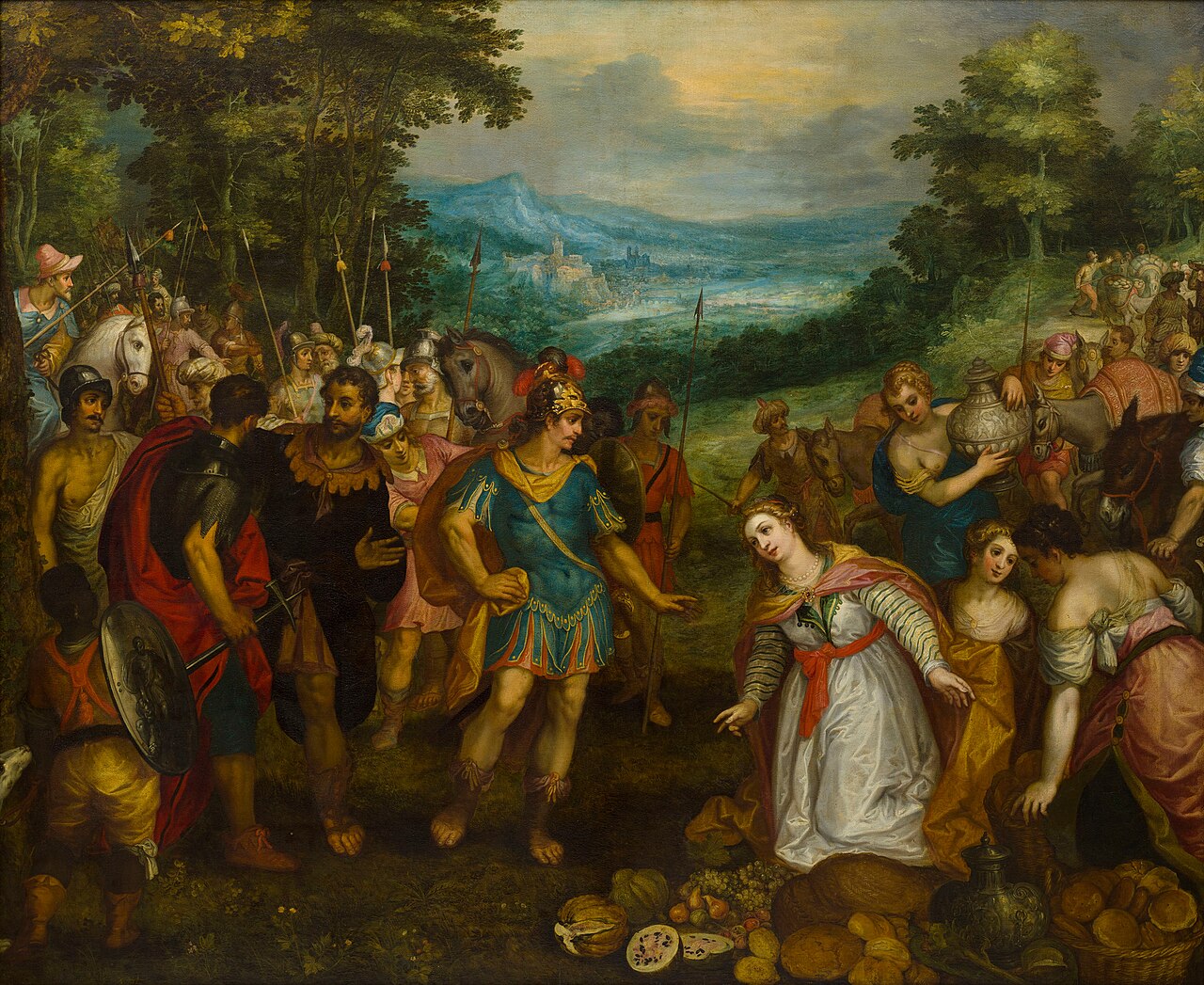
"And Samuel died; and all the Israelites were gathered together, and lamented him, and buried him in his house at Ramah." In Maon lives a rich man whose business is in Carmel, with three thousand sheep. "The name of the man was Nabal; and the name of his wife Abigail: and she was a woman of good understanding, and of a beautiful countenance: but the man was churlish and evil."
David's young men ask for whatever Nabal can give at the shearing feast; his men had protected Nabal's shepherds. "Who is David?… there be many servants now a days that break away every man from his master." David: "Gird ye on every man his sword." He vows to leave no male alive by morning.
A servant tells Abigail. She loads donkeys with bread, wine, sheep, grain, raisins and figs and rides out without telling Nabal. She falls at David's feet: "Upon me, my lord, upon me let this iniquity be… Nabal is his name, and folly is with him… the LORD will certainly make my lord a sure house… this shall be no grief unto thee… that thou hast shed blood causeless." David: "Blessed be the LORD God of Israel, which sent thee this day to meet me: and blessed be thy advice, and blessed be thou, which hast kept me this day from coming to shed blood."
Nabal is drunk at his feast. In the morning, when Abigail tells him, "his heart died within him, and he became as a stone." Ten days later "the LORD smote Nabal, that he died." David sends for Abigail, and she becomes his wife. He also marries Ahinoam of Jezreel. Saul has given Michal to Phalti son of Laish.
Abigail
Abigail acts on her own initiative, takes the blame on herself, appeals to David's future as a king who must not have needless blood on his hands, and speaks of God's "sure house" for him, anticipating 2 Samuel 7. Later Jewish tradition counted her among the prophetesses (Talmud, Megillah 14a). She acts within a world of real danger and limited power; her success depends on persuasion.
Nabal, "fool"
Nabal means "fool" in Hebrew, as Abigail says (25:25). Few parents would name a child that; it may be a nickname or a narrative wordplay. The word can also mean a wine-skin, perhaps another pun given his drunkenness.
Carmel of Judah
This Carmel is a town in the Judean hills (Khirbet el-Kirmil), near Maon, not Mount Carmel on the coast. Saul set up a monument there (15:12).
Samuel's death and the book's author
Samuel dies in 25:1, yet tradition names him as the author of the book. Even traditional accounts therefore assign the rest to others, such as Gad and Nathan (1 Chronicles 29:29).
The Case for the Biblical Account
Scripture's account
Samuel's death; David, Nabal and Abigail (1 Samuel 25).
What evidence would we expect?
Sheep-raising in the southern Judean hills; protection-for-payment arrangements.
The discoveries
Pastoral economy of the Judean desert fringe; ancient texts on protection payments to armed bands.
Testing the discoveries
The setting is realistic; the people are known only from Samuel.
The strongest reconstruction
A story of David's restraint and his marriage into a prominent Calebite family.
What remains possible
Whether "Nabal" was a real name.
What the evidence shows
- Carmel of Judah is distinct from Mount Carmel.
- Nabal was the man's given name.
- "The LORD smote Nabal."
Continue the journey
Echoes Across CivilizationsWomen who save and women who sufferHow do other ancient traditions portray women as deliverers and as victims of war?More from this lesson
On the map
Location securely identified Probable identification Proposed or debated location Biblical route (roads schematic) Scholarly proposal
- David's years as a fugitive. Gibeah → Ramah → Nob → Gath → Adullam → Keilah → the wildernesses of Ziph and Maon → En-gedi → Carmel → Gath → Ziklag. Several sites are proposals (Ramah, Nob, Ziklag); order and lines are schematic.
Echoes Across Civilizations
Optional: how other ancient peoples told similar stories. Open one to compare, then come back to the lesson.
Women who save and women who sufferJewish (Hellenistic) · Egyptian and Ugaritic · Greek
How do other ancient traditions portray women as deliverers and as victims of war?
- Jewish (Hellenistic): Judith Shared literary world
- Egyptian and Ugaritic: Warrior goddesses Anat and Astarte Resemblance only
- Greek: Trojan Women Similar human experience
Why this matters to the rest of Scripture
- "Thine house and thy kingdom shall be established."
- "She openeth her mouth with wisdom."
- The books of Samuel, Nathan and Gad.
- "The fool [nabal] hath said in his heart."