Israel camps at Ebenezer and the Philistines at Aphek; Israel is defeated. "Wherefore hath the LORD smitten us to day…? Let us fetch the ark of the covenant of the LORD out of Shiloh unto us, that, when it cometh among us, it may save us." When it comes, Israel shouts "so that the earth rang again."
The Philistines are afraid: "God is come into the camp… Who shall deliver us out of the hand of these mighty Gods? these are the Gods that smote the Egyptians." "Be strong, and quit yourselves like men." Israel is routed; 30,000 fall; "the ark of God was taken; and the two sons of Eli, Hophni and Phinehas, were slain."
A Benjaminite runs to Shiloh with torn clothes and earth on his head. Eli, ninety-eight and blind, sits by the road. When he hears the ark is taken, "he fell from off the seat backward… and his neck brake." His daughter-in-law goes into labor; dying, she names the child Ichabod: "The glory is departed from Israel: because the ark of God was taken."
Aphek and Ebenezer
Aphek is Tel Aphek (Ras el-Ain), at the springs of the Yarkon, securely identified. Ebenezer is often placed at Izbet Sartah, a small Iron I village about 3 km east, where a 12th-century BC ostracon with an early Hebrew alphabet was found; the identification is a proposal.
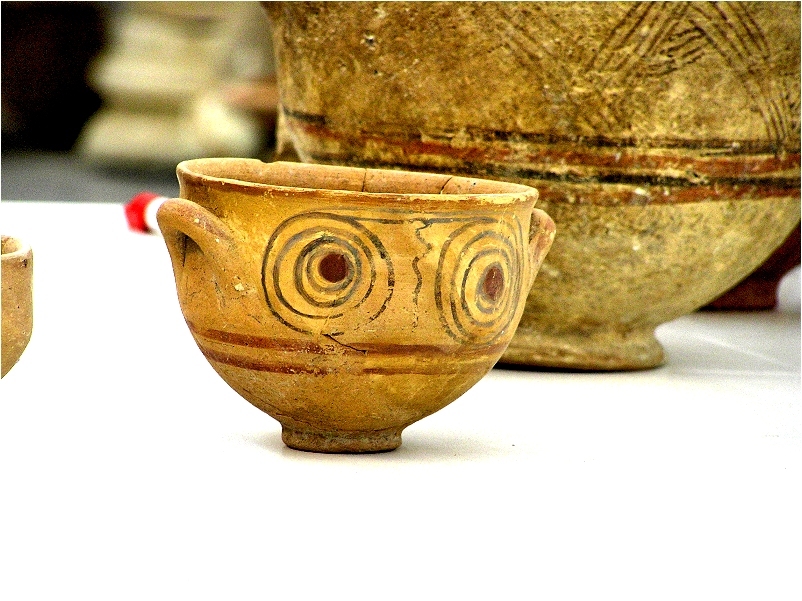
The Philistines
The Philistines (Egyptian Peleset) settled the southern coast in the early 12th century BC with a culture of Aegean origin. By the 11th century they pressed inland. Their speech here ("these mighty Gods") is how Israel's writers imagined outsiders speaking of Israel's God.
The ark
The ark of the covenant was a gold-covered chest with the tablets of the covenant (Exodus 25). Its later fate is unknown; it is never mentioned after Solomon's temple, and no claim to have found it is verified. See the existing investigation on the ark.
The Case for the Biblical Account
Scripture's account
Defeat at Ebenezer and the capture of the ark (1 Samuel 4).
What evidence would we expect?
Philistine expansion inland; destruction at Shiloh; Iron I sites near Aphek.
The discoveries
Philistine material culture expanding in the 11th century BC; Shiloh's Iron I destruction; Izbet Sartah.
Testing the discoveries
The context fits; Shiloh's destruction cannot be tied directly to this battle, which the text does not describe.
The strongest reconstruction
A remembered Philistine victory that ended Shiloh's role (compare Jeremiah 7:12).
What remains possible
The location of Ebenezer; the date of Shiloh's destruction.
What the evidence shows
- Tel Aphek is biblical Aphek.
- Izbet Sartah is Ebenezer.
- Shiloh's Iron I destruction followed this battle.Source: I. Finkelstein (ed.), Shiloh: The Archaeology of a Biblical Site (1993)
- The ark has been found.
Continue the journey
Ancient MysteriesThe Ark Among the PhilistinesWhat can be known about the ark's capture, Dagon's temple and the plague of 1 Samuel 4–6?More from this lesson
On the map
Location securely identified Probable identification Proposed or debated location Biblical route (roads schematic) Scholarly proposal
- The journey of the ark. Shiloh → the battle at Ebenezer (proposed site) → Ashdod → Gath → Ekron → Beth-shemesh → Kiriath-jearim. Lines are schematic.
Investigations
Optional deep dives: the ancient sources, the physical evidence, and every interpretation side by side, including unconventional ones, each labeled for what it is.
The Ark Among the PhilistinesCities: documented · Events: not independently attested · Ark's later fate: unknown
What can be known about the ark's capture, Dagon's temple and the plague of 1 Samuel 4–6?
1 Samuel 4–6 tells how the Philistines captured the ark, how Dagon fell before it in Ashdod, how plague struck their cities, and how the ark came back on a cart. The cities are excavated and Philistine temples are known, but there is no record of these events outside the Bible. Capturing an enemy's gods was common in the ancient world; the biblical story turns the custom on its head.
Open the full investigation →Echoes Across Civilizations
Optional: how other ancient peoples told similar stories. Open one to compare, then come back to the lesson.
When a people's god is taken captiveBabylonian · Assyrian · Moabite
Did other ancient peoples carry off the gods of their enemies, and what happened to the captured gods?
- Babylonian: The exiles of Marduk's statue Shared literary world
- Assyrian: "Godnapping" in Assyrian warfare Possible historical contact
- Moabite: Mesha takes YHWH's vessels Possible historical contact
Also covered: An ark with power?, clearly labeled as a modern theory.
Compare side by side →Why this matters to the rest of Scripture
- "Rise up, LORD, and let thine enemies be scattered."
- "Go ye now unto my place which was in Shiloh."
- "He forsook the tabernacle of Shiloh… and delivered his strength into captivity."