2 Kings 3:27
"Great wrath against Israel"
After Mesha sacrifices his son, "there was great wrath against Israel." Whose wrath? The Hebrew does not say. The library's Greek reads it as Israel's own remorse; the Vulgate as "great indignation in Israel."
Same letters, different readings: the consonants agree, but ancient readers vocalized or interpreted them differently
The family tree
Each row is a language or text tradition. Witnesses in the same row may share ancestry, revise one another, or have an uncertain relationship; the line under each box says which. A solid arrow appears only where direct copying or a documented revised edition is established. Order by date never implies copying. Scroll sideways on a phone.
✓ contains it · ✕ does not · ❝ quotes part of it · ⓘ reports on manuscripts · ▢ pages lost · – no copy survives
- Same line, through lost copies
- Translation
Every witness, in order
c. 840 BC
Mesha Stele (Moabite)
How the site knows this: Reported in scholarship; not checked by the site.
Mesha's own inscription attributes Moab's suffering to Chemosh's anger and its recovery to Chemosh's favor. It does not describe this siege.
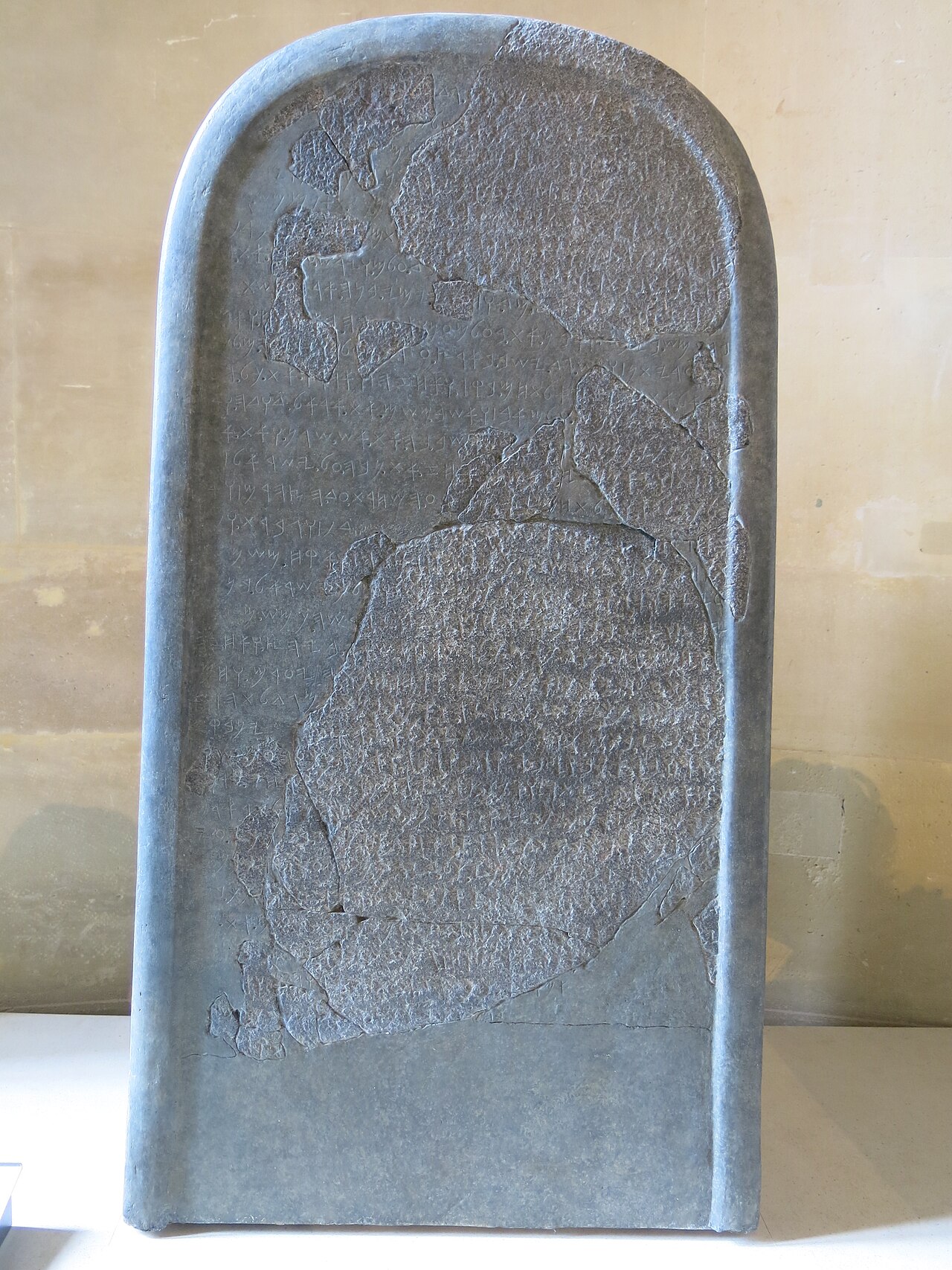
Authentic ancient artifactImage credit Source: Louvre, Mesha Stele (AO 5066) ↗
Unknown (debated)
Original Kings
No original survives.
Translated c. 2nd century BC; kaige revision 1st c. BC–1st c. AD
Septuagint, 4 Kingdoms (library text: Giguet's French)
How the site knows this: Known here only through a translation.
tout Israël en eut un grand remords; ils s'éloignèrent de lui
all Israel felt great remorse; they withdrew from him
One Greek text (Vaticanus type, kaige revision) via Giguet's French; not checked against a critical Greek edition.
c. AD 400
Jerome's Vulgate
How the site knows this: Read in the site's library text: Clementine Vulgate (1592 edition).
et facta est indignatio magna in Israël
and there was great indignation in Israel
AD 1008
Masoretic Text (Leningrad Codex)
How the site knows this: Read in the site's library text: Westminster Leningrad Codex, a digital transcription of the Leningrad Codex.
וַיְהִי קֶצֶף־גָּדוֹל עַל־יִשְׂרָאֵל
and there was great wrath upon/against Israel
Qetsef is usually divine wrath elsewhere in the Bible.
1611
King James Bible
How the site knows this: Read in the site's library text: King James Version (1769 text).
there was great indignation against Israel
What changed, and why
Three readings: Chemosh's wrath (the narrator acknowledging Moab's belief or a power in that land); the LORD's wrath against Israel (for some unnamed fault, or for driving Mesha to the act); human revulsion and fury. The witnesses already interpret it differently.
What the evidence shows
- The witnesses differ in whose wrath or feeling they describe.
- The wrath was Chemosh's.
Sources
Related lessons
- Moab's Revolt and Mesha's Inscription →Mesha king of Moab, who paid Israel a tribute of lambs and wool, rebels. Jehoram of Israel, Jehoshaphat of Judah and the king of Edom march around through Edom and run out of water. Elisha, playing music, promises water and victory: ditches fill with water that looks like blood to the Moabites. Israel ravages Moab. Besieged at Kir-hareseth, Mesha offers his eldest son as a burnt offering on the wall; "great indignation" comes against Israel, and they withdraw.
- Ethics and Prophecy: Power, Violence and Unexpected Witnesses →2 Kings contains some of the Bible's most disturbing scenes: fire on soldiers, bears and youths, child sacrifice, siege cannibalism, Jehu's massacres, atrocities in war, executions of priests. It also gives voice to unexpected witnesses: a captive girl, four outcasts, a Shunammite landowner, Huldah. This lesson gathers both.