Moab's Revolt and Mesha's Inscription
"There was great indignation against Israel"
"And Mesha king of Moab was a sheepmaster, and rendered unto the king of Israel an hundred thousand lambs, and an hundred thousand rams, with the wool. But it came to pass, when Ahab was dead, that the king of Moab rebelled." Jehoram calls Jehoshaphat: "I am as thou art." They go "the way through the wilderness of Edom" and after seven days have no water.
Elisha: "Were it not that I regard the presence of Jehoshaphat the king of Judah, I would not look toward thee… But now bring me a minstrel." "Make this valley full of ditches… ye shall not see wind, neither shall ye see rain; yet that valley shall be filled with water." In the morning water comes "by the way of Edom." The Moabites see it red as blood: "the kings are surely slain… now therefore, Moab, to the spoil." Israel routs them, fells trees, stops wells and covers fields with stones.
At Kir-hareseth Mesha tries to break through to the king of Edom and fails. "Then he took his eldest son that should have reigned in his stead, and offered him for a burnt offering upon the wall. And there was great indignation against Israel: and they departed from him, and returned to their own land."
Mesha's own account
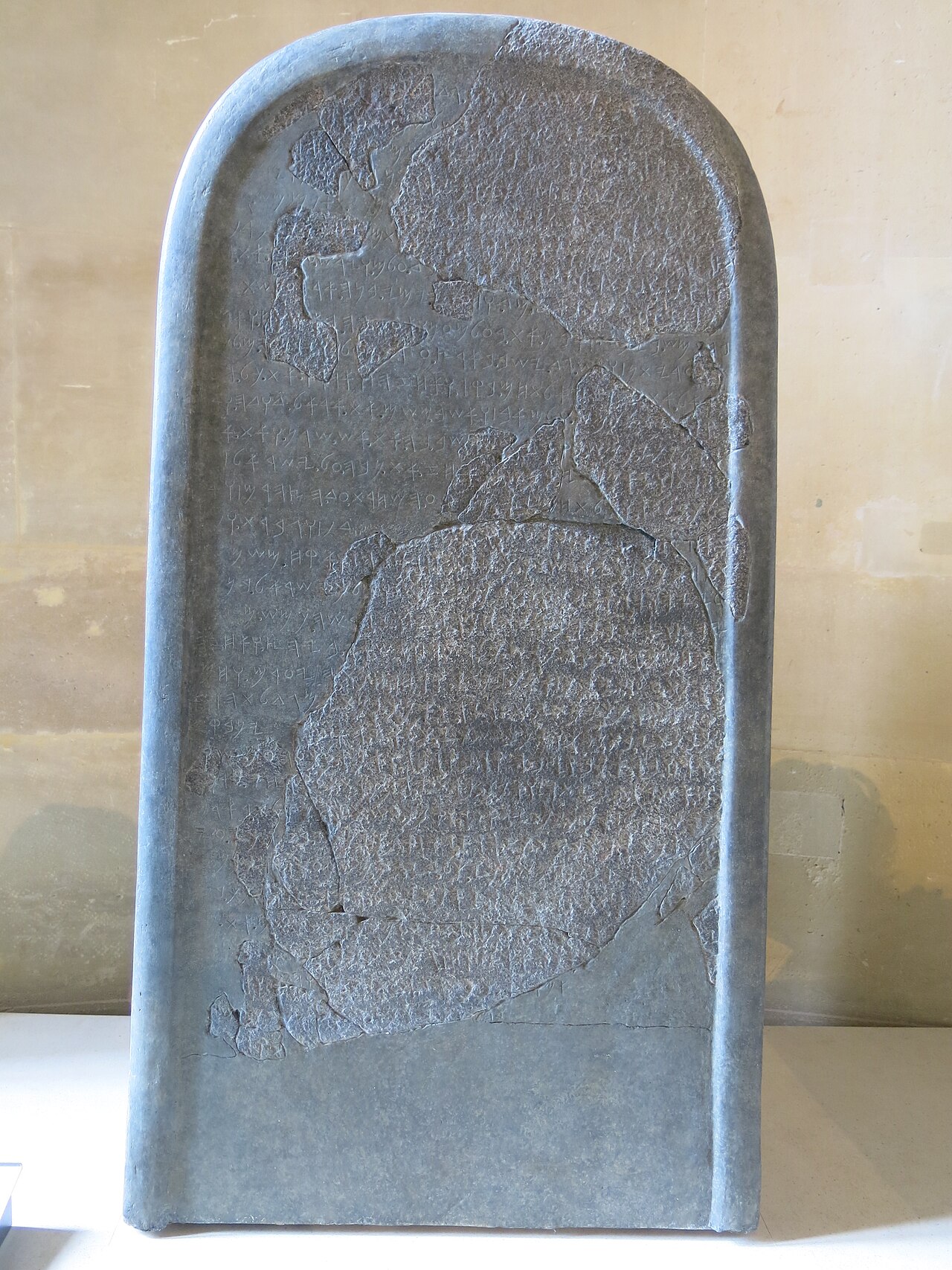
The Mesha Stele (Louvre AO 5066), found at Dhiban in 1868, is Mesha's own inscription in Moabite: "Omri was king of Israel, and he oppressed Moab many days, for Chemosh was angry with his land… but I triumphed over him and over his house." Mesha lists towns he took from Israel (Ataroth, Nebo, Jahaz), devoting Nebo's people to Ashtar-Chemosh, and names "the vessels of YHWH" taken from Nebo. It does not describe the campaign of 2 Kings 3, and 2 Kings 3 does not mention Mesha's victories. Each side tells its own story.
Whose wrath?
Hebrew qetsef gadol, "great wrath," is usually divine wrath elsewhere. Interpretations: the wrath of Chemosh (the text acknowledging the power of Moab's god in his land, which many find difficult); the wrath of the LORD against Israel for some fault; or human revulsion and anger, as the library's Greek suggests ("all Israel felt great remorse"). The site presents the options; the text does not say the sacrifice was effective in itself.
Kir-hareseth
Usually identified with Kerak, a strong hilltop in Moab; Dhibon (Dibon) and the Arnon gorge (Wadi Mujib) are nearby.
The Case for the Biblical Account
Scripture's account
The campaign against Moab (2 Kings 3).
What evidence would we expect?
Moab's independence from Israel in the mid-9th century BC.
The discoveries
The Mesha Stele; excavations at Dhiban; Moabite sites along the King's Highway.
Testing the discoveries
Moab's revolt is documented from Mesha's side; the joint campaign is known only from Kings.
The strongest reconstruction
Moab broke free of the Omrides c. 850–840 BC; an Israelite counter-campaign failed to restore control.
What remains possible
How the stele's events and 2 Kings 3 fit in time.
What the evidence shows
- The Mesha Stele names Omri and Chemosh.Source: Louvre, Mesha Stele (AO 5066) ↗
- Moab regained independence from Israel in the 9th century BC.
- The "great wrath" was Chemosh's.Source: USCCB, notes on 2 Kings 3 ↗
- The library's Greek reads "remorse" in 3:27.
Continue the journey
Journey of a Passage2 Kings 3:27: "Great wrath against Israel"After Mesha sacrifices his son, "there was great wrath against Israel." Whose wrath?More from this lesson
Investigations
Optional deep dives: the ancient sources, the physical evidence, and every interpretation side by side, including unconventional ones, each labeled for what it is.
The Mesha Stele and Moab's RevoltStele: documented · Revolt: documented · Same events as 2 Kings 3: not established
What does King Mesha's own inscription say about Israel?
Found at Dhiban in 1868 and partly broken before it reached the Louvre (AO 5066), the Mesha Stele is a 34-line Moabite inscription of c. 840 BC. Mesha says Omri and his son oppressed Moab because Chemosh was angry, and that he then took back towns from Israel, devoted Nebo's population to Ashtar-Chemosh, and carried off "the vessels of YHWH." It is the longest Iron Age inscription from the region and the earliest outside text to name YHWH.
Open the full investigation →Echoes Across Civilizations
Optional: how other ancient peoples told similar stories. Open one to compare, then come back to the lesson.
Child sacrifice in crisisPhoenician / Punic · Greek
Did Israel's neighbors sacrifice children, and how does the Bible respond?
- Phoenician / Punic: The tophet of Carthage Shared literary world
- Greek: Iphigenia Resemblance only
Why this matters to the rest of Scripture
- "I am as thou art."
- "O people of Chemosh."
- Moab burned the bones of the king of Edom.
- "Shall I give my firstborn for my transgression?"