In Zedekiah's ninth year, on the tenth day of the tenth month, Nebuchadnezzar besieges Jerusalem. By the ninth day of the fourth month of the eleventh year "the famine prevailed in the city, and there was no bread." The wall is broken; Zedekiah's soldiers flee by night. He is captured in the plains of Jericho and brought to Riblah. "And they slew the sons of Zedekiah before his eyes, and put out the eyes of Zedekiah, and bound him with fetters of brass, and carried him to Babylon."
"And in the fifth month, on the seventh day of the month, which is the nineteenth year of king Nebuchadnezzar… came Nebuzaradan, captain of the guard… And he burnt the house of the LORD, and the king's house, and all the houses of Jerusalem." The walls are broken down; the bronze pillars, the stands and the Sea are broken up and carried away. The chief priest Seraiah and other leaders are executed at Riblah. "So Judah was carried away out of their land."
Nebuchadnezzar appoints Gedaliah son of Ahikam son of Shaphan over those who remain, at Mizpah. "Fear not to be the servants of the Chaldees: dwell in the land." In the seventh month Ishmael son of Nethaniah, "of the seed royal," kills him; all the people flee to Egypt. "And it came to pass in the seven and thirtieth year of the captivity of Jehoiachin… Evil-merodach king of Babylon… did lift up the head of Jehoiachin king of Judah out of prison; And he spake kindly to him, and set his throne above the throne of the kings that were with him in Babylon… and he did eat bread continually before him all the days of his life."
The destruction in the ground
Excavations in the City of David found a thick destruction layer of the early 6th century BC: burnt houses (the "Burnt Room," the "House of Ahiel"), collapsed walls, Scythian-type and other arrowheads, and dozens of bullae baked hard by the fire, including names known from Jeremiah. In 2019–2020 a large burnt building on the eastern slope (Givati Parking Lot) was dated to this destruction. Individual buildings cannot be assigned to named people in the Bible.
Lachish and Arad letters
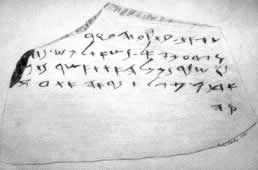
Ostraca from Lachish (found 1935) are letters from a Judahite officer in the last years before 586 BC: "we are watching for the signals of Lachish… for we cannot see Azekah" (Letter 4), recalling Jeremiah 34:7, when only Lachish and Azekah remained. They are not connected with the 701 BC siege.
Dates that differ
2 Kings 25:8 dates the burning to the seventh day of the fifth month; Jeremiah 52:12 to the tenth (the library's Greek Jeremiah has the sixth). Jewish tradition fasts on the ninth of Av, combining them (Talmud Ta'anit 29a). Jehoiachin's release is the 27th day of the twelfth month in Kings, the 25th in Hebrew Jeremiah 52:31 and the 23rd in the library's Greek Jeremiah. See the passage page.
Jehoiachin in Babylon
Babylonian administrative tablets from Nebuchadnezzar's palace (published by E. F. Weidner, 1939), dated c. 592 BC, list rations of oil for "Ya'ukin, king of the land of Yahud" and his five sons. They confirm his captivity at court, not the later release. Evil-merodach is Amel-Marduk, who reigned 562–560 BC.
The Case for the Biblical Account
Scripture's account
The destruction of Jerusalem and Jehoiachin's release (2 Kings 25).
What evidence would we expect?
A destruction layer in Jerusalem; Babylonian records of Judah's royal captives.
The discoveries
City of David and Givati destruction layers; the Lachish letters; the Jehoiachin ration tablets; Amel-Marduk's reign.
Testing the discoveries
The destruction and Jehoiachin's captivity are documented; the exact year (587 or 586 BC) depends on calendar reckoning.
The strongest reconstruction
Babylon destroyed Jerusalem and the temple in 587/586 BC; Jehoiachin was released under Amel-Marduk c. 561 BC.
What remains possible
587 or 586 BC; the day of the burning.
What the evidence shows
- Jerusalem was destroyed by fire in the early 6th century BC.
- Babylonian tablets list rations for Jehoiachin, king of Judah.Source: BAS Library, "Israelite Kings in Non-Biblical, Non-Israelite Inscriptions" ↗
- The burning took place on the seventh day of the fifth month. Jeremiah 52:12 has the tenth.
- The temple was destroyed in 587 BC. 586 BC is also widely used.
Continue the journey
Journey of a Passage2 Kings 25:8 and Jeremiah 52:12: When was the temple burned?2 Kings 25:8 says Nebuzaradan came on the seventh day of the fifth month; Hebrew Jeremiah 52:12 says the tenth; the library's Greek Jeremiah, the sixth.More from this lesson
On the map
Location securely identified Probable identification Proposed or debated location Biblical route (roads schematic) Scholarly proposal
- Judah to Babylon, 597 and 586 BC (schematic). Schematic. Captives went north via Riblah and along the Euphrates; the exact route is not recorded.
Investigations
Optional deep dives: the ancient sources, the physical evidence, and every interpretation side by side, including unconventional ones, each labeled for what it is.
Jehoiachin's Rations in BabylonRations for Jehoiachin: documented · Release: known from the Bible
Is the exiled king of Judah named in Babylonian records?
Administrative tablets from Nebuchadnezzar's palace in Babylon, dated c. 592 BC and published by E. F. Weidner in 1939, record oil rations for "Ya'ukin, king of the land of Yahud," his five sons and other Judeans, alongside other foreign captives. They confirm Jehoiachin's life at the Babylonian court; his release under Amel-Marduk (Evil-merodach) c. 561 BC is known from Kings and Jeremiah.
Open the full investigation →Echoes Across Civilizations
Optional: how other ancient peoples told similar stories. Open one to compare, then come back to the lesson.
Deportation as imperial policyAssyrian · Babylonian
Why did Assyria and Babylon deport conquered peoples?
- Assyrian: Mass deportations Possible historical contact
- Babylonian: Deportees in Babylonia Possible historical contact
Why this matters to the rest of Scripture
- Jeremiah 39; 52The parallel accounts.
- Gedaliah and the flight to Egypt.
- "How doth the city sit solitary."
- Chronicles ends with Cyrus' decree.