Ahaziah and Elijah's Last Prophecy
"Is it not because there is not a God in Israel, that ye go to enquire of Baal-zebub?"
"Then Moab rebelled against Israel after the death of Ahab." Ahaziah "fell down through a lattice in his upper chamber that was in Samaria, and was sick: and he sent messengers, and said unto them, Go, enquire of Baal-zebub the god of Ekron whether I shall recover of this disease."
The angel of the LORD sends Elijah: "Is it not because there is not a God in Israel, that ye go to enquire of Baal-zebub the god of Ekron?… Thou shalt not come down from that bed… but shalt surely die." The messengers describe the man: "an hairy man, and girt with a girdle of leather about his loins. And he said, It is Elijah the Tishbite."
A captain of fifty climbs the hill: "Thou man of God, the king hath said, Come down." "If I be a man of God, then let fire come down from heaven, and consume thee and thy fifty." It happens twice. The third captain falls on his knees: "let my life, and the life of these fifty thy servants, be precious in thy sight." Elijah goes down with him and repeats the word to the king's face. Ahaziah dies; "and Jehoram reigned in his stead… because he had no son."
Baal-zebub and Beelzebul
Baal-zebub means "lord of flies." Many scholars think it is a mocking change of a title like Baal-zebul, "Baal the prince," a title known from Ugaritic texts (zbl b'l). The library's Greek renders "Baal-Mouche" (Baal-fly), the Vulgate "Beelzebub." In the Gospels "Beelzebul" is a name for the prince of demons (Matthew 12:24); the name's later use does not prove it meant the same thing in Ahaziah's time.
Ekron
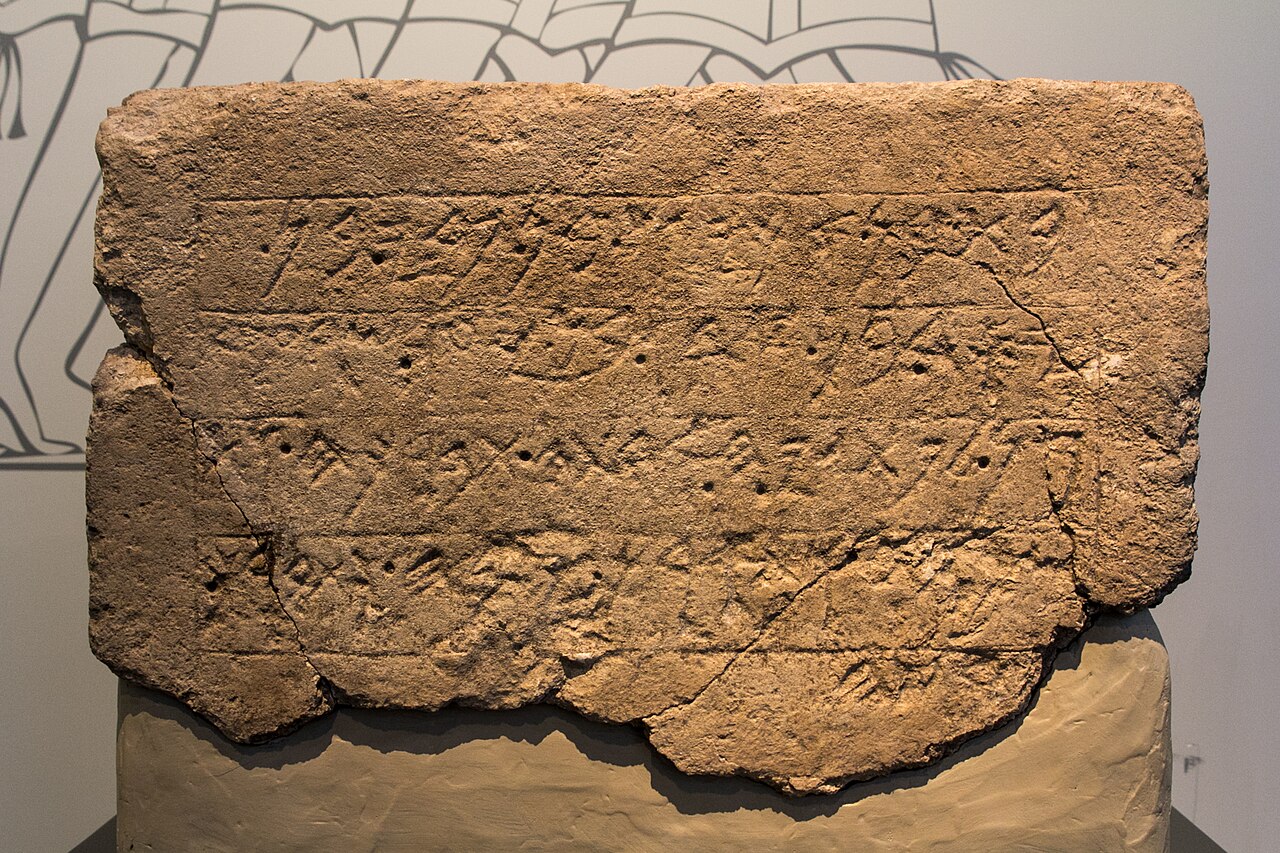
Ekron (Tel Miqne) was a major Philistine city. Its royal dedicatory inscription naming kings Achish and Padi dates to the 7th century BC, about two centuries after Ahaziah; it shows Ekron's later importance but says nothing about Baal-zebub.
Fire from heaven
The killing of the first two companies is told without softening. Readers have long contrasted it with Jesus' rebuke when disciples ask to call down fire "as Elias did" (Luke 9:54–55, in some manuscripts).
The Case for the Biblical Account
Scripture's account
Ahaziah consults Baal-zebub; Elijah's last confrontation (2 Kings 1).
What evidence would we expect?
A Philistine Ekron with its own gods; Moab breaking from Israel after Ahab.
The discoveries
Tel Miqne (Ekron) and its 7th-century inscription; the Mesha Stele describing Moab's revolt.
Testing the discoveries
The setting is real; the episode is known only from Kings.
The strongest reconstruction
A prophetic story closing Elijah's ministry with the theme of 1 Kings 18: which God answers.
What remains possible
The original form of the god's name.
What the evidence shows
- Ekron was a Philistine city at Tel Miqne.
- Baal-zebub is a mocking form of Baal-zebul.
- The Mesha Stele records Moab's revolt from Israel.Source: Louvre, Mesha Stele (AO 5066) ↗
Continue the journey
Journey of a Passage2 Kings 1:2: Baal-zebub, "lord of flies"All witnesses name the god of Ekron.More from this lesson
Investigations
Optional deep dives: the ancient sources, the physical evidence, and every interpretation side by side, including unconventional ones, each labeled for what it is.
The Mesha Stele and Moab's RevoltStele: documented · Revolt: documented · Same events as 2 Kings 3: not established
What does King Mesha's own inscription say about Israel?
Found at Dhiban in 1868 and partly broken before it reached the Louvre (AO 5066), the Mesha Stele is a 34-line Moabite inscription of c. 840 BC. Mesha says Omri and his son oppressed Moab because Chemosh was angry, and that he then took back towns from Israel, devoted Nebo's population to Ashtar-Chemosh, and carried off "the vessels of YHWH." It is the longest Iron Age inscription from the region and the earliest outside text to name YHWH.
Open the full investigation →Why this matters to the rest of Scripture
- The God who answers by fire.
- Beelzebul, prince of demons.
- Fire from heaven, rebuked.
- John the Baptist's leather belt.