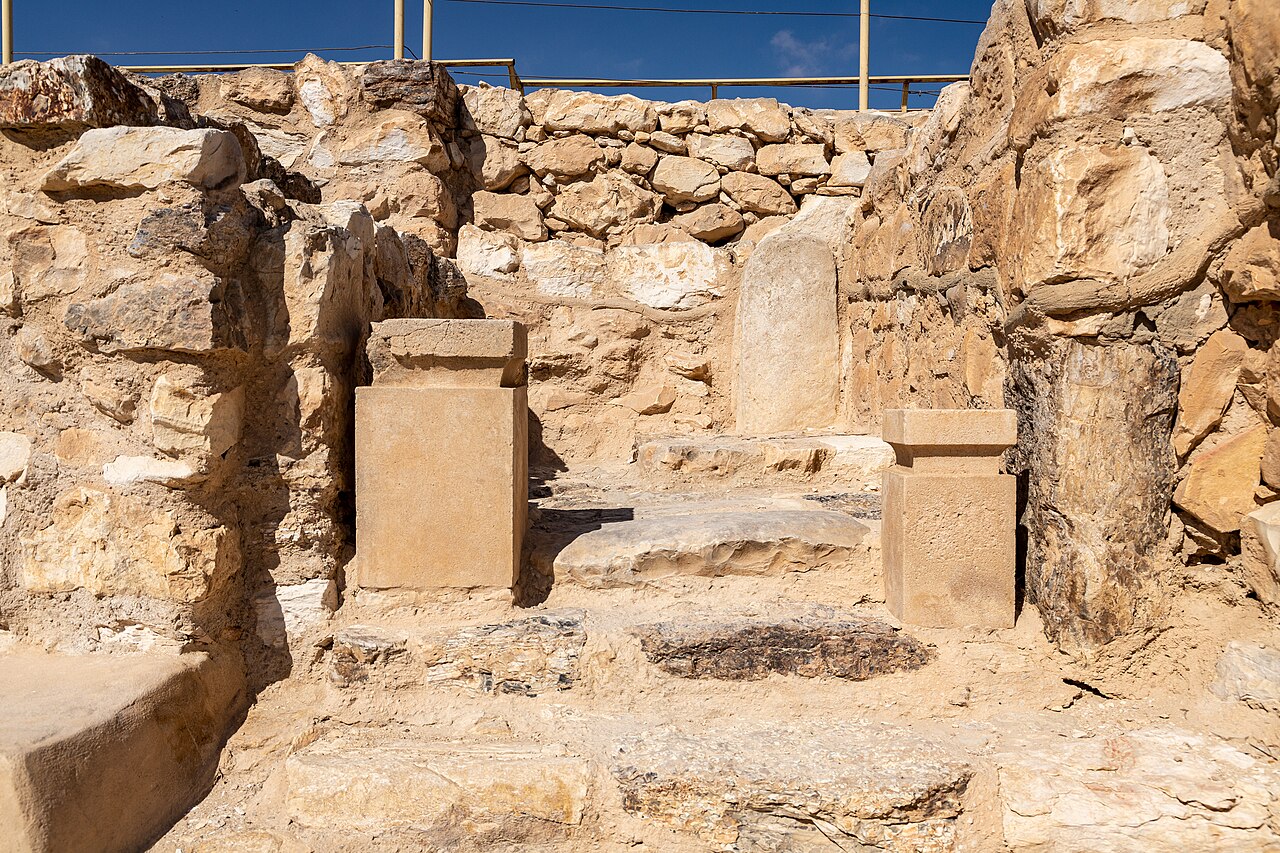
"And the king stood by a pillar, and made a covenant before the LORD." The vessels made for Baal, Asherah and the host of heaven are burned in the Kidron fields and the ashes carried to Bethel. He removes the idolatrous priests, breaks down the houses of the cult prostitutes, "where the women wove hangings for the grove," defiles the high places "from Geba to Beersheba," and "defiled Topheth… that no man might make his son or his daughter to pass through the fire to Molech." He removes "the horses that the kings of Judah had given to the sun" and burns the chariots of the sun.
At Bethel he burns bones from the tombs on the altar, "according to the word of the LORD which the man of God proclaimed," but leaves the tomb of the man of God from Judah. "Surely there was not holden such a passover from the days of the judges." "And like unto him was there no king before him, that turned to the LORD with all his heart, and with all his soul, and with all his might… neither after him arose there any like him. Notwithstanding the LORD turned not from the fierceness of his great wrath… because of all the provocations that Manasseh had provoked him withal."
"In his days Pharaoh-nechoh king of Egypt went up against the king of Assyria to the river Euphrates: and king Josiah went against him; and he slew him at Megiddo, when he had seen him." His body is brought to Jerusalem in a chariot. The people make Jehoahaz king; after three months Necho imprisons him at Riblah, imposes tribute and makes Eliakim king, renaming him Jehoiakim.
"Against" or "to" the king of Assyria?
The Hebrew 'al can mean "against" or "to, on behalf of." The KJV and the library's Greek say Necho went "against" Assyria. The Babylonian Chronicle shows that in 609 BC Egypt was Assyria's ally, marching to help the last Assyrian king, Ashur-uballit II, at Harran against Babylon. So modern translations read "to the king of Assyria." Why Josiah confronted Necho (to block aid to Assyria, or as a vassal summoned to meet him) is debated. 2 Chronicles 35:20–24 describes a battle in which Josiah, warned by Necho, disguises himself and is shot by archers. See the passage page.
Archaeology and the reform
The shrine at Arad (with its two incense altars) was dismantled and buried, and the horned altar at Beersheba was taken apart and reused in a wall. Both were once linked to Hezekiah's or Josiah's reforms; the dating of each is debated, and neither can be confidently assigned to Josiah. Horse figurines found in Jerusalem, some with a disk on the head, have been compared with "the horses of the sun."
The Case for the Biblical Account
Scripture's account
Josiah's reform and death (2 Kings 23).
What evidence would we expect?
Changes in cult sites in late Judah; Egypt's march north in 609 BC.
The discoveries
The Babylonian Chronicle on 609 BC (Egypt aiding Assyria at Harran); dismantled shrines at Arad and Beersheba (dates debated); horse-and-rider figurines.
Testing the discoveries
Necho's campaign is documented; the scope of the reform is debated.
The strongest reconstruction
Josiah centralized worship in Jerusalem and died opposing Egypt's march in 609 BC.
What remains possible
How far the reform reached outside Jerusalem; why Josiah met Necho.
What the evidence shows
- Necho II marched to support Assyria in 609 BC.
- Josiah died at Megiddo in 609 BC.
- The Arad shrine was dismantled by Josiah.
Continue the journey
Journey of a Passage2 Kings 23:29: Necho went "against" or "to" the king of Assyria?The Hebrew preposition 'al can mean "against" or "to, on behalf of." The KJV and the library's Greek read "against"; the Babylonian Chronicle shows Egypt marching to help Assyria in 609 BC, so most modern translations read "to."More from this lesson
Investigations
Optional deep dives: the ancient sources, the physical evidence, and every interpretation side by side, including unconventional ones, each labeled for what it is.
Josiah and the Book Found in the TempleJosiah: historical king · Book found: biblical report · Identification with Deuteronomy: a major hypothesis
Was the scroll found in Josiah's Temple an early form of Deuteronomy?
In about 622 BC, during Temple repairs, the high priest Hilkiah reported finding "the book of the law." King Josiah tore his clothes, read it to the people, removed the high places and held a great Passover in Jerusalem. Since 1805, many scholars have identified that book with Deuteronomy or its core. Others disagree.
Open the full investigation →Why this matters to the rest of Scripture
- The prophecy naming Josiah.
- The Chronicler's battle account.
- Passover at the chosen place.
- "The mourning… in the valley of Megiddon."