"In his days Nebuchadnezzar king of Babylon came up, and Jehoiakim became his servant three years: then he turned and rebelled against him." Bands of Chaldeans, Arameans, Moabites and Ammonites come against Judah, "for the sins of Manasseh… and also for the innocent blood that he shed." "And the king of Egypt came not again any more out of his land."
"Jehoiachin was eighteen years old when he began to reign, and he reigned in Jerusalem three months." Nebuchadnezzar's servants besiege Jerusalem, and the king comes himself. "And Jehoiachin the king of Judah went out to the king of Babylon, he, and his mother, and his servants, and his princes, and his officers: and the king of Babylon took him in the eighth year of his reign."
Nebuchadnezzar takes the treasures and cuts up the gold vessels Solomon made. "And he carried away all Jerusalem… even ten thousand captives, and all the craftsmen and smiths: none remained, save the poorest sort of the people of the land." "And all the men of might, even seven thousand, and craftsmen and smiths a thousand." He makes Mattaniah, Jehoiachin's uncle, king and changes his name to Zedekiah. "And Zedekiah rebelled against the king of Babylon."
The Babylonian Chronicle
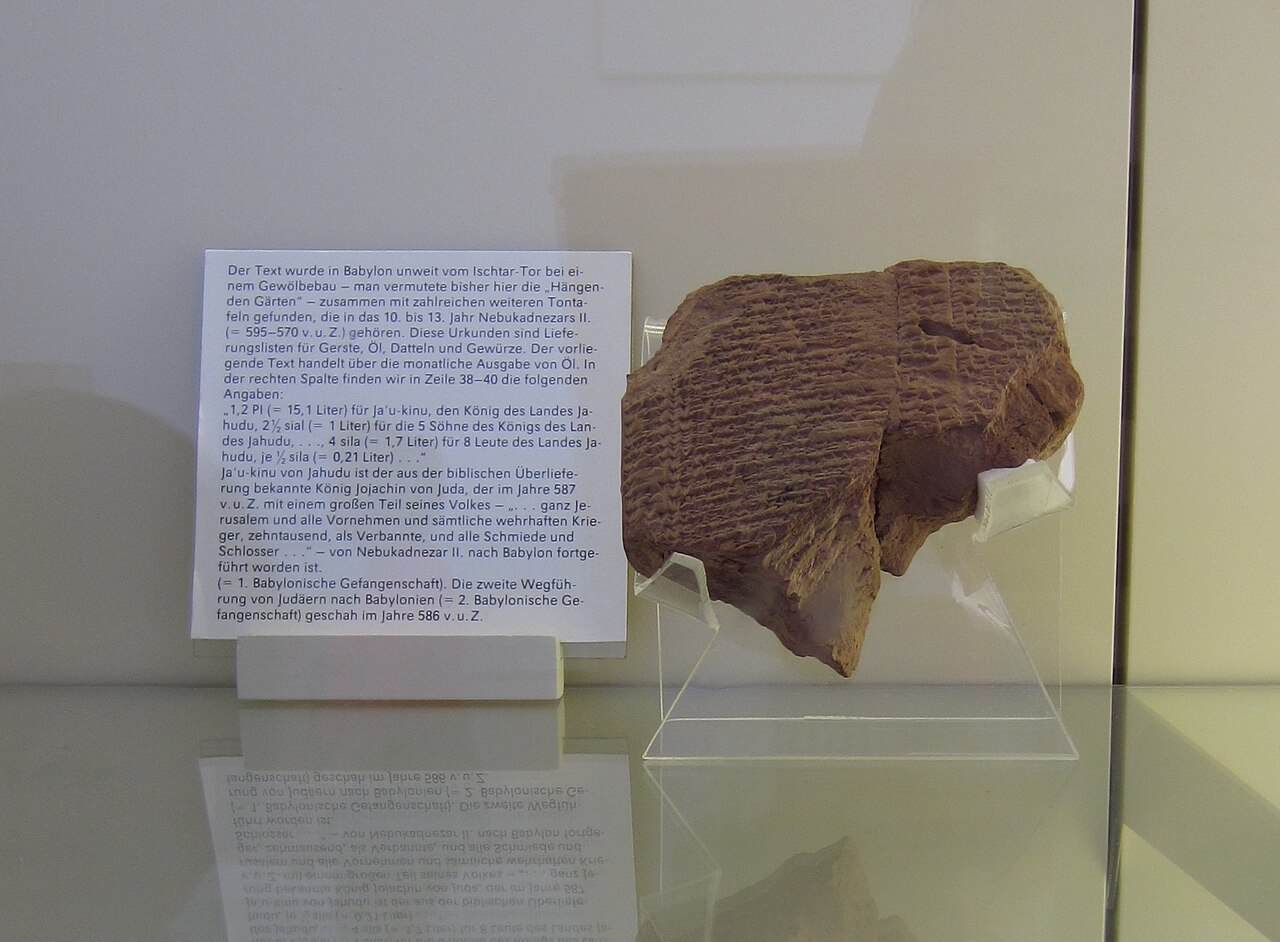
The Babylonian Chronicle for Nebuchadnezzar's early years (British Museum BM 21946) records: "In the seventh year… the king of Akkad… encamped against the city of Judah, and on the second day of the month Adar he seized the city and captured the king. A king of his own choice he appointed in it, took heavy tribute and brought it to Babylon." This dates the capture to 16 March 597 BC. Kings says "the eighth year" of Nebuchadnezzar; the difference is usually explained by different ways of counting regnal years. The tablet is a later Babylonian copy, not an eyewitness original.
How many were deported?
2 Kings 24:14 gives 10,000; 24:16 gives 7,000 men of might and 1,000 craftsmen; Jeremiah 52:28 gives 3,023 "in the seventh year." These may count different groups (households, men, a first wave) or come from different sources. The library's Greek of 24:16 has 70,000, likely a translation or printing slip in Giguet's French; not checked in Greek. Greek Jeremiah lacks 52:28–30 altogether. The site does not combine them into one total. See the passage page.
Jehoiachin: 18 or 8?
2 Kings 24:8 says 18; 2 Chronicles 36:9 in the Hebrew and the library's Greek says 8, with a reign of three months and ten days. Ezekiel 19:5–9 and the mention of his wives (24:15) favor 18. See the passage page.
The Case for the Biblical Account
Scripture's account
The capture of Jerusalem in 597 BC (2 Kings 24).
What evidence would we expect?
A Babylonian record of capturing Jerusalem and replacing its king.
The discoveries
The Babylonian Chronicle BM 21946; Babylonian ration tablets naming Jehoiachin; Lachish and Arad ostraca from Judah's last years.
Testing the discoveries
The capture, the date and the change of king are confirmed by the Babylonian Chronicle.
The strongest reconstruction
Nebuchadnezzar took Jerusalem on 2 Adar 597 BC, deported Jehoiachin and installed Zedekiah.
What remains possible
Total numbers deported.
What the evidence shows
- The Babylonian Chronicle records the capture of "the city of Judah" in 597 BC.Source: British Museum, Babylonian Chronicle (BM 21946) ↗; COJS, Babylonian Chronicle 5: Nebuchadnezzar besieges Jerusalem, 597 BCE ↗
- Jehoiachin was 18 at his accession.
- The deportation figures describe one total.
Continue the journey
Journey of a Passage2 Kings 24:8 and 2 Chronicles 36:9: Jehoiachin: 18 or 8?2 Kings 24:8 makes Jehoiachin 18 at his accession; 2 Chronicles 36:9 in the Hebrew and in the library's Greek makes him 8, reigning "three months and ten days." Some ancient witnesses of Chronicles are reported to read 18.More from this lesson
On the map
Location securely identified Probable identification Proposed or debated location Biblical route (roads schematic) Scholarly proposal
- Judah to Babylon, 597 and 586 BC (schematic). Schematic. Captives went north via Riblah and along the Euphrates; the exact route is not recorded.
Investigations
Optional deep dives: the ancient sources, the physical evidence, and every interpretation side by side, including unconventional ones, each labeled for what it is.
The Babylonian Chronicle and 597 BCCapture of 597 BC: documented · Date: 2 Adar (March 16) 597 BC
Does a Babylonian text record the capture of Jerusalem?
The Babylonian Chronicle for Nebuchadnezzar's early years (British Museum BM 21946) records that in his seventh year he besieged "the city of Judah," took it on the second of Adar, captured the king, appointed a king of his choice, and took heavy tribute to Babylon. This dates the event to 16 March 597 BC. The chronicle does not cover the destruction of 587/586 BC.
Open the full investigation →Echoes Across Civilizations
Optional: how other ancient peoples told similar stories. Open one to compare, then come back to the lesson.
Deportation as imperial policyAssyrian · Babylonian
Why did Assyria and Babylon deport conquered peoples?
- Assyrian: Mass deportations Possible historical contact
- Babylonian: Deportees in Babylonia Possible historical contact
Why this matters to the rest of Scripture
- Coniah (Jehoiachin).
- "The fifth year of king Jehoiachin's captivity."
- Daniel's account of the temple vessels.
- Jechonias in Jesus' genealogy.