Hezekiah "removed the high places, and brake the images, and cut down the groves, and brake in pieces the brasen serpent that Moses had made: for unto those days the children of Israel did burn incense to it: and he called it Nehushtan." "He trusted in the LORD God of Israel; so that after him was none like him among all the kings of Judah." "He rebelled against the king of Assyria, and served him not."
"Now in the fourteenth year of king Hezekiah did Sennacherib king of Assyria come up against all the fenced cities of Judah, and took them." Hezekiah sends to Lachish: "I have offended; return from me." Sennacherib demands "three hundred talents of silver and thirty talents of gold." Hezekiah gives the silver of the temple and palace and cuts the gold from the temple doors.
The Tartan, the Rabsaris and the Rabshakeh come with an army to "the conduit of the upper pool." "What confidence is this wherein thou trustest?… thou trustest upon the staff of this bruised reed, even upon Egypt." The king's officials ask him to speak Aramaic, not "in the Jews' language in the ears of the people that are on the wall." He shouts louder in Hebrew: "Let not Hezekiah deceive you… Hath any of the gods of the nations delivered at all his land out of the hand of the king of Assyria? Where are the gods of Hamath, and of Arpad?" The people answer nothing; the officials come to Hezekiah with torn clothes.
Sennacherib's own account
Sennacherib's annals, on clay prisms (the Taylor Prism in the British Museum, the Oriental Institute Prism in Chicago, and the Jerusalem prism at the Israel Museum, inscribed 691–689 BC), describe the 701 BC campaign: "As for Hezekiah the Judean… 46 of his strong walled cities… I besieged and conquered… Himself I made a prisoner in Jerusalem, his royal residence, like a bird in a cage." He lists tribute including 30 talents of gold and 800 talents of silver. He does not claim to have taken Jerusalem.
Lachish
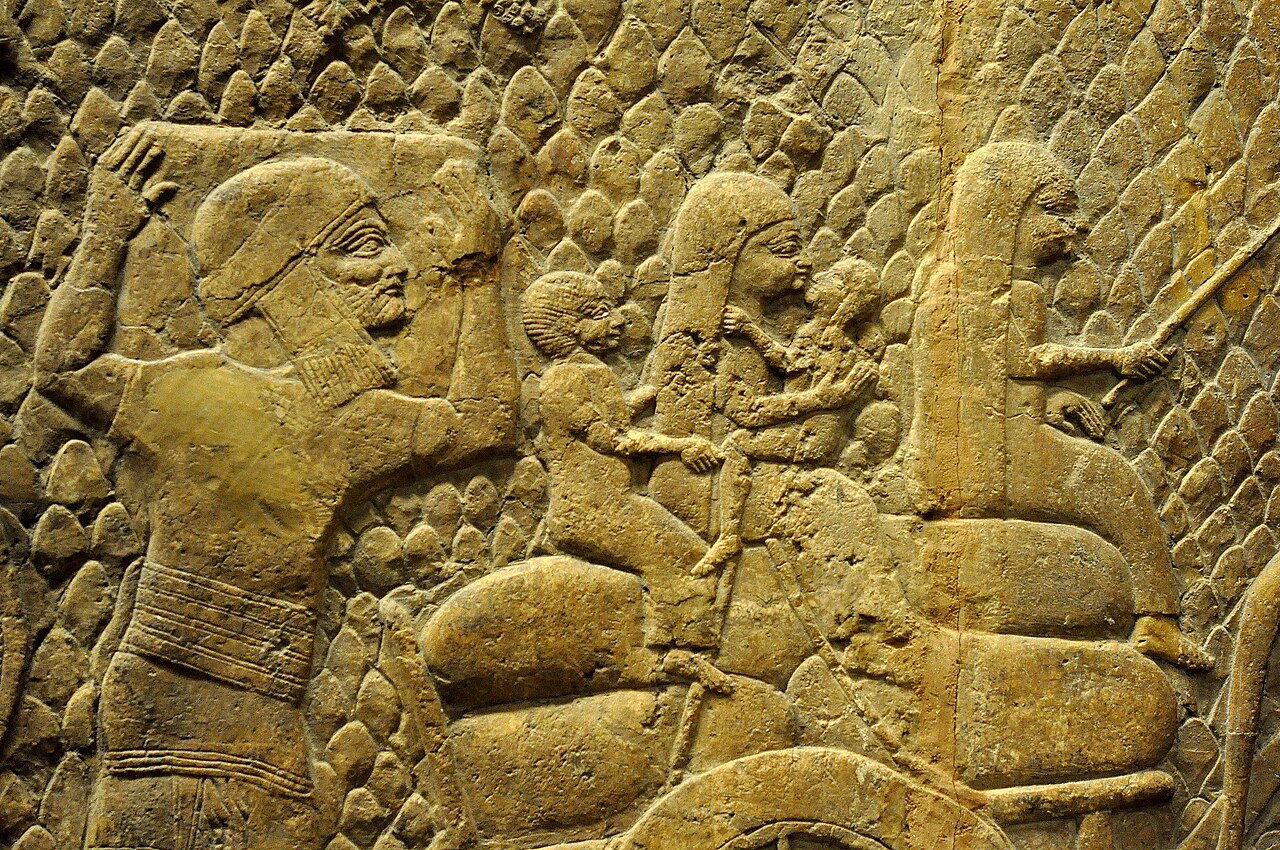
Sennacherib decorated a room of his palace at Nineveh with reliefs of the siege of Lachish (now in the British Museum): siege ramps, battering rams, archers, impaled defenders and families going into exile. At Tel Lachish, excavators found the Assyrian siege ramp, a Judahite counter-ramp, hundreds of arrowheads and the burnt destruction of Level III. It is one of the best-documented sieges in ancient history.
Nehushtan
Hezekiah's destruction of a bronze serpent ascribed to Moses (Numbers 21:9) shows how a sacred object could become an object of worship. The copper serpent from the Timna shrine is a comparable object of an earlier period, not Nehushtan.
The Case for the Biblical Account
Scripture's account
Sennacherib's invasion (2 Kings 18).
What evidence would we expect?
Assyrian records of a campaign against Judah; destroyed Judahite cities.
The discoveries
Sennacherib's prisms; the Lachish reliefs; Lachish Level III with siege ramp; lmlk storage jars across Judah; Jerusalem's Broad Wall.
Testing the discoveries
The campaign is documented from both sides in unusual detail.
The strongest reconstruction
In 701 BC Sennacherib devastated Judah and took heavy tribute, but did not take Jerusalem.
What remains possible
The difference in the silver figure (300 vs 800).
What the evidence shows
- Sennacherib's annals name Hezekiah and claim 46 cities.Source: Israel Museum, Sennacherib Prism (IMJ 71.72.249) ↗; Oracc, Royal Inscriptions of the Neo-Assyrian Period (RINAP) ↗
- Lachish was besieged and destroyed in 701 BC.Source: British Museum, Lachish reliefs (resource) ↗
- The Bible and the prism agree on 30 talents of gold.
- The silver figures (300 and 800) can be fully reconciled.
Continue the journey
Journey of a Passage2 Kings 18:14: Hezekiah's tribute: 300 or 800 talents of silver?The Hebrew, Vulgate and KJV say 300 talents of silver and 30 of gold.More from this lesson
On the map
Location securely identified Probable identification Proposed or debated location Biblical route (roads schematic) Scholarly proposal
- Sennacherib's campaign, 701 BC (schematic). Schematic, following the order of the annals: Phoenicia, the Philistine coast (Ekron), Judah's cities (Lachish), and the blockade of Jerusalem, which was not taken.
Investigations
Optional deep dives: the ancient sources, the physical evidence, and every interpretation side by side, including unconventional ones, each labeled for what it is.
Sennacherib, Hezekiah and the Siege of LachishCampaign: documented · Lachish siege: documented · Jerusalem not taken: documented · Cause of withdrawal: unknown
What do Assyrian records and archaeology say about 701 BC?
Sennacherib's annals claim he took 46 walled cities of Judah, shut Hezekiah in Jerusalem "like a bird in a cage," and received tribute. His palace reliefs show the siege of Lachish; excavations at Lachish found the siege ramp and destruction. Neither text nor relief claims Jerusalem fell. Why Sennacherib withdrew is not explained by Assyrian sources.
Open the full investigation →Echoes Across Civilizations
Optional: how other ancient peoples told similar stories. Open one to compare, then come back to the lesson.
Royal annals and prophetic historyAssyrian · Babylonian
How do empire chronicles tell the same events as Kings?
- Assyrian: Royal annals (Shalmaneser III to Ashurbanipal) Possible historical contact
- Babylonian: Babylonian chronicles Possible historical contact
Why this matters to the rest of Scripture
- The parallel account.
- The Chronicler's account.
- The bronze serpent.
- "O thou inhabitant of Lachish."