Hezekiah's Illness and the Siloam Tunnel
"He made a pool, and a conduit, and brought water into the city"
"Set thine house in order; for thou shalt die, and not live." Hezekiah turns his face to the wall: "Remember now how I have walked before thee in truth and with a perfect heart." Before Isaiah has left the middle court: "I have heard thy prayer, I have seen thy tears: behold, I will heal thee… And I will add unto thy days fifteen years." "Take a lump of figs. And they took and laid it on the boil, and he recovered."
"What shall be the sign?" "Shall the shadow go forward ten degrees, or go back ten degrees?" "Let the shadow return backward ten degrees." "And Isaiah the prophet cried unto the LORD: and he brought the shadow ten degrees backward, by which it had gone down in the dial of Ahaz."
Berodach-baladan (Merodach-baladan) son of Baladan, king of Babylon, sends letters and a present. Hezekiah shows the envoys "all the house of his precious things… there was nothing in his house, nor in all his dominion, that Hezekiah shewed them not." Isaiah: "Behold, the days come, that all that is in thine house… shall be carried into Babylon: nothing shall be left." "Good is the word of the LORD… Is it not good, if peace and truth be in my days?" "And how he made a pool, and a conduit, and brought water into the city, are they not written in the book of the chronicles of the kings of Judah?"
The Siloam tunnel and inscription
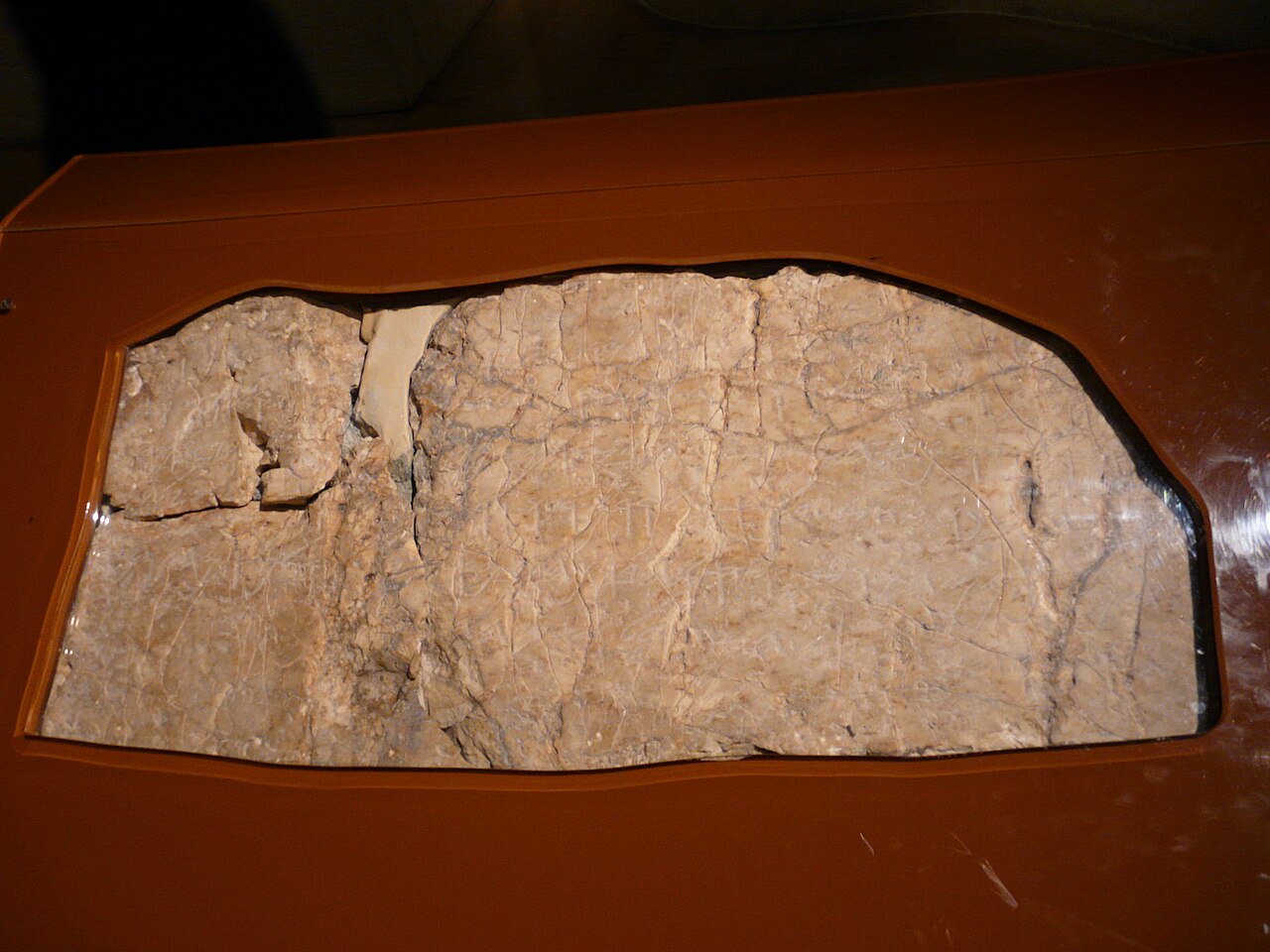
A tunnel 533 m long winds through the rock from the Gihon spring to the Siloam pool. An inscription found inside it in 1880 (now in the Istanbul Archaeological Museums) describes the last moments of cutting: "while there were still three cubits to be cut, the voice of a man calling to his fellow… the quarrymen struck, each toward his fellow, axe against axe, and the water flowed from the spring to the pool, 1,200 cubits." The inscription names no king. Its script fits the late 8th or early 7th century BC, and most scholars connect the tunnel with Hezekiah (20:20; 2 Chronicles 32:30). Some radiocarbon and paleographic studies have suggested other dates; the identification is strong but inferred.
The stairway of Ahaz
Hebrew ma'alot means steps or degrees. It may have been a staircase whose shadow marked the time, or a sundial. The Vulgate says "horologium." The text presents a sign; no astronomical explanation has been confirmed, and claims of a lost day or of spacecraft have no evidence.
Merodach-baladan
Marduk-apla-iddina II was a Chaldean who seized Babylon twice (721–710 and 703 BC) against Assyria. An embassy seeking Judah as an ally fits his anti-Assyrian policy, though no Babylonian text records it.
The Case for the Biblical Account
Scripture's account
Hezekiah's illness, the sign and the envoys (2 Kings 20).
What evidence would we expect?
Waterworks in Jerusalem; a Babylonian king hostile to Assyria.
The discoveries
The Siloam tunnel and inscription; the Broad Wall; Merodach-baladan in Assyrian and Babylonian records.
Testing the discoveries
The tunnel and Merodach-baladan are documented; the link of the tunnel to Hezekiah is inferred.
The strongest reconstruction
Hezekiah secured Jerusalem's water before 701 BC as part of his preparations.
What remains possible
The nature of the shadow sign.
What the evidence shows
- The Siloam inscription describes the tunnel's completion.Source: University of Michigan, Siloam inscription (image database) ↗; Ancient Hebrew Inscriptions (Cambridge Elements) ↗
- The Siloam inscription names Hezekiah.
- Hezekiah built the Siloam tunnel.
- "He brought the shadow ten degrees backward."
Continue the journey
Journey of a Passage2 Kings 20:9–11: The shadow on the steps of AhazThe witnesses agree on the sign.More from this lesson
Investigations
Optional deep dives: the ancient sources, the physical evidence, and every interpretation side by side, including unconventional ones, each labeled for what it is.
The Siloam Tunnel and InscriptionTunnel and inscription: documented · Builder: Hezekiah (strongly supported, inferred)
Did Hezekiah cut the tunnel, and what does the inscription say?
A winding tunnel 533 m long carries the Gihon spring's water to the Siloam pool. An inscription found inside in 1880 describes the moment two teams of diggers met. It names no king; its script and the biblical texts make Hezekiah the most likely builder, but some studies have proposed other dates.
Open the full investigation →Echoes Across Civilizations
Optional: how other ancient peoples told similar stories. Open one to compare, then come back to the lesson.
Water for a city under siegeIsraelite / Canaanite · Greek
How did ancient cities secure water against siege?
- Israelite / Canaanite: Water systems at Megiddo, Hazor and Gibeon Shared literary world
- Greek: The Tunnel of Eupalinos Resemblance only
Why this matters to the rest of Scripture
- The parallel account, with Hezekiah's psalm.
- Hezekiah stopped the upper Gihon.
- "Go, wash in the pool of Siloam."