Jehu's Purge and Assyrian Tribute
"Come with me, and see my zeal for the LORD"
Jehu writes to the guardians of Ahab's seventy sons: choose the best and fight. They are afraid. "Take ye the heads of the men your master's sons." Seventy heads are sent in baskets and laid in two heaps at the gate. "Ye be righteous: behold, I conspired against my master… but who slew all these?"
Jehu meets Jehonadab son of Rechab: "Is thine heart right, as my heart is with thy heart?… Come with me, and see my zeal for the LORD." He announces: "Ahab served Baal a little; but Jehu shall serve him much." He fills the house of Baal with every worshiper, sets eighty men outside, and after the offering commands: "Go in, and slay them; let none come forth." The pillar of Baal is burned; the house of Baal is made "a draught house unto this day."
"Thus Jehu destroyed Baal out of Israel. Howbeit from the sins of Jeroboam… Jehu departed not from after them, to wit, the golden calves that were in Bethel, and that were in Dan." "Because thou hast done well… thy children of the fourth generation shall sit on the throne of Israel." "In those days the LORD began to cut Israel short: and Hazael smote them in all the coasts of Israel; from Jordan eastward, all the land of Gilead." Jehu reigns twenty-eight years in Samaria.
The Black Obelisk
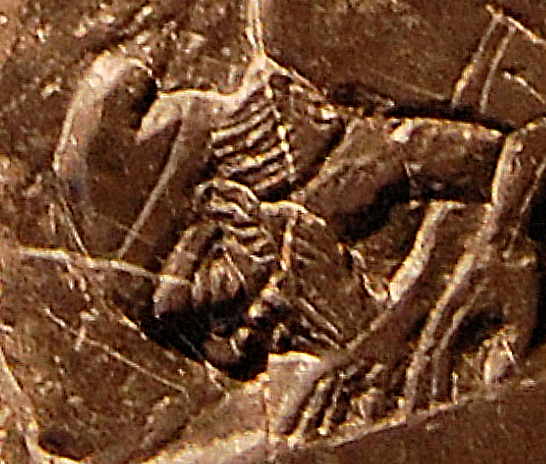
Shalmaneser III's Black Obelisk (British Museum BM 118885), from Nimrud, c. 825 BC, shows a man prostrate before the Assyrian king with the caption: "Tribute of Jehu (Iaua) son of Omri: silver, gold, a gold bowl, a gold vase…" It is dated to 841 BC. This is the only known contemporary image of an Israelite or Judahite king (or his envoy). "Son of Omri" is Assyria's name for Israel's ruler, not a genealogy; Jehu had destroyed Omri's dynasty.
Jehu, praised and condemned
2 Kings 10:30 approves Jehu's action; Hosea 1:4 says God will avenge "the blood of Jezreel upon the house of Jehu." Interpreters explain this as judgment on Jehu's excess, on his own unfaithfulness, or as a different prophetic perspective. Both texts stand in Scripture.
The Rechabites
Jehonadab son of Rechab founded a group that drank no wine, built no houses and lived in tents; Jeremiah 35 holds them up as models of faithfulness two centuries later.
The Case for the Biblical Account
Scripture's account
Jehu's purge (2 Kings 10).
What evidence would we expect?
Jehu's submission to Assyria; Aramean expansion into Gilead.
The discoveries
The Black Obelisk; Shalmaneser III's annals for 841 BC; the Tel Dan Stele.
Testing the discoveries
Jehu's tribute is documented, though Kings does not mention it; the purge is known only from Kings.
The strongest reconstruction
Jehu paid tribute to Assyria in 841 BC and then lost Transjordan to Hazael when Assyria withdrew.
What remains possible
Whether the obelisk shows Jehu himself or an envoy.
What the evidence shows
- The Black Obelisk records tribute from Jehu.Source: CDLI, Black Obelisk of Shalmaneser III (BM 118885) ↗; Oracc, "The Black Obelisk of Shalmaneser III" ↗
- The figure bowing is Jehu himself.
- Hosea 1:4 condemns the bloodshed at Jezreel.
Continue the journey
Journey of a Passage2 Kings 10:30 and Hosea 1:4: Jehu rewarded, Jehu judged2 Kings 10:30 says God approved Jehu's destruction of Ahab's house and promised his sons four generations.More from this lesson
Investigations
Optional deep dives: the ancient sources, the physical evidence, and every interpretation side by side, including unconventional ones, each labeled for what it is.
The Black Obelisk: Jehu before ShalmaneserObelisk: documented · Jehu's tribute: documented · Figure: Jehu or envoy (debated)
Is there a picture of an Israelite king?
Shalmaneser III's Black Obelisk (British Museum BM 118885), found at Nimrud in 1846, shows tribute bearers from five lands. The second register shows a man bowing before the king, labeled "Tribute of Jehu (Ia-ú-a) son of Omri." It records the year 841 BC. It is the only known contemporary picture of a king of Israel or Judah, or of his envoy.
Open the full investigation →Why this matters to the rest of Scripture
- The blood of Jezreel.
- The Rechabites.
- The calves of Bethel and Dan.