Genesis 49:10
"Until Shiloh come": the scepter of Judah
One of the hardest phrases in the Hebrew Bible. Is "Shiloh" a name, a place, a title ("he to whom it belongs"), or "tribute"? Ancient Jewish and Christian readers heard a promise of the Messiah.
Same letters, different readings: the consonants agree, but ancient readers vocalized or interpreted them differently
The family tree
Each row is a language or text tradition. Witnesses in the same row may share ancestry, revise one another, or have an uncertain relationship; the line under each box says which. A solid arrow appears only where direct copying or a documented revised edition is established. Order by date never implies copying. Scroll sideways on a phone.
✓ contains it · ✕ does not · ❝ quotes part of it · ⓘ reports on manuscripts · ▢ pages lost · – no copy survives
- Same line, through lost copies
- Translation
- Modern edition based on it
- Uncertain connection
Five ways to read the same words
- A name or title
- "until Shiloh come" (KJV, NASB): a royal figure called Shiloh.
- "He to whom it belongs"
- Reading shelloh, "whose it is" (Septuagint, NIV, RSV). Compare Ezekiel 21:27: "until he come whose right it is."
- The town of Shiloh
- "as long as men come to Shiloh" (JPS 1917).
- "Tribute"
- Dividing the letters as shai lo, "tribute to him" (ESV, NRSV).
- "He who is sent"
- Jerome's Vulgate.
Every witness, in order
Unknown (debated)
Original Genesis
The poem of Genesis 49 is written in archaic Hebrew, which is part of the difficulty.
Translated c. 250 BC
Septuagint
How the site knows this: Reported in scholarship; not checked by the site.
until the things stored up for him come; and he is the expectation of nations.
Reads the word as shelloh, "that which is his." Some Greek manuscripts read "until he comes for whom it is stored up."
1st century BC
Dead Sea Scrolls: Commentary on Genesis A (4Q252)
How the site knows this: Reported in scholarship; not checked by the site.
…until the Messiah of righteousness comes, the Branch of David.
A Qumran commentary that interprets this verse as a promise of the Davidic Messiah: the earliest surviving interpretation of the verse.
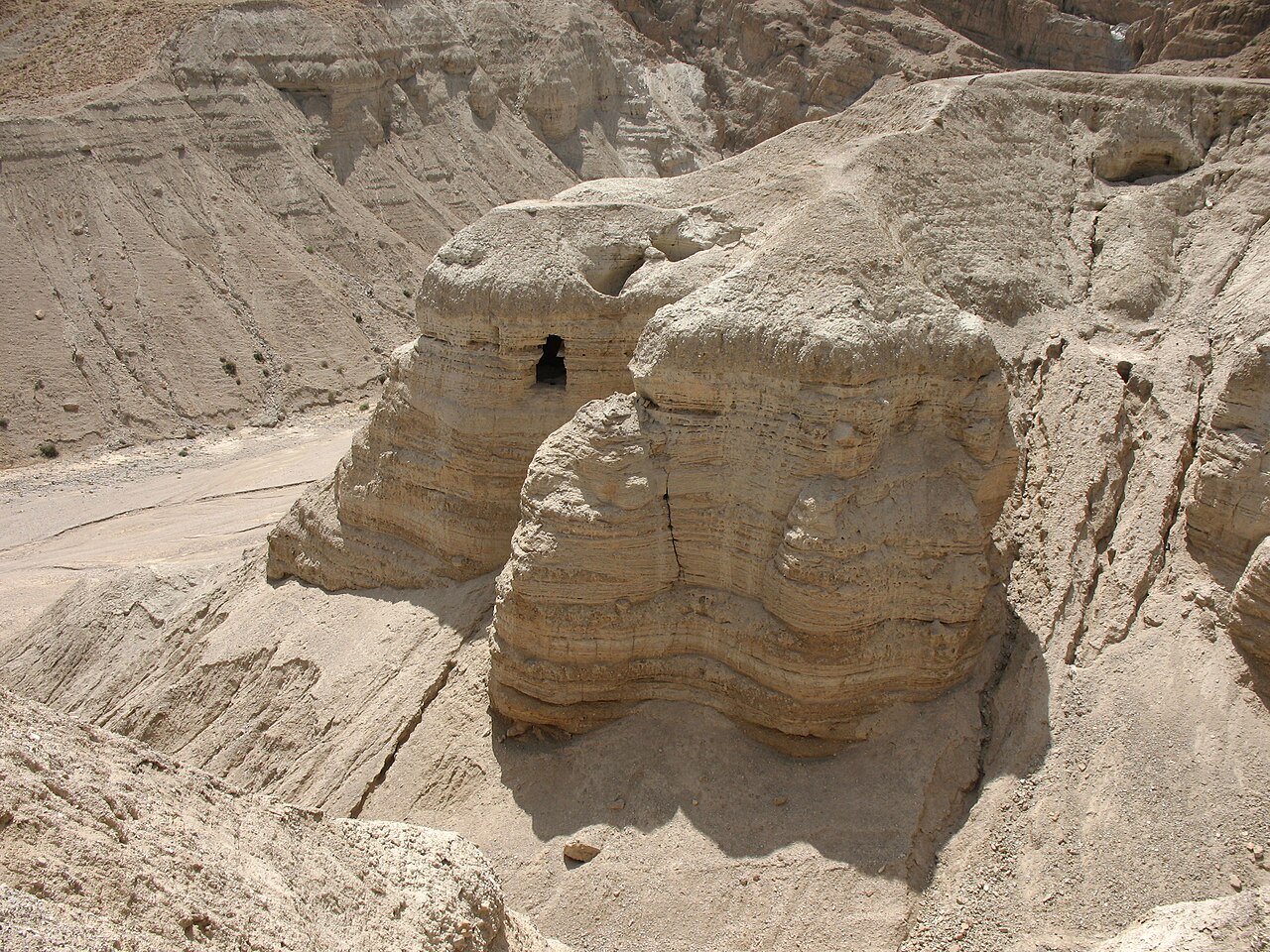
Site or place photographImage credit Pictured: the caves at Qumran.
c. 2nd–4th century AD
Targum Onkelos (Aramaic)
How the site knows this: Reported in scholarship; not checked by the site.
until the Messiah comes, whose is the kingdom
The standard Aramaic translation read in synagogues renders the phrase as a promise of the Messiah.
c. AD 400
Jerome's Vulgate
How the site knows this: Read in the site's library text: Clementine Vulgate (1592 edition).
donec veniat qui mittendus est
until he that is to be sent comes
Jerome connected the word with shaliach, "one who is sent."
AD 1008
Masoretic Text (Leningrad Codex)
How the site knows this: Read in the site's library text: Westminster Leningrad Codex, a digital transcription of the Leningrad Codex.
עַד כִּי־יָבֹא שִׁילֹה וְלוֹ יִקְּהַת עַמִּים
until Shiloh come; and unto him shall the obedience of the peoples be.
The written letters are שילה (shylh); the Masoretic marginal reading tradition gives shiloh. The Samaritan Pentateuch has the same consonants. Whether the text originally had a yod is itself debated.
1611
King James Bible
How the site knows this: Read in the site's library text: King James Version (1769 text).
until Shiloh come; and unto him shall the gathering of the people be.
Treats Shiloh as a name or title of the coming ruler.
1917
JPS (1917)
How the site knows this: Read in the site's library text: JPS Tanakh (1917).
as long as men come to Shiloh
Reads Shiloh as the town where the tabernacle later stood.
today
Modern Bibles
How the site knows this: Checked in a published edition.
until tribute comes to him (ESV) · until he to whom it belongs shall come (NIV)
Each reflects a different way of dividing or vocalizing the same letters.
What changed, and why
The consonants of this verse are well preserved; what differs is how the rare word is read and divided. That is why we classify it as "same letters, different readings" rather than as a copying variant.
What is striking is the agreement of the earliest interpreters. The Qumran commentary (1st century BC) and the synagogue Aramaic translation both read the verse as a promise of the Messiah from Judah. Christians from the New Testament onward saw it fulfilled in Jesus, "the Lion of the tribe of Juda" (Revelation 5:5).
What the evidence shows
- The Hebrew word is difficult and has been read several ways since antiquity.
- A Dead Sea Scroll commentary (4Q252) interprets the verse as a promise of the Davidic Messiah.
- Targum Onkelos renders the phrase "until the Messiah comes."
- Genesis 49:10 foretells the Messiah. Held by early Jewish and Christian interpreters.
Sources
- NET Bible translators' note on Genesis 49:10 ↗
- E. Tov, Textual Criticism of the Hebrew Bible, 3rd ed. (Fortress, 2012)
Related lessons
- Jacob's Final Blessings →Jacob adopts Joseph's sons and crosses his hands to bless the younger. Then he speaks poetic words over each of his twelve sons, giving Judah the scepter.