Era 2 · The Family of AbrahamGenesis
Jacob's Final Blessings
Crossed hands, twelve sons, and the scepter of Judah
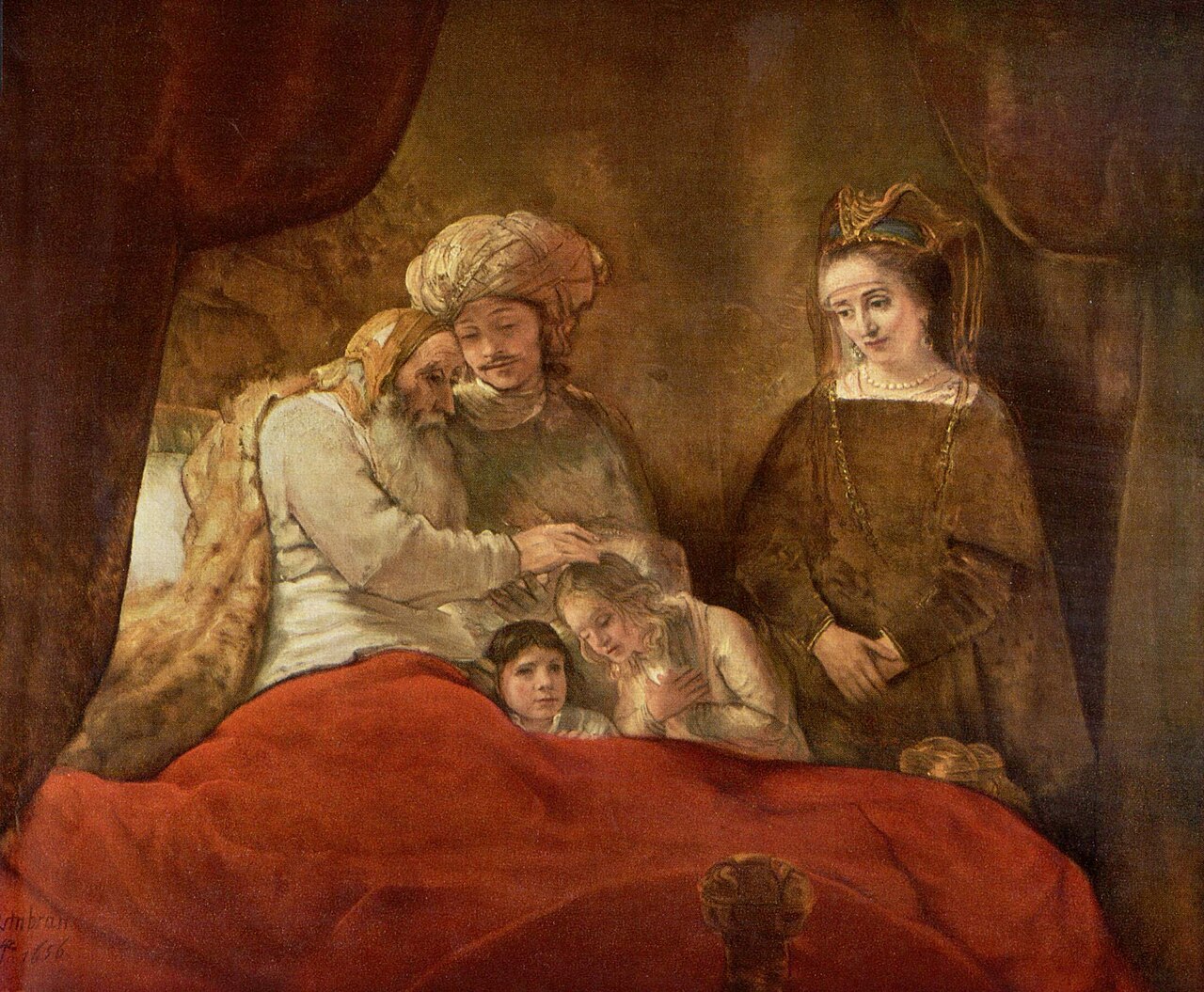
Jacob is ill. Joseph brings his two sons, Manasseh and Ephraim. Jacob gathers his strength and sits up. "Thy two sons, Ephraim and Manasseh, which were born unto thee in the land of Egypt… are mine; as Reuben and Simeon, they shall be mine." Joseph's sons will stand as tribes in Israel.
Joseph places Manasseh, the elder, at Jacob's right hand and Ephraim at his left. But Jacob, nearly blind, crosses his arms and puts his right hand on Ephraim. Joseph tries to move it. "I know it, my son, I know it… his younger brother shall be greater than he." Once more, the younger first. Jacob blesses them: "The Angel which redeemed me from all evil, bless the lads."
Then he calls all his sons: "Gather yourselves together, that I may tell you that which shall befall you in the last days." What follows is poetry, among the oldest in the Bible.
- Reuben: "Unstable as water, thou shalt not excel," because of Bilhah.
- Simeon and Levi: "Instruments of cruelty are in their habitations… I will divide them in Jacob, and scatter them in Israel," because of Shechem.
- Judah: "thou art he whom thy brethren shall praise… Judah is a lion's whelp… The sceptre shall not depart from Judah… until Shiloh come; and unto him shall the gathering of the people be."
- Zebulun by the sea; Issachar the strong donkey; Dan a judge and a serpent by the way. Then a sudden prayer: "I have waited for thy salvation, O LORD."
- Gad, Asher, Naphtali; Joseph "a fruitful bough by a well," blessed by "the mighty God of Jacob… the shepherd, the stone of Israel."
- Benjamin: "shall ravin as a wolf."
Jacob gives one last charge: bury me with my fathers in the cave of Machpelah, "there they buried Abraham and Sarah his wife; there they buried Isaac and Rebekah his wife; and there I buried Leah." Then he "gathered up his feet into the bed, and yielded up the ghost, and was gathered unto his people."
Ancient poetry
Genesis 49 is written in compressed, archaic Hebrew poetry, full of wordplay on each son's name (Judah and "praise," Dan and "judge," Gad and "raiders"). Frank Moore Cross and David Noel Freedman counted it among Israel's oldest poems, alongside the Song of the Sea (Exodus 15) and the Song of Deborah (Judges 5). Other scholars date its present form to the time of the monarchy, when Judah's royal role was clear.
Adopting grandsons
Jacob's adoption of Ephraim and Manasseh, with the boys placed on his knees (48:12), reflects real adoption customs in which a child placed on the knees was received as one's own. It explains why later Israel has a tribe of Ephraim and a tribe of Manasseh but no tribe of Joseph.
The lion of Judah
The blessing of Judah shaped Israel's hope for a king from Judah, fulfilled in David's dynasty. Later Jewish interpreters read "until Shiloh come" as a promise of the Messiah, and the New Testament calls Jesus "the Lion of the tribe of Juda" (Revelation 5:5). The Hebrew of 49:10 is notoriously difficult; see the Journey of a Passage.
The Case for the Biblical Account
Scripture's account
Jacob adopts Ephraim and Manasseh and pronounces poetic blessings over his twelve sons (Genesis 48–49).
What evidence would we expect?
Archaic language; adoption customs; correspondence between the blessings and the tribes' later history.
The discoveries
Archaic Hebrew poetic features in Genesis 49; Near Eastern adoption practices; tribal histories in Joshua and Judges that match several blessings (Simeon absorbed into Judah, Levi scattered as priests, Zebulun near the coast).
Testing the discoveries
The match between blessings and later tribal history can be read as prophecy fulfilled, or as poetry composed or shaped once those histories were known.
The strongest reconstruction
Genesis 49 preserves very old tribal poetry, set in the mouth of the common ancestor. Its forward-looking words became central to Israel's hope.
What remains possible
Jacob's own words handed down; an ancient poem gathered from tribal sayings; or both.
What the evidence shows
- Genesis 49 contains archaic Hebrew poetry.Source: F. M. Cross & D. N. Freedman, Studies in Ancient Yahwistic Poetry (1975; Eerdmans 1997)
- Several blessings correspond to the tribes' later situations (Simeon and Levi scattered). Joshua 19:1–9; Joshua 21.
- Genesis 49:10 is a prophecy of the Messiah. Held by ancient Jewish interpreters and by Christians.
Continue the journey
Journey of a PassageGenesis 49:10: "Until Shiloh come": the scepter of JudahOne of the hardest phrases in the Hebrew Bible.More from this lesson
Why this matters to the rest of Scripture
- "By faith Jacob, when he was a dying, blessed both the sons of Joseph."
- "The Lion of the tribe of Juda, the Root of David, hath prevailed."
- Moses' blessing of the tribes, a companion poem.
- God "refused the tabernacle of Joseph… but chose the tribe of Judah."