Era 2 · The Family of AbrahamGenesis
The Promised Son
Isaac's birth, Hagar's tears, and the mountain of Moriah
In Gerar, Abraham repeats his old fear and calls Sarah his sister. King Abimelech takes her, and God warns him in a dream. The foreign king turns out more honest than the patriarch: "What hast thou done unto us?" Abraham prays, and Abimelech's household is healed.
Then, exactly as promised, "Sarah conceived, and bare Abraham a son in his old age." Abraham is a hundred. They name him Isaac. "God hath made me to laugh," Sarah says, "so that all that hear will laugh with me."
At the feast for Isaac's weaning, Sarah sees Ishmael laughing or playing, and demands that Hagar and her son be cast out. Abraham is deeply grieved, but God tells him to listen to Sarah: Isaac will carry the promise, and Ishmael too will become a nation. Abraham sends Hagar off with bread and a skin of water. When the water runs out in the wilderness of Beersheba, Hagar puts the boy under a bush and sits a bowshot away: "Let me not see the death of the child." God hears the boy's voice. "What aileth thee, Hagar? fear not." God opens her eyes, and she sees a well. Ishmael grows up in the wilderness of Paran, an archer, and Hagar finds him an Egyptian wife.
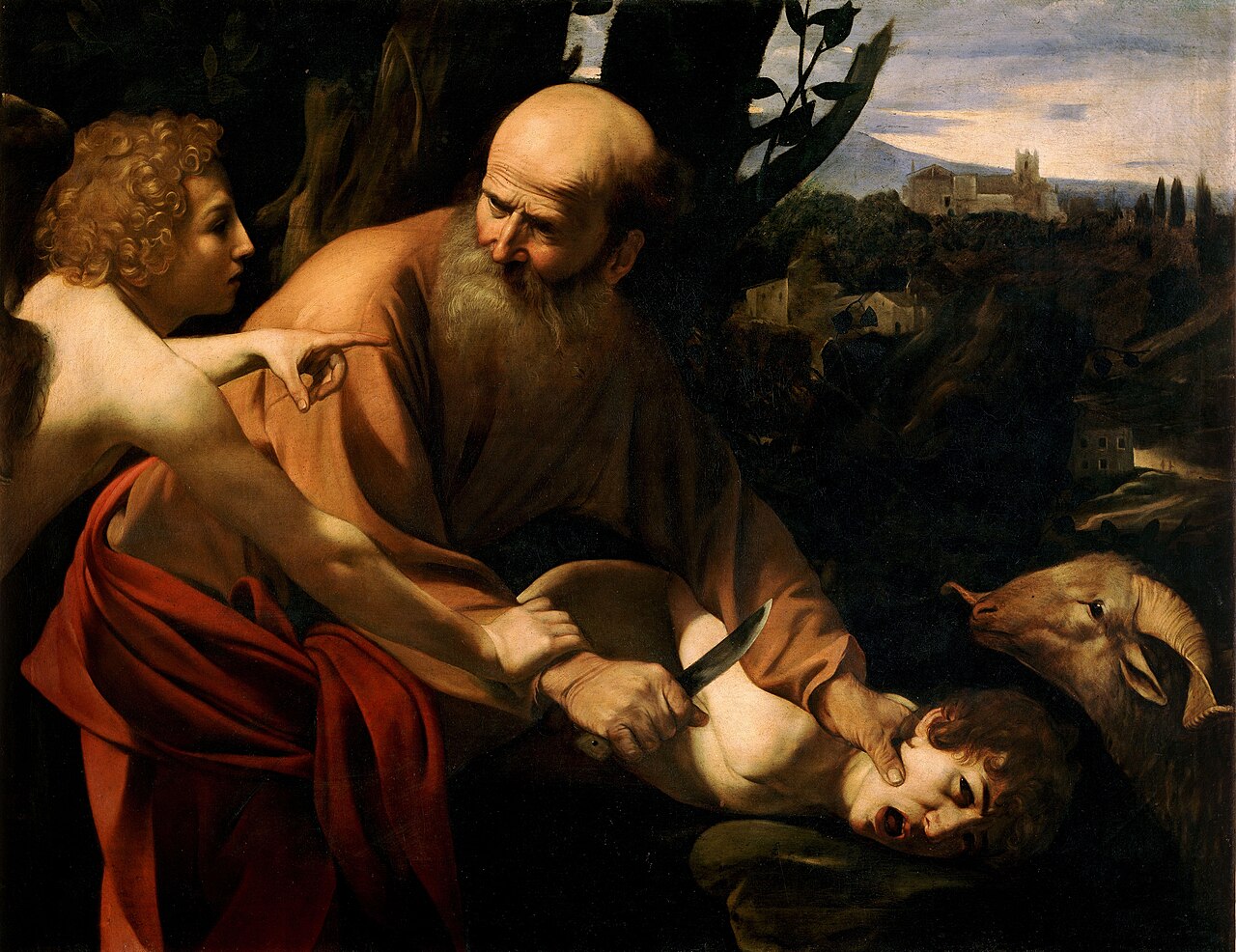
"After these things God did tempt Abraham", that is, tested him. "Take now thy son, thine only son Isaac, whom thou lovest, and get thee into the land of Moriah; and offer him there for a burnt offering." Abraham rises early. Three days' journey. Isaac carries the wood; Abraham carries the fire and the knife. "My father… where is the lamb?" "My son, God will provide himself a lamb."
Abraham builds the altar, binds Isaac, and raises the knife. "Abraham, Abraham… Lay not thine hand upon the lad." Caught in a thicket is a ram, and Abraham offers it instead. He names the place "The LORD will provide," and the promise is sworn again: "in thy seed shall all the nations of the earth be blessed; because thou hast obeyed my voice."
A world that sacrificed children
Genesis 22 is shocking because child sacrifice was real. The Moabite king sacrifices his son on the city wall in 2 Kings 3:27. Thousands of urns with burned infant remains at Carthage and other Phoenician colonies are widely interpreted as child sacrifice. Israel's law forbids it outright (Leviticus 18:21; Deuteronomy 12:31). Many readers see Genesis 22 as teaching at the very start of Israel's story that this God does not want children killed: He provides the substitute.
Moriah
2 Chronicles 3:1 says Solomon built the Temple "in mount Moriah," and Jewish tradition identifies the place of the binding with Jerusalem's Temple Mount. Samaritan tradition places it on Mount Gerizim. Genesis itself only says "the land of Moriah," three days from Beersheba.
Beersheba and the wells
Genesis 21 ends with Abraham and Abimelech swearing an oath over a well at Beersheba, "the well of the oath" or "of seven," sealed with seven ewe lambs. Water rights were a real source of conflict for herders in the dry Negev, and the town of Beersheba remains a key place in Israel's story.
The Case for the Biblical Account
Scripture's account
Isaac is born; Hagar and Ishmael are sent away; God tests Abraham at Moriah and provides a ram (Genesis 20–22).
What evidence would we expect?
A setting in the Negev and Philistine plain; water disputes; religious practices such as sacrifice that make the test intelligible.
The discoveries
The Negev's dependence on wells; ancient treaties over water; archaeological and textual evidence of child sacrifice in the wider region.
Testing the discoveries
Genesis calls Abimelech's people "Philistines" (21:32, 26:1). The Philistines known from archaeology arrived around 1200 BC, long after the traditional date for Abraham. Some see an updated name for earlier Aegean-linked inhabitants; others see a sign of later composition.
The strongest reconstruction
The setting is realistic, the conflicts are the kind herders faced, and the test speaks directly to a world that practiced child sacrifice. The specific events rest on Genesis' testimony.
What remains possible
That the stories preserve family memories, with some names updated by later scribes, or that they were composed later as Israel reflected on its origins.
How Jews, Christians and Muslims read the binding
The Akedah is read at Rosh Hashanah. Rabbinic commentary dwells on Isaac's willingness and Abraham's faith, and some traditions imagine Isaac as a grown man who consented.
Hebrews 11:17–19 says Abraham reasoned that God could raise Isaac from the dead. The only son, the wood carried up the hill, and the substitute provided by God have been read as foreshadowing Christ.
The Qur'an (37:99–111) tells the story without naming the son; most Muslim interpreters identify him as Ishmael. It is remembered at Eid al-Adha.
What the evidence shows
- Child sacrifice was practiced in parts of the ancient Mediterranean and Near East. The interpretation of the Carthage remains is debated by a minority.
- The Philistines known from archaeology arrived around 1200 BC.
- Genesis 22 took place on Jerusalem's Temple Mount. An ancient tradition supported by 2 Chronicles 3:1.
- God tested Abraham and provided the sacrifice.
Continue the journey
Connected elsewhere in ScriptureGod Calls from the TentLeviticus 1:3–9: The burnt offering law; and Leviticus 18:21 forbids child sacrifice outright.More from this lesson
Why this matters to the rest of Scripture
- The burnt offering law; and Leviticus 18:21 forbids child sacrifice outright.
- Abraham accounted "that God was able to raise him up, even from the dead."
- "He that spared not his own Son, but delivered him up for us all."
- Solomon builds the Temple "in mount Moriah."
- Isaac as the child of promise.