Era 2 · The Family of AbrahamGenesis
The Brothers Return
Famine, a hidden ruler, a silver cup, and Judah's offer
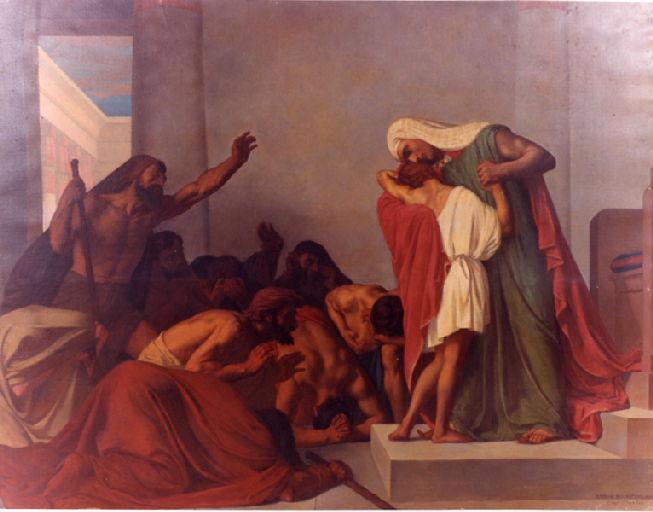
The famine reaches Canaan. "Why do ye look one upon another?" Jacob sends ten sons to buy grain in Egypt, but keeps Benjamin, Rachel's other son, at home. In Egypt they bow before the governor with their faces to the earth. Joseph knows them at once; they do not know him. "Joseph remembered the dreams which he dreamed of them."
He speaks harshly through an interpreter: "Ye are spies." They protest: twelve brothers, one at home with their father, "and one is not." He jails them for three days, then keeps Simeon and sends the rest home with grain: bring back the youngest. The brothers, not knowing he understands Hebrew, say to each other, "We are verily guilty concerning our brother… therefore is this distress come upon us." Joseph turns away and weeps.
On the way home they find their silver back in their sacks. "What is this that God hath done unto us?" Jacob refuses to send Benjamin: "Joseph is not, and Simeon is not, and ye will take Benjamin away: all these things are against me." Reuben offers his own two sons as a guarantee. Jacob refuses.
The grain runs out. Judah steps forward: "I will be surety for him; of my hand shalt thou require him." Jacob relents and sends them with gifts, "a little balm, and a little honey, spices, and myrrh, nuts, and almonds," and double the silver. "If I be bereaved of my children, I am bereaved."
In Egypt, Joseph sees Benjamin and has to leave the room to weep. At dinner he seats the brothers in exact birth order, to their amazement, and gives Benjamin five times as much. Then the test: his steward hides Joseph's silver cup in Benjamin's sack. They are overtaken on the road; the cup is found; they tear their clothes and all return.
Joseph offers them freedom: only Benjamin will stay as his slave. Judah comes near and makes the longest speech in Genesis. He tells the whole story, his father's grief, the son "of his old age," "his life is bound up in the lad's life." "Now therefore, I pray thee, let thy servant abide instead of the lad a bondman to my lord… for how shall I go up to my father, and the lad be not with me?" The brother who once sold a brother into slavery now offers himself as a slave to save one.
Famine refugees at Egypt's border
Egypt controlled its eastern frontier with forts, and foreigners came in time of hunger. A scribe's report in Papyrus Anastasi VI (about 1200 BC) records that Shasu herdsmen from Edom were allowed past the fortress of Tjeku into the pools of the eastern Delta "to keep them alive and to keep their cattle alive." That is precisely the situation of Jacob's sons: hungry herders from the north-east arriving at Egypt's border for food.
The silver cup
The steward says it is the cup by which his master "divineth" (44:5). Reading omens from liquids, such as patterns of oil on water in a cup, is well documented in Mesopotamian texts. Whether Joseph used it, or simply played the part of an Egyptian official, Genesis does not say.
Gifts from Canaan
Jacob's gifts are the products of Canaan's hills: balm (resin), honey (often grape or date syrup), gum, myrrh-like resin, pistachio nuts and almonds. They were luxury items that Egypt did not produce itself.
The Case for the Biblical Account
Scripture's account
Jacob's sons travel twice to Egypt for grain; Joseph tests them until Judah offers himself for Benjamin (Genesis 42–44).
What evidence would we expect?
Egyptian control of foreigners at the frontier; famine migrations; trade goods from Canaan; divination practices.
The discoveries
Papyrus Anastasi VI on herders admitted in time of need; Egyptian frontier forts; Canaanite trade goods; liquid-divination texts.
Testing the discoveries
These fit, but they are general. The chapters are, above all, a carefully built narrative of guilt, testing and change, which archaeology cannot test.
The strongest reconstruction
The background is realistic. The story's main claim, that the brothers were transformed, is moral and spiritual.
What remains possible
That the episodes are remembered history, told with literary skill, or a literary composition with a historical setting.
What the evidence shows
- Egypt admitted hungry herders from the east through its frontier in time of need.Source: Papyrus Anastasi VI (c. 1200 BC): Edomite herders admitted to the Delta "to keep them alive"
- Reading omens from liquids in a cup was practiced in the ancient Near East.
- Judah's offer marks a real change of heart in the family. This is the story's own interpretation of events.
Continue the journey
Next in the storyJoseph Reveals HimselfJoseph reveals himself and forgives his brothers.More from this lesson
Why this matters to the rest of Scripture
- "At the second time Joseph was made known to his brethren."
- "Greater love hath no man than this, that a man lay down his life for his friends."
- "Our Lord sprang out of Juda."