Era 2 · The Family of AbrahamGenesis
Judah, Tamar, and Joseph's Trials
"She hath been more righteous than I"
Genesis pauses Joseph's story to follow Judah, the brother who proposed selling him. Judah marries a Canaanite woman and has three sons. He finds a wife, Tamar, for his eldest, Er. Er is wicked and dies. By custom, the next brother, Onan, must give Tamar a child to carry on Er's name; Onan refuses to let her conceive, and he too dies. Judah, fearing for his last son, Shelah, sends Tamar back to her father's house to wait, and never gives her to him.
Tamar sees that she has been left with no husband, no child and no future. When she hears Judah is going up to shear his sheep, she takes off her widow's clothes, veils herself, and sits by the road at Enaim. Judah, taking her for a prostitute, propositions her. As a pledge for payment she asks for his seal, its cord, and his staff, the ancient equivalent of his ID.
Three months later Judah is told: Tamar is pregnant. "Bring her forth, and let her be burnt." As she is brought out, she sends him the seal, cord and staff: "By the man, whose these are, am I with child." Judah recognizes them, the same word used when Jacob was made to "recognize" Joseph's bloody robe. "She hath been more righteous than I; because that I gave her not to Shelah my son." Tamar bears twins, Perez and Zerah. Perez becomes the ancestor of David and, in Matthew's genealogy, of Jesus.
In Egypt, "the LORD was with Joseph." Potiphar puts him in charge of everything he owns. Potiphar's wife, day after day, says, "Lie with me." Joseph refuses: "How then can I do this great wickedness, and sin against God?" One day she grabs his garment; he flees and leaves it in her hand. She uses it as evidence and accuses him of assault. Potiphar throws Joseph into the prison "where the king's prisoners were bound." And there, too, "the LORD was with Joseph," and the keeper puts him in charge.
Pharaoh's chief cupbearer and chief baker land in the same prison. Each has a troubling dream. "Do not interpretations belong to God? tell me them." Three branches of a vine: in three days the cupbearer will be restored. Three baskets with birds eating from the top one: in three days the baker will be hanged. Both come true on Pharaoh's birthday. Joseph had asked only one thing: "think on me… and make mention of me unto Pharaoh." "Yet did not the chief butler remember Joseph, but forgat him."
The levirate duty
A brother's duty to give a son to his dead brother's widow appears in Israel's law (Deuteronomy 25:5–10) and in the book of Ruth. It also appears in the Middle Assyrian Laws (§33) and the Hittite Laws (§193), which even extend the duty to the father-in-law if no brother is available. Tamar's action, shocking to us, claims a right her world recognized. Judah's verdict on himself shows that Genesis sees it that way too.
An Egyptian story of a false accusation
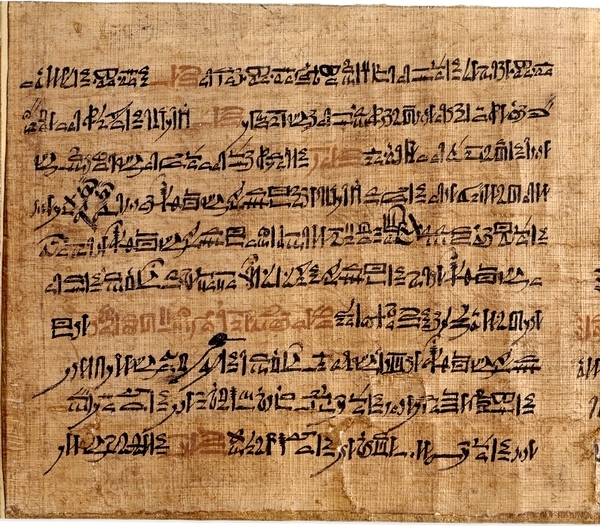
The Egyptian Tale of Two Brothers, preserved on a papyrus from about 1200 BC (now in the British Museum), tells of a younger brother working in his older brother's household. The older brother's wife tries to seduce him; he refuses; she then accuses him of assault, and he must flee for his life. The parallel with Potiphar's wife is striking, though the Egyptian tale then turns into a fantasy of gods and transformations.
Cupbearers, bakers, and dreams
Egyptian royal households had officials over drink and bread, and Egyptians took dreams seriously: a Ramesside dream book (Papyrus Chester Beatty III, about 1275 BC) lists dreams with their good or bad meanings. Joseph's "Do not interpretations belong to God?" sets him apart from such manuals.
The Case for the Biblical Account
Scripture's account
Tamar secures her levirate rights through Judah; Joseph rises in Potiphar's house, is falsely accused, imprisoned, and interprets dreams (Genesis 38–40).
What evidence would we expect?
Levirate customs; Egyptian court offices and prisons; Egyptian interest in dreams; seals as identity tokens.
The discoveries
Levirate laws in Assyrian and Hittite collections; cylinder and stamp seals worn on cords; Egyptian court titles; the Ramesside dream book; the Tale of Two Brothers.
Testing the discoveries
These show a realistic setting. The Tale of Two Brothers shows the seduction motif was known in Egypt; it does not show that Genesis borrowed it, or that Joseph's experience is fictional.
The strongest reconstruction
Genesis 38–40 fits real Near Eastern law and Egyptian court life closely, and uses a familiar motif to make a moral point unique to Israel's faith: faithfulness to God when unobserved.
What remains possible
A historical Joseph whose experience echoed a known pattern; or a narrative that drew on Egyptian storytelling; or a real core retold with literary art.
What the evidence shows
- Levirate marriage appears in Assyrian and Hittite law as well as Israel's.Source: Middle Assyrian Laws A §33 and Hittite Laws §193 (levirate marriage), in M. Roth, Law Collections from Mesopotamia and Asia Minor
- An Egyptian tale of about 1200 BC tells of a false seduction accusation.Source: Tale of Two Brothers, Papyrus D'Orbiney (British Museum EA 10183, c. 1200 BC), in M. Lichtheim, Ancient Egyptian Literature II
- Egyptians recorded dream interpretations in written manuals.Source: Ramesside Dream Book, Papyrus Chester Beatty III (British Museum EA 10683, c. 1275 BC)
- Genesis 39 borrowed from the Tale of Two Brothers. Some see literary influence; others a common human situation.
- "Do not interpretations belong to God?"
Continue the journey
Echoes Across CivilizationsThe spurned wife and the false accusationIs the story of Potiphar's wife unique, or did other ancient cultures tell it too?More from this lesson
Echoes Across Civilizations
Optional: how other ancient peoples told similar stories. Open one to compare, then come back to the lesson.
The spurned wife and the false accusationEgypt · Greece
Is the story of Potiphar's wife unique, or did other ancient cultures tell it too?
- Egypt: The Tale of Two Brothers (Papyrus D'Orbiney) Possible historical contact
- Greece: Bellerophon (Iliad 6) and Phaedra (Euripides, Hippolytus) Resemblance only
A widow and her husband's familyHittite · Middle Assyrian · Israelite
Did other ancient laws provide for a widow to marry into her late husband's family?
- Hittite: Hittite Laws §193 Shared literary world
- Middle Assyrian: Middle Assyrian Laws A §§30, 33, 43 Shared literary world
- Israelite: Tamar and Judah Possible historical contact
Why this matters to the rest of Scripture
- "Judas begat Phares and Zara of Thamar": Tamar in the genealogy of Jesus.
- "Let thy house be like the house of Pharez, whom Tamar bare unto Judah."
- Israel's law of the levirate.
- "Whose feet they hurt with fetters… the word of the LORD tried him."