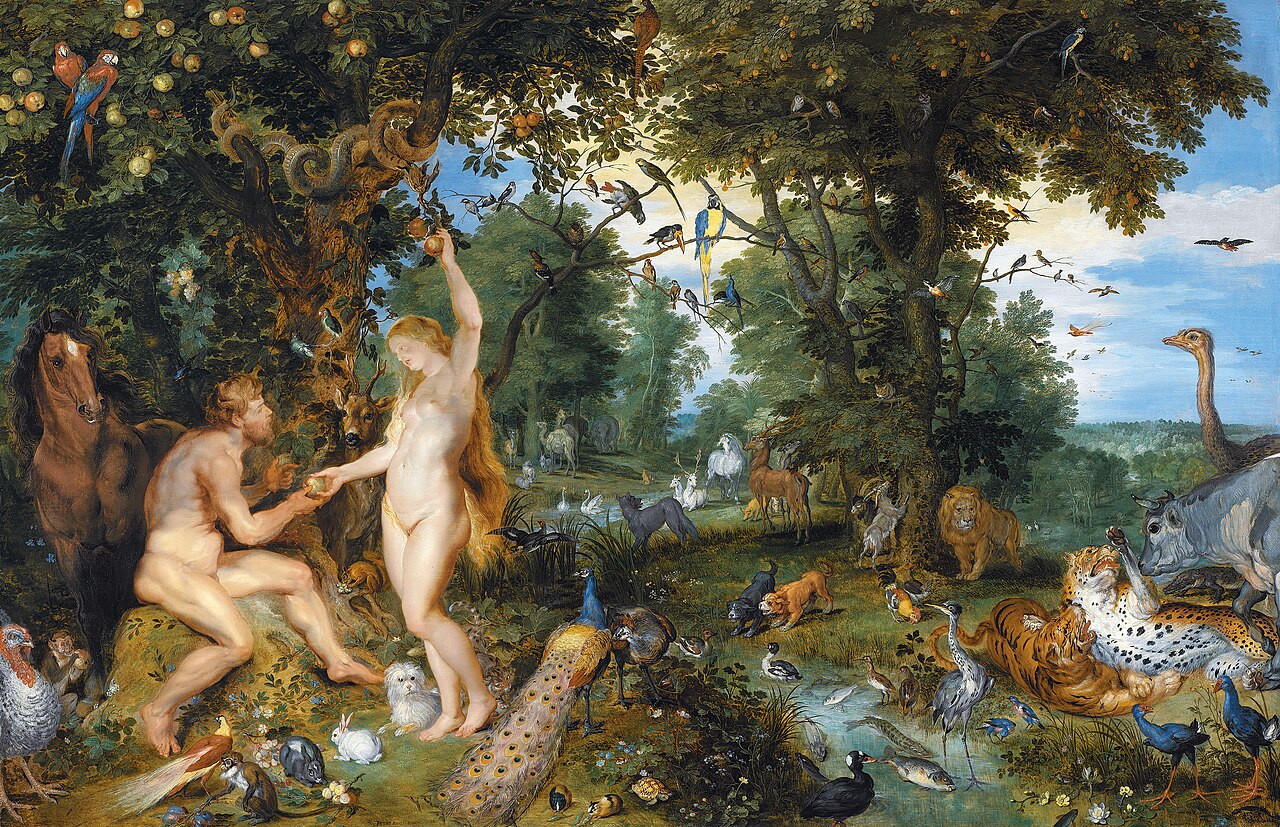
God plants a garden in Eden and places the man there to work it and keep it. A river flows out of Eden and divides into four rivers: the Pishon, the Gihon, the Tigris, and the Euphrates. In the middle of the garden stand two trees: the tree of life, and the tree of the knowledge of good and evil.
The man is free to eat from any tree but one. "Of the tree of the knowledge of good and evil, thou shalt not eat of it." God gives him a partner, the woman, and the two of them live together openly and without shame.
Then the serpent arrives with a question: "Did God really say…?" It promises that eating the fruit will make them like God. The woman eats, gives the fruit to her husband, and he eats. Immediately their eyes are opened, they feel shame, and they hide from God.
God calls out, "Where art thou?" The man blames the woman, and the woman blames the serpent. Consequences follow: pain, toil, conflict, and death. But even here God shows mercy: He clothes them with garments of skin, and He speaks of a future offspring of the woman who will crush the serpent's head. Then they are sent out of the garden, and the way back to the tree of life is guarded.
Can we find Eden on a map?
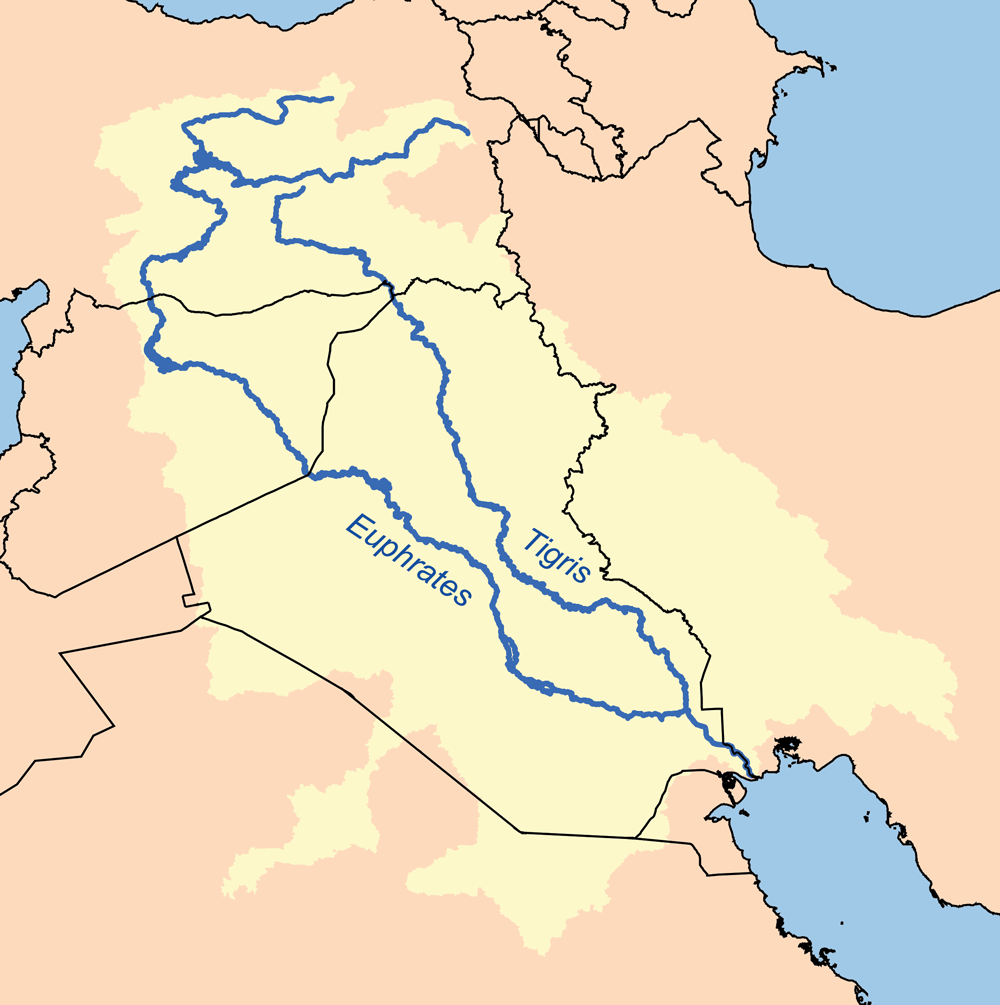
Genesis does something unusual for a story about paradise: it gives geography. Two of the four rivers, the Tigris and the Euphrates, are real rivers that still flow through modern Iraq. That anchors at least part of the Eden account in the ancient Near East.
| River | Identification |
|---|---|
| Tigris | Known Mesopotamian river |
| Euphrates | Known Mesopotamian river |
| Pishon | Uncertain |
| Gihon | Uncertain |
The other two rivers have never been confidently identified. Proposals place Eden in southern Mesopotamia (near the Persian Gulf), in the mountains of eastern Turkey where the Tigris and Euphrates begin, and elsewhere. Some suggest the Flood reshaped the landscape, which would explain why the four-river system no longer matches. Others read Eden as sacred geography, a real place described in a way that points beyond ordinary maps.
Echoes in other ancient stories
Mesopotamian literature also tells of divine gardens and the loss of immortality. In the Epic of Gilgamesh, the hero finds a plant that restores youth, and a serpent steals it while he bathes. Ancient peoples shared a sense that humanity had lost something, and that death was not how things were meant to be. Genesis gives that loss its own explanation: not divine jealousy or bad luck, but a broken relationship with a good God.
The Case for the Biblical Account
Scripture's account
God places the first humans in a garden, gives one command, and they disobey after the serpent's temptation. They are expelled, and death enters human experience (Genesis 2:8–3:24).
What evidence would we expect?
If Eden was a real place, we might expect geography that matches the four rivers. We might also expect the memory of a lost paradise to echo across ancient cultures.
The discoveries
Two of the four rivers are real and identifiable. Mesopotamian literature shares themes of divine gardens, life-giving plants, serpents, and lost immortality.
Testing the discoveries
The Tigris and Euphrates identification is certain. The Pishon and Gihon are not, so no proposed location has been confirmed. The literary parallels are real but could reflect shared memory or shared symbols.
The strongest reconstruction
Genesis places Eden in the Mesopotamian world, near the Tigris and Euphrates. The precise site cannot be fixed today, possibly because the landscape has changed.
What remains possible
A real place whose geography has changed, a sacred geography pointing to God's presence, or both. That humanity's brokenness began with turning from God is a matter of faith that Christians and Jews have held for millennia.
Adam and Eve: how believers read them
Adam and Eve were the first two human beings, the ancestors of everyone. Paul treats Adam as a real person in Romans 5 and 1 Corinthians 15.
Some believers hold that Adam and Eve were real people chosen by God as the representative heads of humanity, without being the only humans alive. Others read Adam ("human" in Hebrew) as a portrait of every person's story.
Genetic studies of human diversity do not support all humans descending only from one recent pair. How to relate that to Genesis is a live question for theologians. Archaeology cannot settle it either way.
What the evidence shows
- The Tigris and Euphrates are real rivers in Mesopotamia.
- Mesopotamian stories share themes of gardens, serpents, and lost immortality.
- Eden's exact location can be identified. The Pishon and Gihon are unidentified.
- Sin and death entered the world through human disobedience.
Continue the journey
Ancient MysteriesAdapa, Ninti, and Lost ImmortalityDo the Mesopotamian stories of Adapa and of Ninti, "lady of the rib," illuminate Genesis 2–3?More from this lesson
Investigations
Optional deep dives: the ancient sources, the physical evidence, and every interpretation side by side, including unconventional ones, each labeled for what it is.
Adapa, Ninti, and Lost ImmortalityAncient texts: documented · Connection with Genesis: debated
Do the Mesopotamian stories of Adapa and of Ninti, "lady of the rib," illuminate Genesis 2–3?
Adapa, a wise man, refuses heaven's bread and water of life and so remains mortal. In the Sumerian myth of Enki and Ninhursag, a goddess named Ninti heals Enki's rib, a pun that may echo Eve, made from a rib and named "mother of all living." Both comparisons are real; both need care.
Open the full investigation →Echoes Across Civilizations
Optional: how other ancient peoples told similar stories. Open one to compare, then come back to the lesson.
Paradise and lost immortalitySumer · Babylon
Did other cultures remember a garden, a tree of life, or immortality lost?
- Sumer: Enki and Ninhursag Shared literary world
- Babylon: The Myth of Adapa Shared literary world
- Babylon: Epic of Gilgamesh, Tablet XI Shared literary world
Why this matters to the rest of Scripture
- The "first gospel": the woman's offspring will crush the serpent's head.
- Paul contrasts Adam's disobedience with Christ's obedience.
- "As in Adam all die, even so in Christ shall all be made alive."
- The tree of life returns, beside a river flowing from God's throne.
Sources to explore
Overviews are a starting point. Each links onward to the primary sources and specialist studies behind it.