Era 2 · The Family of AbrahamGenesis
Pharaoh's Dreams
Seven fat cows, seven lean, and a prisoner made ruler
Two full years pass. Then Pharaoh dreams. Seven sleek, fat cows come up out of the Nile and graze among the reeds. Seven ugly, gaunt cows come up after them and eat them, and look no better for it. He sleeps again and dreams of seven full ears of grain swallowed by seven thin ears scorched by the east wind.
None of Egypt's magicians and wise men can interpret it. Then the cupbearer remembers: "I do remember my faults this day." Joseph is rushed from the prison. He shaves, changes his clothes, and stands before Pharaoh. "It is not in me: God shall give Pharaoh an answer of peace."
The two dreams are one. Seven good years of great plenty are coming, and after them seven years of famine so severe the plenty will be forgotten. The dream is doubled "because the thing is established by God." Then Joseph, unasked, gives advice: appoint a wise man over Egypt, collect a fifth of the harvest in the good years, store the grain in the cities under Pharaoh's authority.
"Can we find such a one as this is, a man in whom the Spirit of God is?" Pharaoh puts his signet ring on Joseph's hand, dresses him in fine linen, puts a gold chain around his neck, has him ride in his second chariot, and men cry before him, "Abrech!" He gives Joseph an Egyptian name, Zaphnath-paaneah, and a wife, Asenath, daughter of Potipherah, priest of On. Joseph is thirty: thirteen years since he was sold.
In the seven good years Joseph gathers grain "as the sand of the sea" until they stop counting. His two sons are born: Manasseh, "God hath made me forget all my toil," and Ephraim, "God hath caused me to be fruitful in the land of my affliction." Then the famine comes, "and all countries came into Egypt to Joseph for to buy corn."
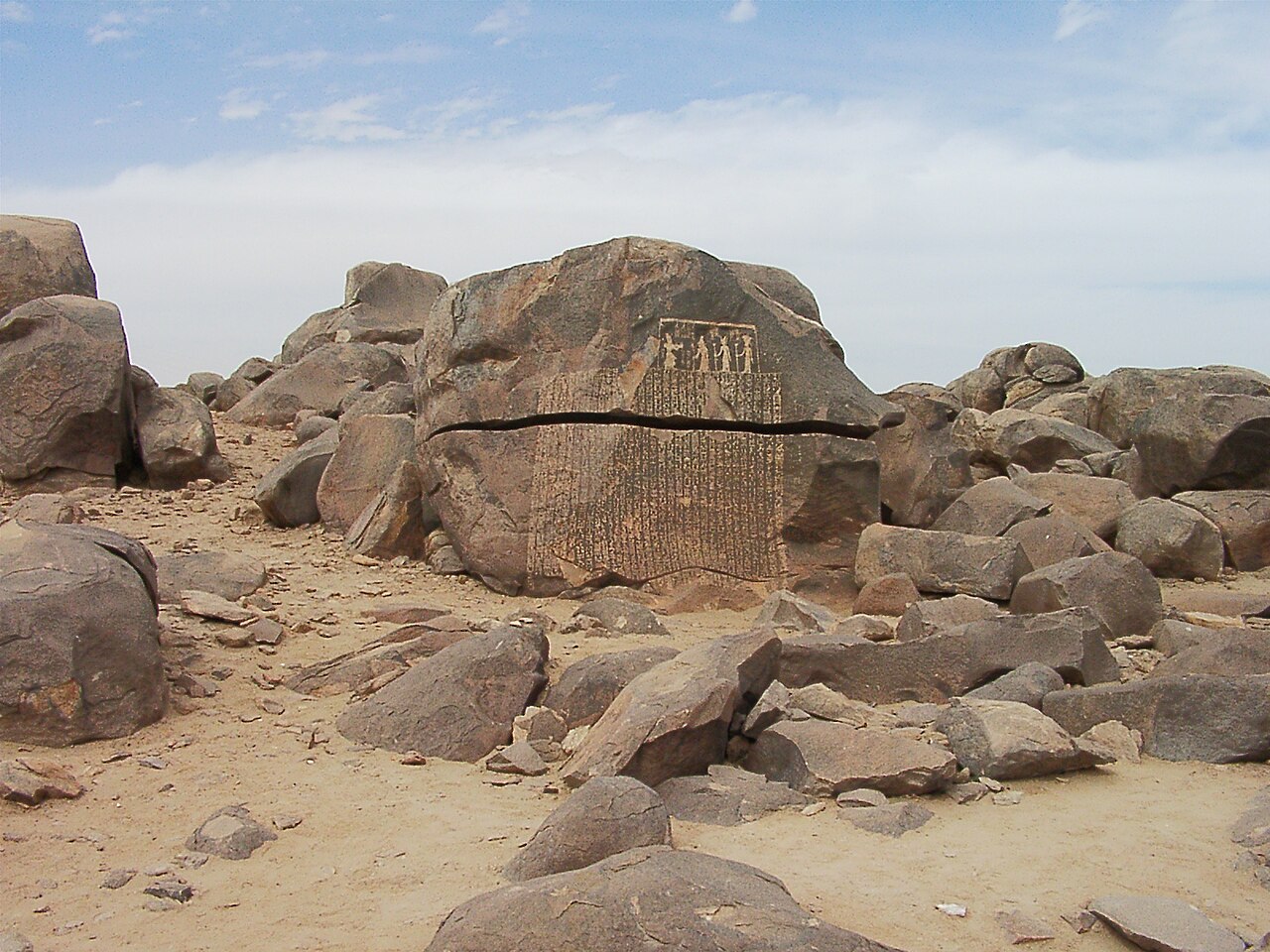
Egypt lived by the Nile
Egypt's harvest depended on the yearly Nile flood. A low flood meant famine, and Egyptian texts from many periods describe hunger after failed floods. The Famine Stela on Sehel Island tells of seven years of low Niles under King Djoser (about 2650 BC), ended when the king honored the god Khnum. The inscription was carved more than two thousand years after Djoser, in the Ptolemaic period, and is not a record of Joseph's famine, but it shows that "seven years of famine" was a known Egyptian theme.
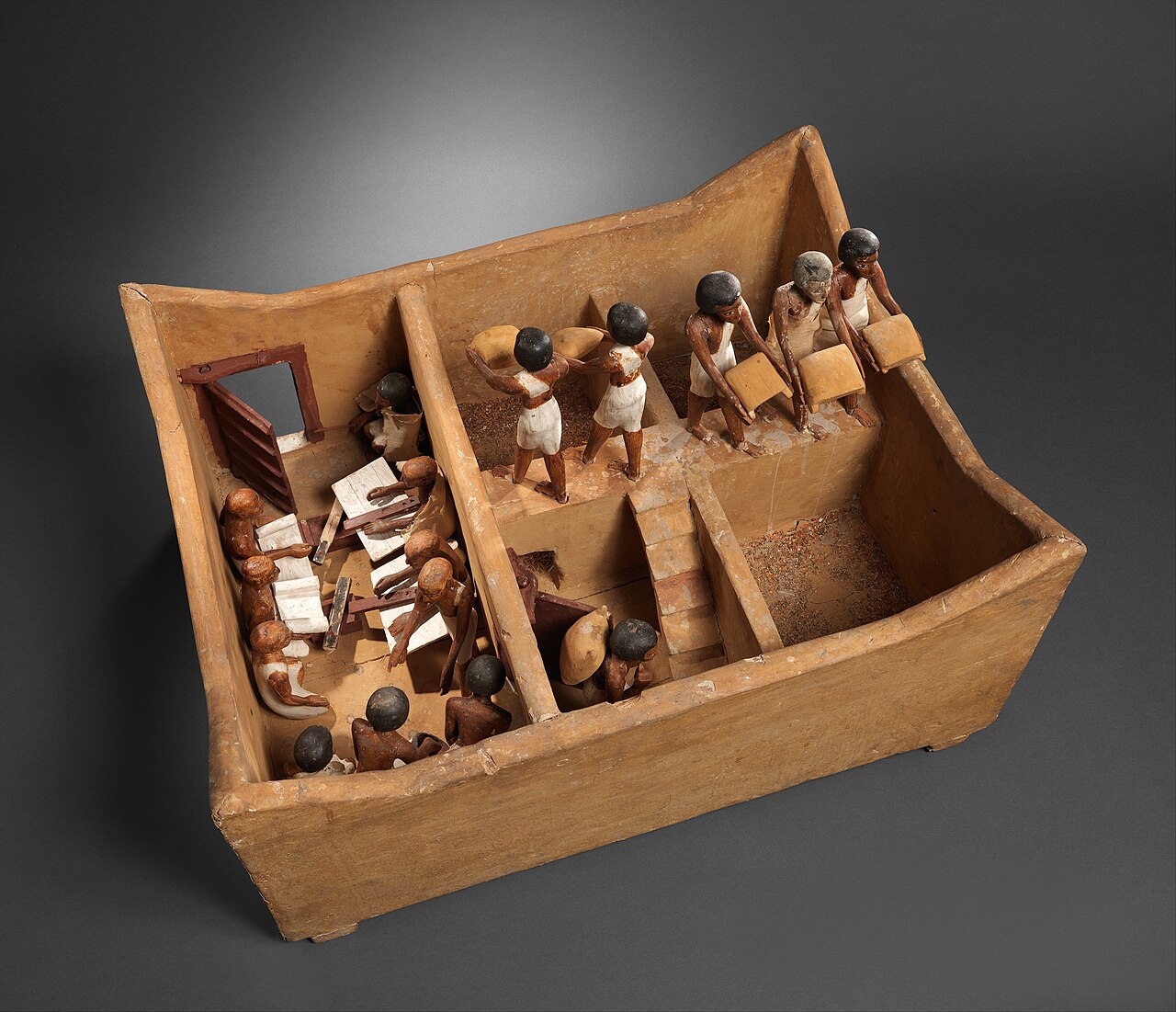
Granaries and scribes
Egyptian administrators stored grain in large state and temple granaries, and scribes recorded every measure. Wooden tomb models, like the granary from the tomb of Meketre (about 1980 BC), show workers carrying sacks while scribes keep the accounts. Joseph's role, an official over food storage, matches a real Egyptian office.
Egyptian details in the story
- The "magicians" (hartummim) take their title from an Egyptian word for lector-priests, experts in sacred texts.
- Joseph shaves before meeting Pharaoh: Egyptian men were clean-shaven, unlike the bearded Levantines in the Beni Hasan painting.
- Investiture with a ring, linen and gold collar matches Egyptian scenes of officials rewarded with the "gold of honor."
- On is Heliopolis, the great sun-temple city near modern Cairo.
- Joseph rides a chariot. Chariots reached Egypt during the Second Intermediate Period (about 1650–1550 BC), which matters for dating the story.
The Case for the Biblical Account
Scripture's account
Joseph interprets Pharaoh's dreams, becomes chief minister, and stores grain for seven years of famine (Genesis 41).
What evidence would we expect?
Nile-driven famines; state grain storage; foreigners rising to high office; Egyptian titles and names in the story.
The discoveries
Famine texts and the Famine Stela tradition; granary models and records; foreigners in high positions (and later the Hyksos, Levantine rulers of northern Egypt); Egyptian loanwords and court customs throughout the chapter.
Testing the discoveries
No famine of exactly seven years matching Joseph has been identified, and no record names him. The Egyptian names Zaphenath-paneah, Asenath and Potiphera have name forms that some Egyptologists date mainly to the first millennium BC.
The strongest reconstruction
The chapter shows detailed knowledge of Egyptian life. Scholars disagree on whether that knowledge reflects the second millennium BC, the first millennium BC, or an old story retold with later details.
What remains possible
A Levantine official in Middle Bronze Age Egypt; a remembered rise later described in the language of later Egypt; or a later literary work. See the next panel.
When does Joseph's story fit Egypt? Three positions
James Hoffmeier and Kenneth Kitchen argue that the court titles, customs and slave price fit the second millennium BC, and that later-looking names may have been updated by later scribes. A Levantine official in the period of Levantine rule in the Delta (Hyksos) or just before is plausible.
Egyptologist Nili Shupak (2025) argues the story began as an oral tradition from the mid- or late second millennium about a Semite who rose to power in Egypt, was written down in the early first millennium, and was edited later. This rejects the idea that it is simply a late novel.
Donald Redford and Bernd Schipper argue that the Egyptian names, titles and literary motifs best fit the first millennium BC, with Schipper pointing to Persian-period Egypt, where Judean communities lived.
Note the distinction our site keeps throughout: when the events are placed in biblical chronology is one question; when the written story reached its present form is another. An account can describe an earlier event even if its surviving wording is later.
What the evidence shows
- Egypt suffered famines when the Nile flood failed.
- Egypt stored grain in state granaries under scribal administration.
- The Famine Stela records Joseph's famine. It was composed in the Ptolemaic period about King Djoser.Source: The Famine Stela on Sehel Island (Ptolemaic period), in M. Lichtheim, Ancient Egyptian Literature III
- The Joseph story's Egyptian details fit the second millennium BC.Source: J. K. Hoffmeier, Israel in Egypt: The Evidence for the Authenticity of the Exodus Tradition (Oxford, 1997), ch. 4; K. A. Kitchen, On the Reliability of the Old Testament (Eerdmans, 2003), ch. 7; B. U. Schipper, "The Egyptian Background of the Joseph Story," Hebrew Bible and Ancient Israel 8 (2019) ↗
- The Joseph story preserves an older oral tradition later written and edited. Shupak 2025; a recent argument within this debate.Source: N. Shupak, "The Joseph Story (Genesis 37–50) from an Egyptological Perspective: Multilayered Story or Exilic Novella?" JAOS (2025) ↗
- Joseph's specific famine and Pharaoh have been identified.
Continue the journey
Echoes Across CivilizationsSeven years of famineDid other ancient texts speak of seven years of famine and of storing grain against them?More from this lesson
Echoes Across Civilizations
Optional: how other ancient peoples told similar stories. Open one to compare, then come back to the lesson.
Seven years of famineEgypt · Babylon · Ugarit
Did other ancient texts speak of seven years of famine and of storing grain against them?
- Egypt: The Famine Stela Similar human experience
- Babylon: Epic of Gilgamesh, Tablet VI Shared literary world
- Ugarit: The Epic of Aqhat Shared literary world
Why this matters to the rest of Scripture
- God "gave him favour and wisdom in the sight of Pharaoh king of Egypt."
- "The king sent and loosed him… He made him lord of his house."
- Daniel, like Joseph: "there is a God in heaven that revealeth secrets."
Sources to explore
- N. Shupak, "The Joseph Story (Genesis 37–50) from an Egyptological Perspective: Multilayered Story or Exilic Novella?" JAOS (2025) ↗
- B. U. Schipper (with others), The Joseph Story between Egypt and Israel (Mohr Siebeck, 2021, open access) ↗
Overviews are a starting point. Each links onward to the primary sources and specialist studies behind it.