John 7:53–8:11
The woman caught in adultery
One of the most loved stories about Jesus is missing from the earliest manuscripts of John and appears in different places in later ones.
Disputed addition: some witnesses include it, some do not
The family tree
Each row is a language or text tradition. Witnesses in the same row may share ancestry, revise one another, or have an uncertain relationship; the line under each box says which. A solid arrow appears only where direct copying or a documented revised edition is established. Order by date never implies copying. Scroll sideways on a phone.
✓ includes the disputed words · ✕ does not include them · ❝ quotes part of them · ⓘ reports on manuscripts · ▢ pages lost · – no copy survives
- Copied or printed directly
- Revised edition (documented)
- Same line, through lost copies
- Translation
- Modern edition based on it
- Uncertain connection
- John's original Gospelc. AD 90–100
- Papyrus 66c. AD 200Descends, through lost copies, from John's original Gospel
- Papyrus 75c. AD 175–225Descends, through lost copies, from John's original Gospel
- Codices Sinaiticus and Vaticanus4th centuryDescends, through lost copies, from John's original Gospel
- Codex Bezae (D)c. AD 400Descends, through lost copies, from John's original Gospel
- Codex Alexandrinus5th centuryDescends, through lost copies, from John's original Gospel
- Family 13 and others11th–15th centuryDescends, through lost copies, from John's original Gospel
Every witness, in order
c. AD 90–100
John's original Gospel
The original does not survive.
c. AD 200
Papyrus 66
How the site knows this: Reported in scholarship; not checked by the site.
One of the oldest copies of John. It goes straight from 7:52 to 8:12.
c. AD 175–225
Papyrus 75
How the site knows this: Reported in scholarship; not checked by the site.
Another very early copy of John, also without the story.
3rd century
Didascalia Apostolorum
How the site knows this: Reported in scholarship; not checked by the site.
A church manual that tells how Jesus dealt mercifully with a woman who had sinned, showing the story circulated early, though it does not say where it was found.
4th century
Codices Sinaiticus and Vaticanus
How the site knows this: Reported in scholarship; not checked by the site.
Neither contains the story.
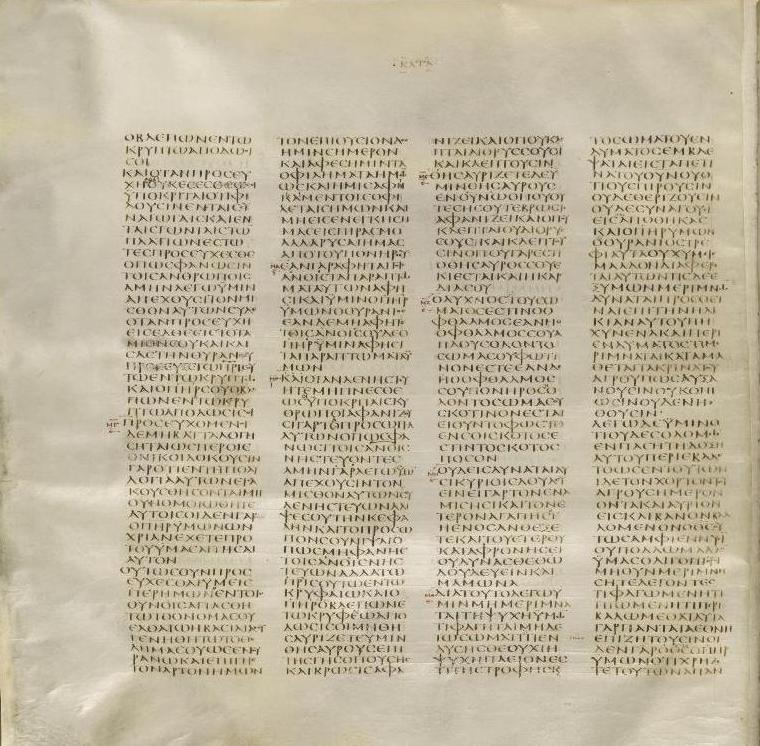
Historical manuscriptImage credit Pictured: a page of Matthew in Sinaiticus.
c. AD 400
Codex Bezae (D)
How the site knows this: Reported in scholarship; not checked by the site.
The earliest surviving Greek manuscript that contains the story, in its familiar place in John 7–8.
c. AD 400
Jerome's Vulgate
How the site knows this: Read in the site's library text: Clementine Vulgate (1592 edition).
Jerome included it, saying he found it in many Greek and Latin copies. Augustine suggested some had removed it, fearing it would seem to excuse adultery.
c. 5th century
Syriac Peshitta
How the site knows this: Reported in scholarship; not checked by the site.
The standard Syriac Bible originally lacked the story.
5th century
Codex Alexandrinus
The pages for this part of John are lost, but counting the space on the missing leaves suggests the story was not included.
11th–15th century
Family 13 and others
How the site knows this: Reported in scholarship; not checked by the site.
Some manuscripts place the story after Luke 21:38; others after John 7:36 or at the end of John. A story that moves around suggests it circulated on its own before settling in John.
1516
Erasmus' Greek New Testament
How the site knows this: Reported in scholarship; not checked by the site.
Erasmus printed the story in John, as found in the medieval Greek manuscripts he used in Basel.
Source: Andrew J. Brown, ed., Novum Testamentum ab Erasmo recognitum, Opera Omnia of Erasmus (ASD VI-1 to VI-4, 2008–2013); Basel University Library manuscripts Erasmus used, digitized (e-manuscripta.ch) ↗
1516–1633
Received Text (Textus Receptus)
How the site knows this: Reported in scholarship; not checked by the site.
The printed Greek editions that grew out of Erasmus' work (Stephanus 1550, Beza), all including the story.
1611
King James Bible
How the site knows this: Read in the site's library text: King James Version (1769 text).
Includes it as part of John without comment, following the printed Received Text.
today
Modern Bibles
How the site knows this: Checked in a published edition.
Nearly all still print it, in brackets or with a note that the earliest manuscripts do not have it.
What changed, and why
Most textual scholars conclude the passage was not part of John's original Gospel. Many also think it records a genuine early tradition about Jesus, which is why churches kept it and why translators keep printing it.
What the evidence shows
- The earliest manuscripts of John (P66, P75, Sinaiticus, Vaticanus) lack the passage.
- Codex Bezae (c. 400) is the earliest Greek manuscript to include it.
- The story preserves a genuine early tradition about Jesus.
- John wrote it as part of his Gospel.
Source: Metzger, Textual Commentary on the Greek NT, 2nd ed. (1994), pp. 187–189
Sources
- Metzger, A Textual Commentary on the Greek New Testament, 2nd ed. (1994)
- Knust & Wasserman, To Cast the First Stone (2019)
Related lessons
- Why Our Bibles Differ Today →Why Catholic and Protestant Bibles have different books, why modern Bibles have footnotes, and why translations read differently.