Nehemiah 12:10–11, 22
Jaddua and "Darius the Persian"
The high-priest list runs Jeshua, Joiakim, Eliashib, Joiada, Jonathan (Johanan), Jaddua, and 12:22 records priests "to the reign of Darius the Persian." The list reaches decades, possibly a century, after Nehemiah. The library's Greek chapter 12 is shorter and differently numbered.
Manuscript variant: witnesses differ in wording
The family tree
Each row is a language or text tradition. Witnesses in the same row may share ancestry, revise one another, or have an uncertain relationship; the line under each box says which. A solid arrow appears only where direct copying or a documented revised edition is established. Order by date never implies copying. Scroll sideways on a phone.
✓ contains it · ✕ does not · ❝ quotes part of it · ⓘ reports on manuscripts · ▢ pages lost · – no copy survives
- Same line, through lost copies
- Translation
- Related (shared ancestry)
Every witness, in order
407 BC
Elephantine petition (Aramaic papyrus)
How the site knows this: Reported in scholarship; not checked by the site.
Names "Johanan the high priest" in Jerusalem. Edition not collated by the site.
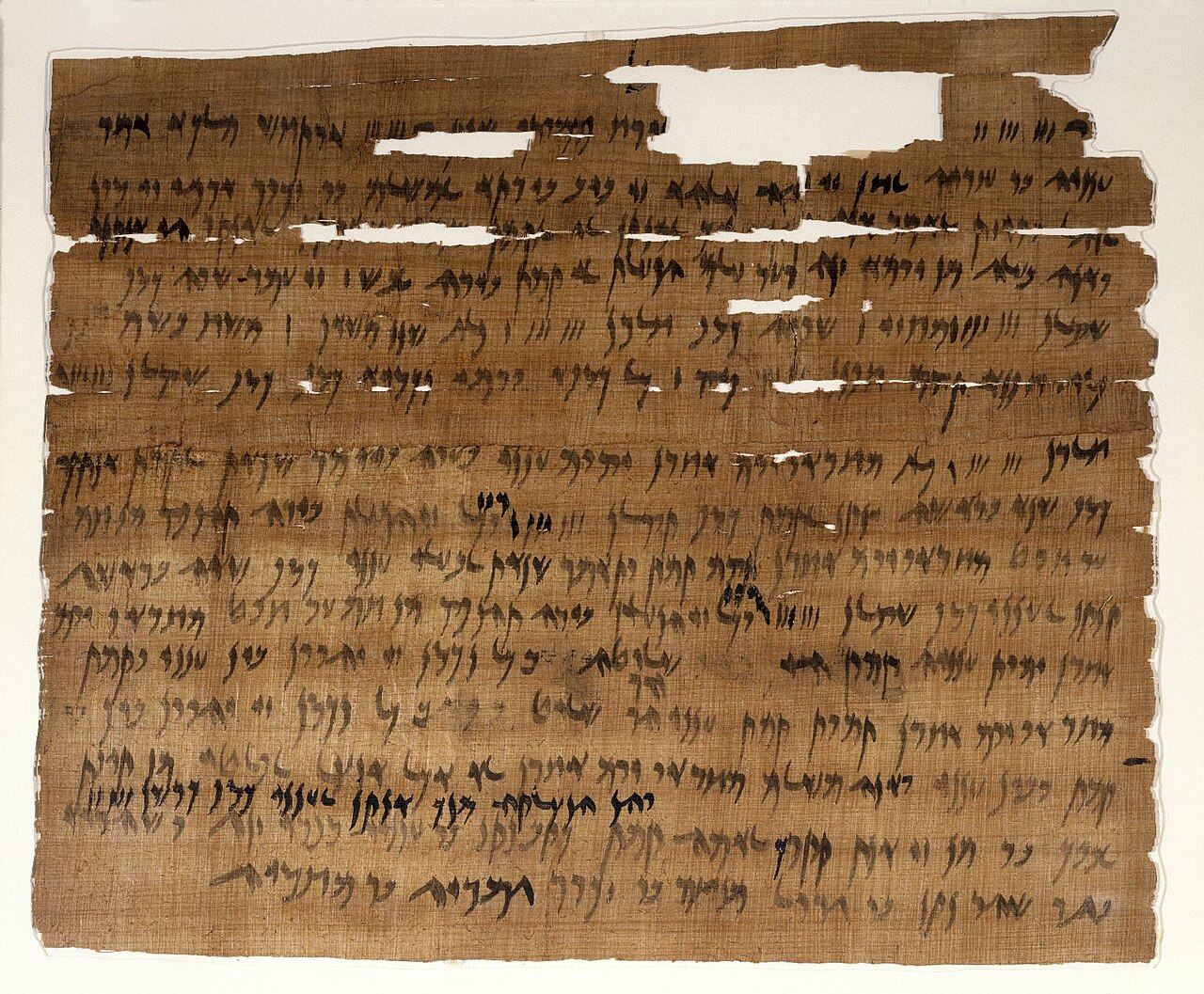
Historical manuscriptImage credit Source: A. E. Cowley, Aramaic Papyri of the Fifth Century B.C. (1923), nos. 30–32 (the temple petition; not collated by the site); B. Porten and A. Yardeni, Textbook of Aramaic Documents from Ancient Egypt, vol. 1 (1986): A4.7–A4.9 (not collated by the site)
Memoir c. 430 BC; book compiled c. 400–300 BC (debated)
Original Ezra–Nehemiah
No original survives. No Qumran fragment of Nehemiah has been identified.
Translated c. 2nd century BC or later
Greek 2 Esdras 11–23 (library text: Giguet's French)
How the site knows this: Known here only through a translation.
(12:11) Et Joad engendra Jonathas, et Jonathas engendra Jadu.
The library's Greek chapter 12 lacks several verses (e.g. 12:4–6) and runs about one verse behind the Hebrew numbering near the end. Greek 2 Esdras via Giguet's French; not checked against a critical Greek edition.
c. AD 400
Jerome's Vulgate (2 Esdras = Nehemiah)
How the site knows this: Read in the site's library text: Clementine Vulgate (1592 edition).
sacerdotes in regno Darii Persæ
AD 1008
Masoretic Text (Leningrad Codex)
How the site knows this: Read in the site's library text: Westminster Leningrad Codex, a digital transcription of the Leningrad Codex.
בִּימֵי אֶלְיָשִׁיב יוֹיָדָע וְיוֹחָנָן וְיַדּוּעַ… עַל־מַלְכוּת דָּרְיָוֶשׁ הַפָּרְסִי
in the days of Eliashib, Joiada, Johanan and Jaddua… to the reign of Darius the Persian
1611
King James Bible
How the site knows this: Read in the site's library text: King James Version (1769 text).
in the days of Eliashib, Joiada, and Johanan, and Jaddua… to the reign of Darius the Persian
What changed, and why
If Johanan was high priest in 407 BC and Josephus' Jaddua met Alexander in 332 BC, the list runs into the late Persian period, and "Darius the Persian" may be Darius III (336–330 BC). Alternatively Darius II (423–405 BC). Josephus' story of Jaddua and Alexander is widely regarded as legendary. The list shows record-keeping continued after Nehemiah.
What the evidence shows
- Johanan was high priest in 407 BC.
Source: A. E. Cowley, Aramaic Papyri of the Fifth Century B.C. (1923), nos. 30–32 (the temple petition; not collated by the site)
- "Darius the Persian" is Darius III.
Sources
- Josephus, Jewish Antiquities 11.159–183 (Nehemiah), 11.297–347 (Sanballat, Jaddua and Alexander)
- A. E. Cowley, Aramaic Papyri of the Fifth Century B.C. (1923), nos. 30–32 (the temple petition; not collated by the site)
Related lessons
- Priests, Processions and the Wall Dedication →Lists of priests and Levites who came with Zerubbabel and Jeshua, the high priests from Jeshua to Jaddua, and the priestly heads under Joiakim. Then the dedication of the wall: Levites and singers are gathered, priests purify themselves, the people, the gates and the wall, and two great thanksgiving choirs walk in opposite directions on the wall, meeting at the temple. Women and children rejoice. Officers are appointed over the storerooms.
- Investigation: Sanballat, Bagohi and the Elephantine Archive →In 407 BC the Jewish garrison at Elephantine wrote to Bagohi, governor of Judah, asking help to rebuild their temple, destroyed in 410. They mention Johanan the high priest in Jerusalem and Delaiah and Shelemiah, sons of Sanballat, governor of Samaria. These are contemporary documents naming people from Nehemiah's world, a generation later. They do not mention Nehemiah, and Bagohi is not Nehemiah.