Siduri's speech in the Old Babylonian Gilgamesh (early 2nd millennium BC) and Ecclesiastes 9:7–9 give the same advice in nearly the same order: food and joy, clean clothes, washing or oil, the wife in one's embrace, all because death is the human lot. A second parallel, the three-ply rope (Ecclesiastes 4:12), appears in the Sumerian Bilgamesh and Huwawa. But the Siduri advice is missing from the Standard Babylonian epic copied in the 1st millennium BC, centuries before Ecclesiastes. So: borrowing, shared tradition, or coincidence of human experience?
Parallel: documented (Old Babylonian tablet) · Direct borrowing: not demonstrable · Shared motif: best supported · Exact wording: C check (EC-C08)
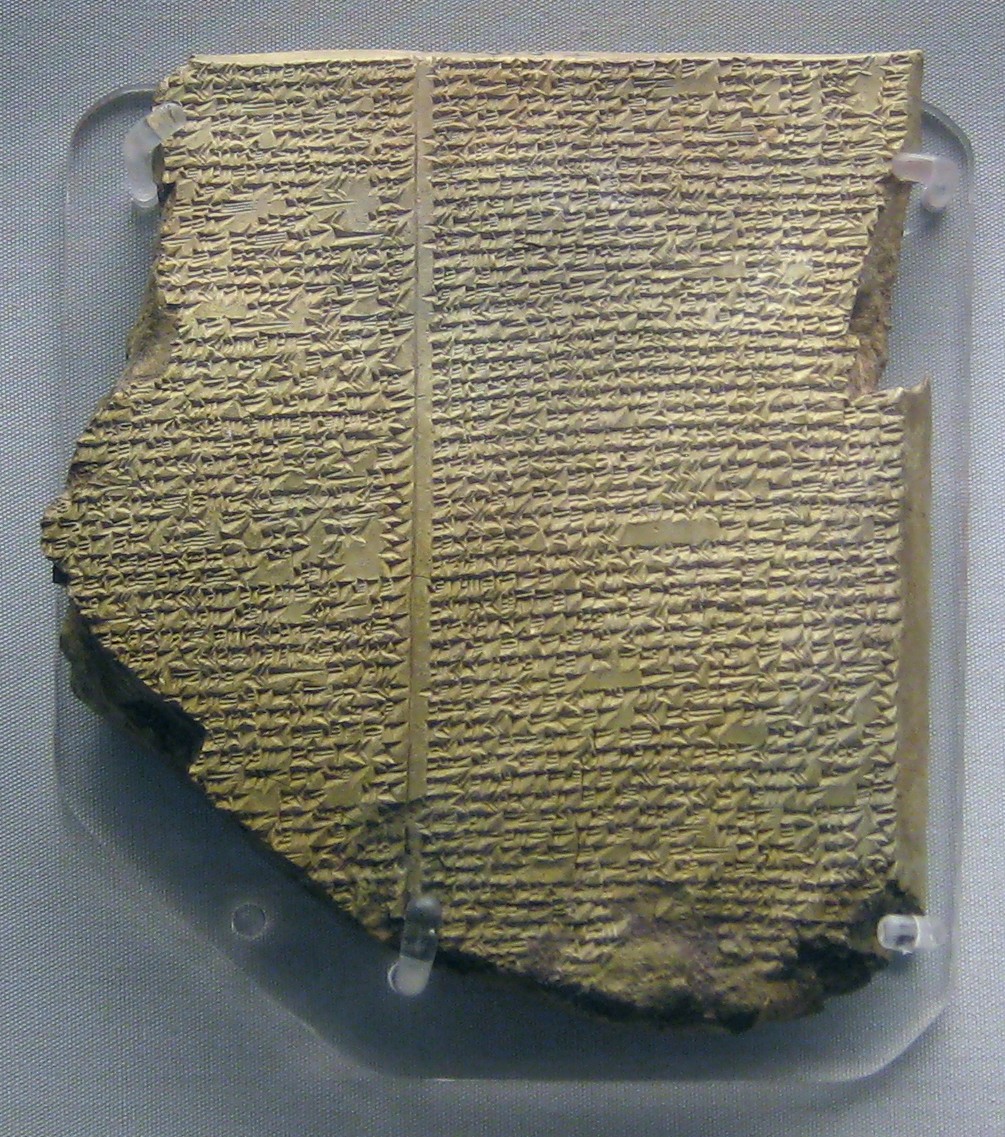
Authentic ancient artifactThe Flood Tablet (Gilgamesh, Tablet XI), 7th century BC, British Museum.Image credit
1 What Scripture says
"Go thy way, eat thy bread with joy, and drink thy wine with a merry heart; for God now accepteth thy works. Let thy garments be always white; and let thy head lack no ointment. Live joyfully with the wife whom thou lovest all the days of the life of thy vanity" (Ecclesiastes 9:7–9).
2 What evidence we might expect
If Ecclesiastes borrowed from Gilgamesh, the Siduri passage should have been available in the author's time and place, and the wording should match beyond what a common motif explains.
If the two share a widespread motif, similar advice should appear in other cultures (Egypt, Greece) and in forms not tied to the Gilgamesh story.
3 What ancient sources survive
Gilgamesh, Old Babylonian version (Sippar tablet)
Language
Akkadian
Composed
Early 2nd millennium BC
Oldest surviving copy
The Sippar tablet (Meissner fragment), Old Babylonian period
Status
Not scripture
Contains Siduri's advice to enjoy life (paraphrased on the site).
Gilgamesh, Standard Babylonian version, Tablet X
Language
Akkadian
Composed
Late 2nd millennium BC (attributed to Sin-leqi-unninni)
Oldest surviving copy
1st-millennium BC tablets, especially from Nineveh (7th century BC)
Status
Not scripture
The Siduri scene is retold, but her advice to enjoy life is absent.
Bilgamesh and Huwawa (Sumerian), version A
Language
Sumerian
Composed
Early 2nd millennium BC or earlier
Oldest surviving copy
Old Babylonian school tablets
Status
Not scripture
Contains the saying that a three-ply rope cannot be cut (paraphrased).
Ecclesiastes
Language
Hebrew
Composed
Most scholars: c. 450–250 BC (tradition: Solomon)
Oldest surviving copy
4Q109, mid-2nd century BC (reported); complete in the Leningrad Codex (AD 1008)
Status
Scripture (Jewish and Christian)
4 What discoveries exist
The Old Babylonian Siduri passage became known in the early 20th century when the Sippar tablet was published (B. Meissner, 1902); commentators soon noticed its likeness to Ecclesiastes 9:7–9. A. R. George's critical edition (2003) gathers the Gilgamesh manuscripts and shows that the Standard Babylonian Tablet X lacks the advice.
Egyptian harpers' songs (Middle and New Kingdom) and Greek lyric and Epicurean sayings urge enjoyment because of death as well, which shows the motif was international.
5 How interpretations compare
Scholarly reconstruction
Shared motif, no direct borrowing
Ecclesiastes and Siduri draw on a long, widespread tradition of "enjoy life in view of death," which circulated in many forms in the ancient Near East.
Evidence offered: The same motif in Egypt and Greece; the Siduri advice absent from the 1st-millennium epic; no evidence of the Old Babylonian text in Persian- or Hellenistic-period Judah.
Assessment: Best supported. It explains the likeness without requiring an unknown route of transmission.
Some form of the Siduri tradition survived in oral or written wisdom and reached Judean scribes, perhaps through Aramaic.
Evidence offered: The closeness of the sequence (food, clothes, washing, wife) in both texts.
Assessment: Possible, but no intermediate text is known.
Alternative explanation
Direct literary borrowing
The author of Ecclesiastes read the Old Babylonian Gilgamesh.
Evidence offered: Similar sequence of ideas.
Assessment: Unlikely: the passage is not known to have circulated in the 1st millennium BC, and the wording differs.
Traditional reading
Reception: Ecclesiastes' distinctive frame
Jewish and Christian readers have stressed that Ecclesiastes grounds joy in God's gift ("God now accepteth thy works") and places it before God's judgment (11:9; 12:14), which the Babylonian text does not.
Assessment: A real difference of the texts, whatever their relationship.
6 The strongest supported reconstruction
Most likely, a Judean sage used a motif as old as Mesopotamian and Egyptian literature, answering mortality with present joy, and set it inside Israel's faith in God as giver and judge.
7 What remains possible or unknown
Whether any form of Siduri's advice circulated in the 1st millennium BC.
Exact relationship of the three-ply-rope saying to the Sumerian poem.
The precise wording and line numbers of both parallels (C check EC-C08).
8 How this material came to us
Gilgamesh was rediscovered in the 19th century from the Nineveh tablets; the Old Babylonian tablets followed. Ecclesiastes was copied continuously in Hebrew from the 2nd century BC (Qumran) to the medieval Masoretic codices. The two traditions were brought together only by modern scholarship.
What the evidence shows
Independently documentedSiduri's advice to enjoy life appears in the Old Babylonian Gilgamesh.
Source: A. R. George, The Babylonian Gilgamesh Epic: Introduction, Critical Edition and Cuneiform Texts (Oxford, 2003)
Strongly supportedThe Standard Babylonian Gilgamesh lacks Siduri's advice.
Source: A. R. George, The Babylonian Gilgamesh Epic: Introduction, Critical Edition and Cuneiform Texts (Oxford, 2003)
DisputedEcclesiastes 9:7–9 was copied from Gilgamesh. A shared motif is better supported.