1 John 5:7–8
The three that bear record in heaven
The King James wording includes a clear statement of the Trinity that is absent from early Greek manuscripts. Here is how it entered the text.
Disputed addition: some witnesses include it, some do not
The family tree
Each row is a language or text tradition. Witnesses in the same row may share ancestry, revise one another, or have an uncertain relationship; the line under each box says which. A solid arrow appears only where direct copying or a documented revised edition is established. Order by date never implies copying. Scroll sideways on a phone.
✓ includes the disputed words · ✕ does not include them · ❝ quotes part of them · ⓘ reports on manuscripts · ▢ pages lost · – no copy survives
- Copied or printed directly
- Revised edition (documented)
- Same line, through lost copies
- Translation
- Modern edition based on it
- Uncertain connection
- Priscillian, Liber Apologeticusc. AD 380Uncertain relationship to a Latin comment or tradition in Spain
- Early Vulgate manuscripts6th–8th centuryDescends, through lost copies, from Jerome's Vulgate (c. AD 400)
- Later Vulgate manuscripts9th century onwardDescends, through lost copies, from Early Vulgate manuscripts
Side by side
- Early Greek manuscripts
- For there are three that testify: the Spirit, the water, and the blood; and these three agree.
- King James Bible (1611)
- For there are three that bear record in heaven, the Father, the Word, and the Holy Ghost: and these three are one. And there are three that bear witness in earth, the Spirit, and the water, and the blood: and these three agree in one.
Every witness, in order
c. AD 90–110
Original letter of 1 John
The original does not survive.
4th–5th century
Sinaiticus, Vaticanus, Alexandrinus
How the site knows this: Reported in scholarship; not checked by the site.
For there are three that testify: the Spirit, the water, and the blood; and these three agree.
The early Greek text, without the added words about the Father, the Word, and the Holy Spirit. This is the reading of essentially all Greek manuscripts for over a thousand years.
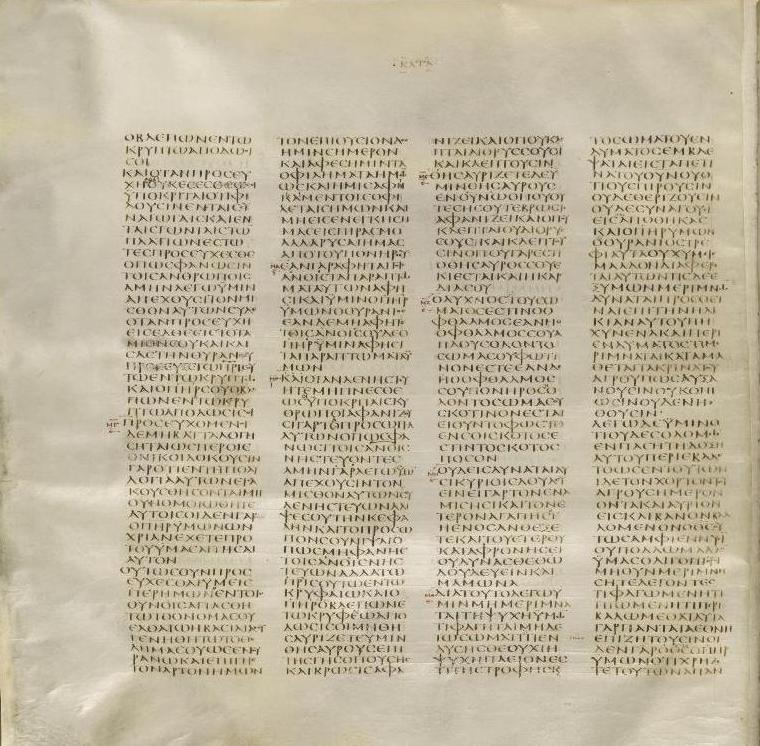
Historical manuscriptImage credit Pictured: a page of Matthew in Sinaiticus.
c. AD 380
Priscillian, Liber Apologeticus
How the site knows this: Reported in scholarship; not checked by the site.
The earliest clear appearance of the added words, in a Latin writer in Spain. They may have begun as a comment explaining the passage.
6th–8th century
Early Vulgate manuscripts
How the site knows this: Reported in scholarship; not checked by the site.
The oldest Vulgate manuscripts, such as Codex Fuldensis (546) and Codex Amiatinus (c. 700), do not have the added words in the text.
9th century onward
Later Vulgate manuscripts
How the site knows this: Reported in scholarship; not checked by the site.
In heaven: the Father, the Word, and the Holy Spirit…
From the 9th century (for example Codex Cavensis), the added words appear in Latin copies and became standard in the medieval Western church.
1516 and 1519
Erasmus' Greek New Testament
How the site knows this: Reported in scholarship; not checked by the site.
Erasmus printed the Greek without the added words, because the later Greek manuscripts he used in Basel (for these letters, chiefly a 12th-century copy now called GA 2815) lacked them. He did not use Sinaiticus, Vaticanus, or Alexandrinus.
Source: Andrew J. Brown, ed., Novum Testamentum ab Erasmo recognitum, Opera Omnia of Erasmus (ASD VI-1 to VI-4, 2008–2013); Basel University Library manuscripts Erasmus used, digitized (e-manuscripta.ch) ↗
c. 1520
Codex Montfortianus (GA 61)
How the site knows this: Reported in scholarship; not checked by the site.
A Greek manuscript copied around 1520, probably in England. It is the source Erasmus used for the added words in 1522.
1522
Erasmus' third edition
How the site knows this: Reported in scholarship; not checked by the site.
In heaven: the Father, the Word, and the Holy Spirit…
A revision of his earlier editions. After criticism, Erasmus added the words in 1522, taking them from a Greek manuscript produced around 1520 (Codex Montfortianus, GA 61), whose wording appears to have been translated from the Latin. Only about eight or nine Greek manuscripts, all late and several in the margin, have them.
1522–1633
Received Text (Textus Receptus)
How the site knows this: Reported in scholarship; not checked by the site.
The later printed Greek editions (Stephanus 1550, Beza) kept the words from Erasmus' third edition.
1611
King James Bible
How the site knows this: Read in the site's library text: King James Version (1769 text).
For there are three that beare record in heauen, the Father, the Word, and the holy Ghost: and these three are one. And there are three that beare witnesse in earth, the Spirit, and the Water, and the blood, and these three agree in one.
Translated from the printed Received Text editions, which kept the words.
today
Modern Bibles
How the site knows this: Checked in a published edition.
For there are three that testify: the Spirit, the water and the blood; and the three are in agreement.
Translate the early Greek text and mention the added words in a footnote.
What changed, and why
Almost all scholars, including those who hold firmly to the Trinity, agree the added words were not part of 1 John. They seem to have begun in Latin as an explanatory reading and only entered Greek printed Bibles in the 1500s.
What the evidence shows
- The added words are absent from Greek manuscripts before the late Middle Ages.
Source: Metzger, Textual Commentary on the Greek NT, 2nd ed. (1994), pp. 647–649
- They first appear in Latin around AD 380.
- Erasmus added them in his 1522 edition.
- The doctrine of the Trinity depends on this verse. The doctrine was taught and defined long before the words appeared.
Sources
- Metzger, A Textual Commentary on the Greek New Testament, 2nd ed. (1994)
- Metzger & Ehrman, The Text of the New Testament, 4th ed. (2005)
Related lessons
- Why Our Bibles Differ Today →Why Catholic and Protestant Bibles have different books, why modern Bibles have footnotes, and why translations read differently.
- Gutenberg, Tyndale, and the King James Bible →The printing press, the Reformation, and translators willing to die for it put the Bible into ordinary hands.