Genesis 46:27
Seventy or seventy-five? Jacob's family in Egypt
The Hebrew counts seventy people of Jacob's house in Egypt. The Greek Septuagint counts seventy-five, and so does Stephen in Acts 7:14, and a Dead Sea Scroll of Exodus 1:5.
Manuscript variant: witnesses differ in wording
The family tree
Each row is a language or text tradition. Witnesses in the same row may share ancestry, revise one another, or have an uncertain relationship; the line under each box says which. A solid arrow appears only where direct copying or a documented revised edition is established. Order by date never implies copying. Scroll sideways on a phone.
✓ contains it · ✕ does not · ❝ quotes part of it · ⓘ reports on manuscripts · ▢ pages lost · – no copy survives
- Same line, through lost copies
- Translation
- Related (shared ancestry)
- Modern edition based on it
How the counts are built
- Hebrew (70)
- 66 who came with Jacob (46:26) + Joseph + his 2 sons + Jacob himself = 70.
- Greek (75)
- Joseph's line counts 9 instead of 2, by including five grandsons and great-grandsons named in the Greek of 46:20.
- Why it matters
- Neither number is a mistake in arithmetic. They count different people. Stephen used the Bible his hearers read.
Every witness, in order
Unknown (debated)
Original Genesis
No original survives.
Translated c. 250 BC
Septuagint
How the site knows this: Reported in scholarship; not checked by the site.
The sons of Joseph born to him in Egypt were nine souls. All the souls of the house of Jacob who came into Egypt were seventy-five.
In verse 20 the Greek adds five descendants of Manasseh and Ephraim (Machir, Gilead, Shuthelah, Tahan and Edom), so Joseph's line counts nine and the total becomes 75. The Greek also has 75 at Exodus 1:5 (but 70 at Deuteronomy 10:22).
1st century BC
4QExod-b (4Q13), at Exodus 1:5
How the site knows this: Reported in scholarship; not checked by the site.
…seventy-five persons…
A Hebrew scroll from Qumran Cave 4. At Exodus 1:5, which repeats the count, it reads seventy-five, like the Greek. This shows the number 75 existed in Hebrew manuscripts, not only in translation.
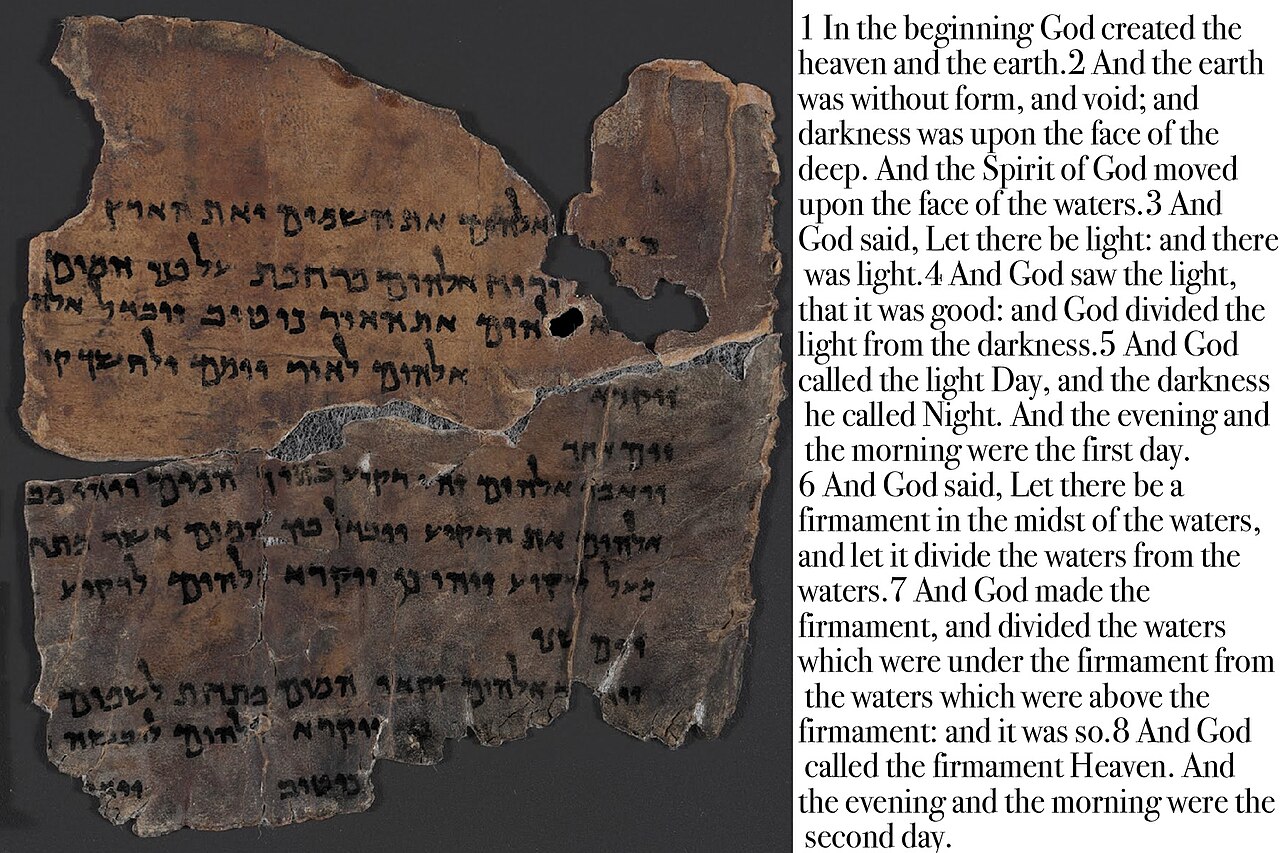
Historical manuscriptImage credit Pictured: a Genesis fragment from Qumran, not 4QExod-b.
Source: E. Ulrich, F. M. Cross et al., Qumran Cave 4.VII: Genesis to Numbers, DJD XII (Oxford, 1994)
c. AD 60–90
Stephen's speech, Acts 7:14
How the site knows this: Read in the site's library text: the Greek New Testament editions in the library (Textus Receptus, Byzantine Textform, Statistical Restoration).
ἐν ψυχαῖς ἑβδομήκοντα πέντε
…all his kindred, threescore and fifteen souls.
Stephen, speaking Greek, follows the Septuagint count of seventy-five.
AD 1008
Masoretic Text (Leningrad Codex)
How the site knows this: Read in the site's library text: Westminster Leningrad Codex, a digital transcription of the Leningrad Codex.
כָּל־הַנֶּפֶשׁ לְבֵית־יַעֲקֹב הַבָּאָה מִצְרַיְמָה שִׁבְעִים
All the souls of the house of Jacob which came into Egypt were seventy.
Seventy here, at Exodus 1:5, and at Deuteronomy 10:22. Verse 27 also counts Joseph's sons as two.
Ancient tradition; medieval copies
Samaritan Pentateuch
How the site knows this: Read in the site's library text: Samaritan Pentateuch, Kennicott's 1780 text digitized by A. Sigalov.
כל הנפש לבית יעקב הבאה מצרימה שבעים
…were seventy.
Agrees with the Masoretic count of seventy.
1611
King James Bible
How the site knows this: Read in the site's library text: King James Version (1769 text).
all the souls of the house of Jacob, which came into Egypt, were threescore and ten.
Seventy in Genesis; seventy-five in Acts, where it translates the Greek.
today
Modern Bibles
How the site knows this: Checked in a published edition.
were seventy in all
Follow the Hebrew; many note the Greek and Qumran reading of seventy-five.
Source: NIV ↗
What changed, and why
This is a real textual difference with a clear explanation: two counting conventions, one including Joseph's later descendants. The Qumran scroll shows that the number 75 was not invented by translators; it existed in Hebrew too.
For readers who ask whether Acts contradicts Genesis: Stephen quotes the Greek Bible accurately, and the Greek Bible counts a larger group. Seventy was also a symbolic number of completeness, matching the seventy nations of Genesis 10.
What the evidence shows
- The Masoretic and Samaritan texts count seventy; the Septuagint counts seventy-five.
- A Qumran Hebrew manuscript of Exodus 1:5 reads seventy-five.
Source: E. Ulrich, F. M. Cross et al., Qumran Cave 4.VII: Genesis to Numbers, DJD XII (Oxford, 1994)
- Acts 7:14 follows the Septuagint's count.
Sources
- E. Ulrich, F. M. Cross et al., Qumran Cave 4.VII: Genesis to Numbers, DJD XII (Oxford, 1994)
- NET Bible translators' note on Genesis 46:27 ↗
- E. Tov, Textual Criticism of the Hebrew Bible, 3rd ed. (Fortress, 2012)
Related lessons
- Joseph Reveals Himself →Joseph reveals himself and forgives his brothers. Jacob's whole family, seventy in the Hebrew count, settles in Goshen, while Joseph's policies bring Egypt's land under Pharaoh.
- Hebrew, Greek, and Samaritan →Three ancient lines of copying, Hebrew, Greek, and Samaritan, let us compare the text and see where it was preserved and where it changed.