Mark 16:9–20
The ending of Mark
The two oldest complete copies of Mark end at 16:8. Most later copies continue to verse 20. Here is the evidence on both sides.
Disputed addition: some witnesses include it, some do not
The family tree
Each row is a language or text tradition. Witnesses in the same row may share ancestry, revise one another, or have an uncertain relationship; the line under each box says which. A solid arrow appears only where direct copying or a documented revised edition is established. Order by date never implies copying. Scroll sideways on a phone.
✓ includes the disputed words · ✕ does not include them · ❝ quotes part of them · ⓘ reports on manuscripts · ▢ pages lost · – no copy survives
- Copied or printed directly
- Revised edition (documented)
- Same line, through lost copies
- Translation
- Related (shared ancestry)
- Modern edition based on it
- Uncertain connection
- Mark's original Gospelc. AD 65–75
- Codex Vaticanus4th century
- Codex Sinaiticusmid-4th centuryDescends, through lost copies, from Mark's original Gospel
- Codex Washingtonianus (W)4th–5th centuryDescends, through lost copies, from Mark's original Gospel
- Codex Alexandrinus5th centuryDescends, through lost copies, from Mark's original Gospel
- Codex Regius (L)8th centuryDescends, through lost copies, from Mark's original Gospel
Every witness, in order
c. AD 65–75
Mark's original Gospel
The original does not survive. How Mark first ended is the question this page examines.
c. AD 170
Tatian's Diatessaron
How the site knows this: Reported in scholarship; not checked by the site.
A harmony that wove the four Gospels into one story. The original is lost; later translations and commentaries of it include material from the longer ending, but how closely they reflect Tatian's own text is debated.
c. AD 180
Irenaeus, Against Heresies 3.10.5
How the site knows this: Reported in scholarship; not checked by the site.
Quotes one verse, Mark 16:19, saying "towards the conclusion of his Gospel, Mark says." He does not quote the whole passage, but it shows that some copies he knew had at least this verse at the end of Mark by the late 2nd century.
c. AD 320; c. 400
Eusebius and Jerome
How the site knows this: Reported in scholarship; not checked by the site.
Eusebius wrote that the accurate copies of Mark ended at 16:8; Jerome later repeated this. Yet Jerome included the longer ending in his Vulgate.
4th century
Codex Vaticanus
How the site knows this: Reported in scholarship; not checked by the site.
Ends at 16:8, but the scribe left an entire blank column after it, the only such gap in its New Testament, which some take as a sign he knew of more text.
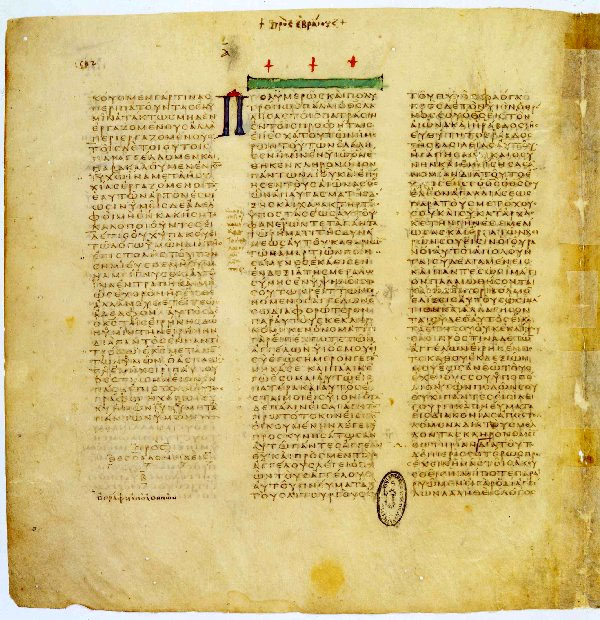
Historical manuscriptImage credit Pictured: a different page of the codex.
mid-4th century
Codex Sinaiticus
How the site knows this: Reported in scholarship; not checked by the site.
Ends Mark at 16:8, followed by a decorative line and the title "According to Mark."
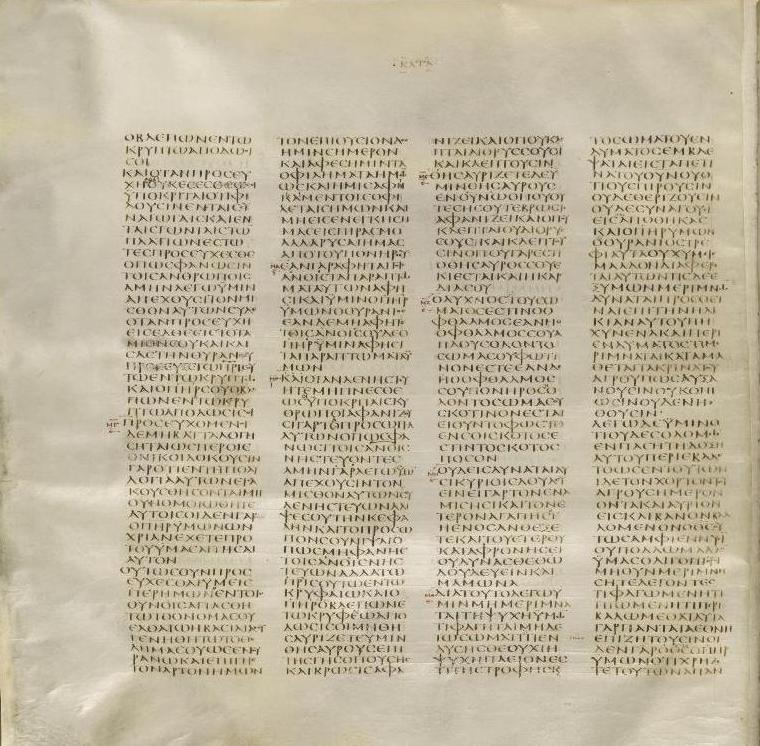
Historical manuscriptImage credit Pictured: a page of Matthew in the same codex.
Source: Codex Sinaiticus online ↗
c. AD 400
Codex Bobbiensis (Old Latin)
How the site knows this: Reported in scholarship; not checked by the site.
Shorter ending only: the women report briefly to Peter, and Jesus sends out through them the proclamation of eternal salvation.
The only manuscript with the "shorter ending" alone, instead of verses 9–20.
c. AD 400
Jerome's Vulgate
How the site knows this: Read in the site's library text: Clementine Vulgate (1592 edition).
Includes 16:9–20. Through the Vulgate, the longer ending was read across Western Christianity for a thousand years.
4th–5th century
Codex Washingtonianus (W)
How the site knows this: Reported in scholarship; not checked by the site.
Includes 9–20 with an extra passage after verse 14, the "Freer Logion," found in no other manuscript.
5th century
Codex Alexandrinus
How the site knows this: Reported in scholarship; not checked by the site.
Includes verses 9–20, as do the large majority of later Greek manuscripts.
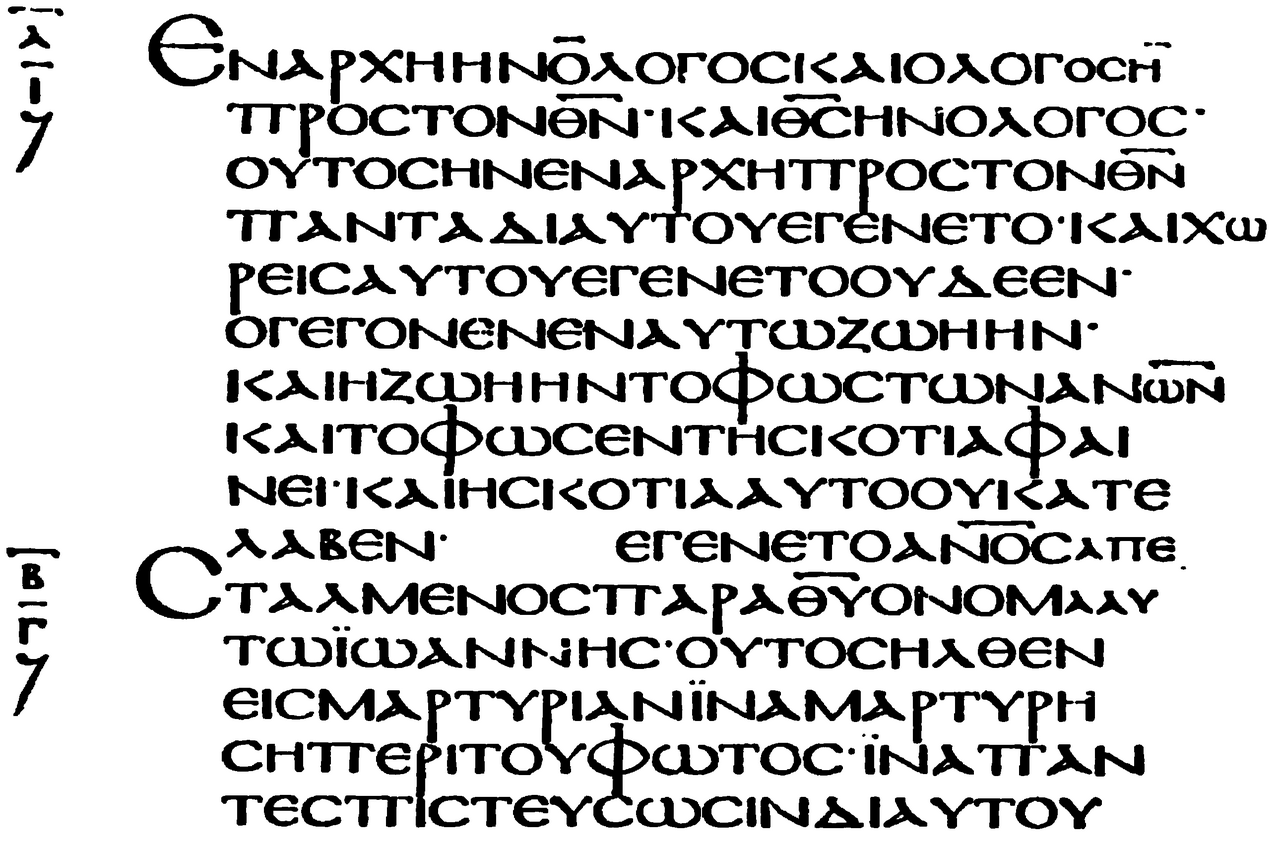
Historical manuscriptImage credit Pictured: the opening of John in the same codex.
8th century
Codex Regius (L)
How the site knows this: Reported in scholarship; not checked by the site.
Gives both the shorter ending and the longer ending, each introduced with a note that some copies have it.
1516
Erasmus' Greek New Testament
How the site knows this: Reported in scholarship; not checked by the site.
The first published Greek New Testament. Erasmus worked mainly from a few medieval Greek manuscripts available in Basel (for the Gospels, chiefly a 12th-century copy now called GA 2), not from the great early codices. Those manuscripts include 16:9–20.
Source: Andrew J. Brown, ed., Novum Testamentum ab Erasmo recognitum, Opera Omnia of Erasmus (ASD VI-1 to VI-4, 2008–2013); Basel University Library manuscripts Erasmus used, digitized (e-manuscripta.ch) ↗
1516–1633
Received Text (Textus Receptus)
How the site knows this: Reported in scholarship; not checked by the site.
The family of printed Greek editions that grew out of Erasmus' work: his later editions, Stephanus (1550), and Beza (1565–1604). The name comes from a 1633 Elzevir edition.
1611
King James Bible
How the site knows this: Read in the site's library text: King James Version (1769 text).
Prints 9–20 as part of Mark without comment. Its New Testament was translated from the printed Received Text editions (chiefly Beza and Stephanus), not from any single ancient manuscript.
today
Modern Bibles (NIV, ESV, NASB)
How the site knows this: Checked in a published edition.
Most still print 9–20 but set them off with brackets or a heading and a note such as: "The earliest manuscripts and some other ancient witnesses do not have verses 9–20." They have not removed the passage.
What changed, and why
Why many scholars think Mark ended at 16:8
- The two oldest complete copies end there.
- Eusebius and Jerome said the best copies they knew ended there.
- The style and vocabulary of 9–20 differ from the rest of Mark.
- Other endings (the shorter ending, the Freer Logion) suggest scribes felt a need to supply one.
Why others defend the longer ending
- Irenaeus quotes verse 19 as coming from the end of Mark's Gospel around AD 180, earlier than any surviving manuscript of Mark 16.
- The vast majority of manuscripts in Greek, Latin, Syriac, and Coptic include it.
- Ending a Gospel with "for they were afraid" seems abrupt; the original ending may have been lost early and these verses preserve early tradition.
- Vaticanus' blank column may show its scribe knew a longer text.
What the evidence shows
- Codex Sinaiticus and Codex Vaticanus end Mark at 16:8.
- Irenaeus quoted Mark 16:19 around AD 180.
- Mark originally ended at 16:8.
Source: Metzger, Textual Commentary on the Greek NT, 2nd ed. (1994), pp. 102–107
Sources
- Metzger, A Textual Commentary on the Greek New Testament, 2nd ed. (1994)
- Black (ed.), Perspectives on the Ending of Mark: Four Views (2008)
- Codex Sinaiticus online ↗
Related lessons
- The Great Codices →Christians adopted the book form early, and in the 4th century produced the first great Bibles bound in single volumes.
- Why Our Bibles Differ Today →Why Catholic and Protestant Bibles have different books, why modern Bibles have footnotes, and why translations read differently.