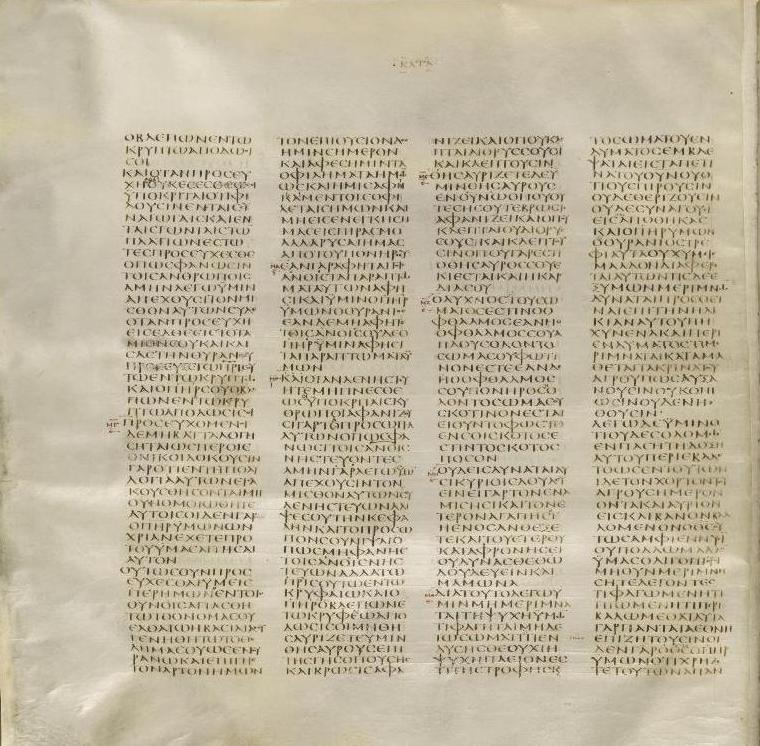
Ancient books were usually scrolls, long strips rolled up on a stick. Early Christians strongly preferred a newer format: the codex, sheets folded and bound together like a modern book. A codex could hold far more, was easier to carry, and let readers flip to a passage.
Once Christianity was legal and supported, churches could afford to produce magnificent full Bibles. Three have survived from the 4th and 5th centuries, written in Greek on parchment made from animal skins.
- Codex Sinaiticus (mid-4th century): the oldest complete New Testament. Found at St. Catherine's Monastery in Sinai in the 1840s–50s; most of it is now in the British Library.
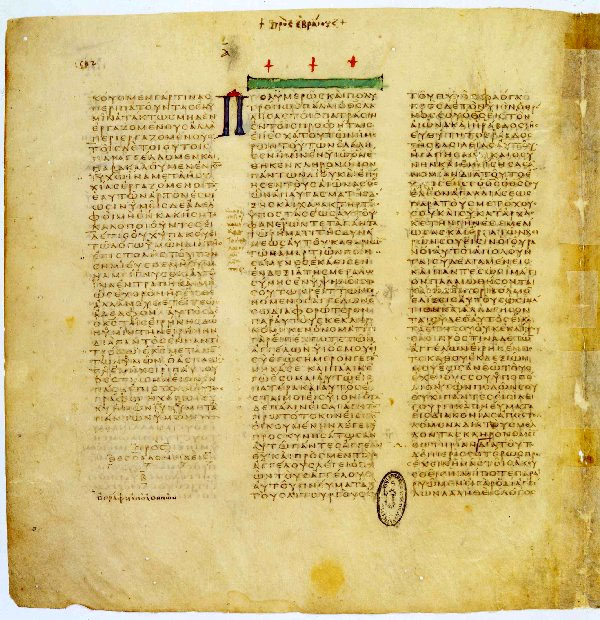
- Codex Vaticanus (4th century): in the Vatican Library since at least the 1400s. One of the most important witnesses to both Testaments, though missing the start of Genesis and the end of the New Testament.
- Codex Alexandrinus (5th century): in the British Library, with nearly the whole Greek Bible.
Surprises inside the codices
These Bibles include a few writings that are not in our New Testament. Codex Sinaiticus ends with the Epistle of Barnabas and part of the Shepherd of Hermas. Codex Alexandrinus includes the letters of Clement. These were respected early writings that were read in some churches but did not become part of the canon.
The ending of Mark
In both Sinaiticus and Vaticanus, the Gospel of Mark ends at 16:8, with the women fleeing the empty tomb, afraid. The longer ending familiar from the King James Bible (16:9–20) is absent. Most later manuscripts include it. Modern Bibles usually print it with a note.
What the evidence shows
- Codex Sinaiticus is the oldest complete surviving New Testament.Source: Codex Sinaiticus online ↗
- The two oldest complete copies of Mark end at 16:8.
- Mark 16:9–20 was part of Mark's original Gospel. Most textual scholars think it was added early; some defend it. See the full evidence in Journey of a Passage.Source: Metzger, Textual Commentary on the Greek NT, 2nd ed. (1994), pp. 102–107; Mark 16:9–20: Journey of a Passage ↗
- Constantine's 50 Bibles included Sinaiticus or Vaticanus. A guess sometimes made; no evidence confirms it.
Continue the journey
Journey of a PassageMark 16:9–20: The ending of MarkThe two oldest complete copies of Mark end at 16:8.More from this lesson
Connections
- Where the oldest complete copies end.
- Why Our Bibles Differ Today →How modern Bibles handle passages like this.
Sources to explore
Overviews are a starting point. Each links onward to the primary sources and specialist studies behind it.