Which Writings Were Scripture?
How the early church recognized the New Testament
In the second century, Christian writings circulated one by one and in small collections. Churches read them aloud in worship alongside the Old Testament, and they were already being treated as Scripture: 2 Peter 3:16 places Paul's letters among "the other scriptures."
Around AD 140, a teacher in Rome named Marcion forced the question. He rejected the Old Testament and its God and accepted only an edited Gospel of Luke and ten of Paul's letters. The church rejected him, and his challenge pushed believers to say clearly which books were theirs.
Other writings appeared too, some called gospels, such as the Gospel of Thomas and the Gospel of Peter. Most came later than the four Gospels and many taught very different ideas about Jesus. Around AD 180, Irenaeus, bishop of Lyon, insisted there are exactly four Gospels, no more and no fewer, and the four-Gospel collection was by then widely received.
How churches decided
- Apostolic: written by an apostle or a close companion of one.
- Ancient: from the first generation, not a later composition.
- Received everywhere: read in churches across the Christian world, not just in one place.
- Faithful: consistent with the teaching handed down from the apostles.
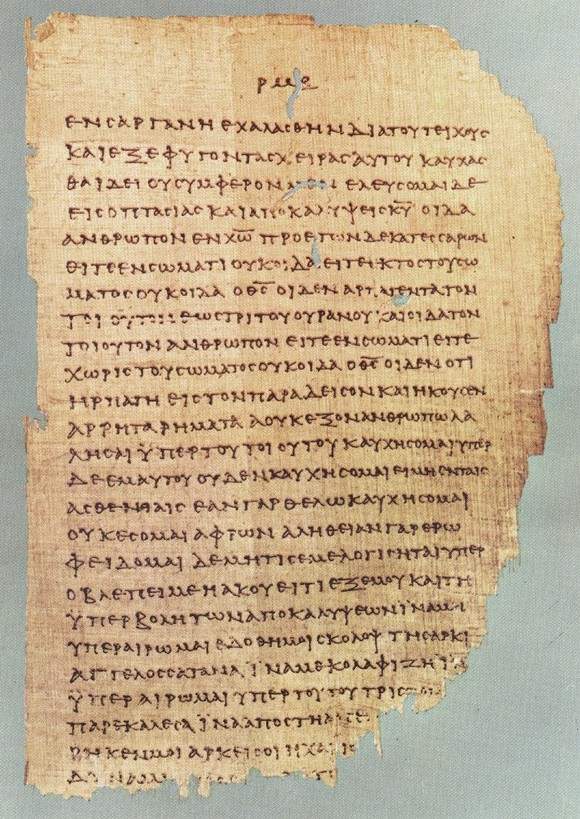
Papyrus 46, from around AD 200, is a single book containing Paul's letters, including Hebrews. It shows Paul's letters were already being collected and copied together as a set.
In the early 300s, the historian Eusebius sorted Christian books into three groups: those accepted everywhere (the four Gospels, Acts, Paul's letters, 1 Peter, 1 John), those disputed by some (James, Jude, 2 Peter, 2 and 3 John), and those rejected. Revelation he placed in both lists, because opinions varied.
What the evidence shows
- By about AD 180 the four Gospels were widely received as a set. Irenaeus; possibly earlier.
- Paul's letters were collected together by about AD 200. Papyrus 46.
- Some books (James, Jude, 2 Peter, Revelation) were debated into the 4th century.Source: Eusebius, Church History 3.25 (New Advent) ↗
- Later gospels such as Thomas were suppressed because they told the true story. There is no evidence for this; most are later and were simply not received by the churches.
Continue the journey
Next in the storyConstantine, Nicaea, and the CanonThe popular story says Constantine picked the books of the Bible at Nicaea.More from this lesson
Connections
- Paul's letters counted among "the other scriptures."
- Letters were read aloud and shared between churches.
- "The faith which was once delivered unto the saints."
Sources to explore
Overviews are a starting point. Each links onward to the primary sources and specialist studies behind it.