Writing the New Testament
Jesus, the apostles, and the first Christian writings
Jesus did not write a book. He taught, healed, gathered disciples, was crucified around AD 30–33, and, his followers testified, rose from the dead. Their Bible was the Jewish Scriptures; there was no New Testament yet.
At first the good news spread by word of mouth: eyewitnesses telling what they had seen and heard. Within about twenty years, Christian writing began, and the earliest pieces are not Gospels but letters. Paul wrote to the churches he had founded between about AD 49 and 62.
Paul's letters preserve even earlier material. In 1 Corinthians 15:3–7, written around AD 55, he passes on a summary he had "received": Christ died for our sins, was buried, was raised on the third day, and appeared to Peter, the Twelve, more than five hundred people, James, and all the apostles. Many scholars, including skeptical ones, date this creed to within a few years of the crucifixion.
Then came the Gospels. Most scholars date Mark to around AD 65–75, Matthew and Luke a little later, and John toward the end of the century. Early tradition connects Mark to Peter's preaching, Luke to Paul's companion, and Matthew and John to apostles. The other letters and Revelation complete the collection, all within about seventy years of Jesus.
How early is early?
| Person | Earliest surviving biography | Gap |
|---|---|---|
| Alexander the Great (d. 323 BC) | Plutarch and Arrian, about AD 100–150 | ~400 years |
| Jesus (d. c. AD 30–33) | Mark, about AD 65–75; Paul's letters from AD 49 | ~20–40 years |
The oldest piece of the New Testament
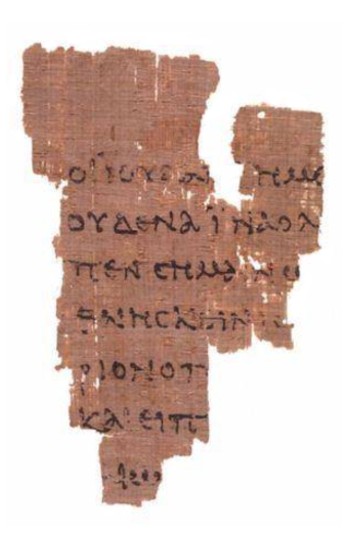
Papyrus 52 is a scrap the size of a credit card, now in Manchester, England, with a few lines of John 18 on each side. It is usually dated to the first half of the 2nd century, though some scholars allow a wider range. It shows John's Gospel was already being copied in Egypt, far from where it was written.
Around AD 120, a church leader named Papias recorded what an elder had told him: that Mark had been Peter's interpreter and wrote down accurately what Peter remembered of Jesus' words and deeds.
Who wrote the Gospels?
Matthew the apostle, Mark the companion of Peter, Luke the physician and companion of Paul, and John the apostle. The early church was unanimous about these names. Mark and Luke were not apostles, an unlikely choice if names were being invented for prestige.
The Gospels are formally anonymous; the titles were attached in the 2nd century. Their authors drew on eyewitness traditions but may not be the named individuals.
The relationship among Matthew, Mark, and Luke (the Synoptic problem). Most scholars think Mark came first and Matthew and Luke used it, with a hypothetical sayings source called "Q." No copy of Q has ever been found.
What the evidence shows
- Paul wrote letters to churches in the AD 50s. Seven letters are accepted by nearly all scholars.
- The creed in 1 Corinthians 15 predates Paul's letter.
- Mark was written first and used by Matthew and Luke. The majority view, not unanimous.
- "Q" existed as a written document. A reconstruction; no manuscript survives.
- Jesus rose from the dead. The early belief is documented; the event itself is a matter of faith.
Continue the journey
Next in the storyWhich Writings Were Scripture?Churches read the apostles' writings in worship, defended them against rivals, and gradually agreed on the books we call the New Testament.More from this lesson
Connections
- The earliest summary of the gospel.
- Luke says he "traced the course of all things accurately from the first" using eyewitness accounts.
- "These are written, that ye might believe."
Sources to explore
Overviews are a starting point. Each links onward to the primary sources and specialist studies behind it.