The Seven Sages and the Watchers: Who Brought Knowledge to Humanity?
Mesopotamian tradition remembered seven apkallu, wise beings who came before the Flood and taught humanity the arts of civilization. Specialists have argued that 1 Enoch's Watchers are a deliberate Jewish reversal of this tradition: the same idea of heavenly teachers before the Flood, but judged rather than honored.
Ancient traditions: documented · Literary connection: argued by specialists · Identity of the beings: unknown
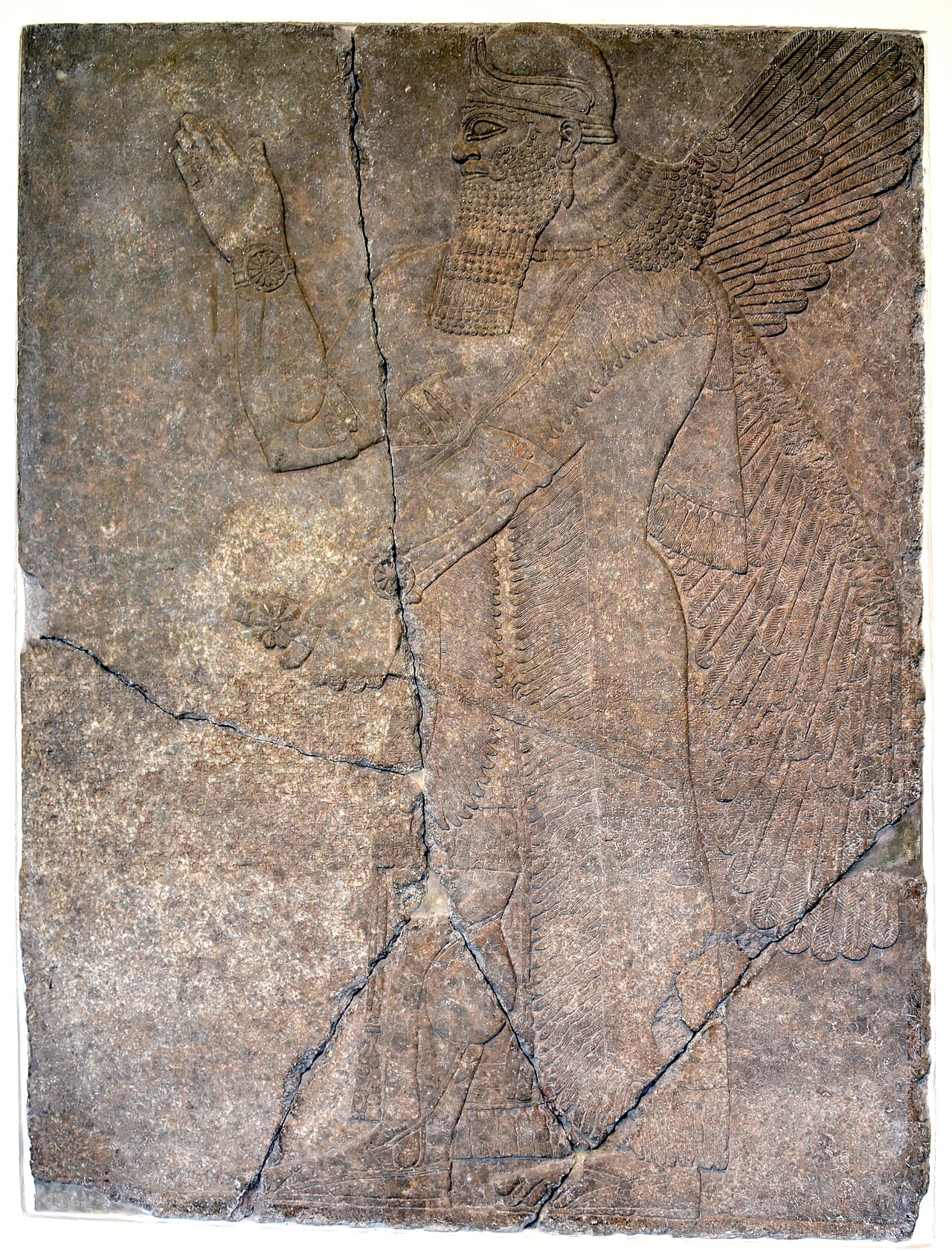
Authentic ancient artifactA winged apkallu sage from the palace of Ashurnasirpal II at Nimrud, 9th century BC (Pergamon Museum, Berlin).Image credit
1 What Scripture says
Genesis credits the first arts of civilization to humans: Cain builds a city, Jabal herds livestock, Jubal plays the lyre and pipe, Tubal-cain forges bronze and iron (Genesis 4:17–22). No heavenly teacher appears. Enoch, the seventh from Adam, "walked with God" (5:24).
2 What evidence we might expect
Mesopotamian texts naming antediluvian sages and their teachings.
Images whose identification is supported by inscriptions or ritual texts.
Clues that Jewish writers knew these traditions.
3 What ancient sources survive
Uruk List of Kings and Sages
Language
Akkadian
Composed
Seleucid period copy of older tradition
Oldest surviving copy
Clay tablet from Uruk dated 165 BC (W 20030,7)
Pairs each king before the Flood with an apkallu, beginning with Uan-Adapa, and then lists post-Flood sages.
Bit Meseri and other ritual texts
Language
Akkadian
Composed
1st millennium BC
Oldest surviving copy
Neo-Assyrian tablets
Name the seven sages and prescribe figurines of them buried as household protectors.
Berossus, Babyloniaca
Language
Greek
Composed
c. 290–278 BC
Oldest surviving copy
Quoted by later writers (Alexander Polyhistor, Eusebius, George Syncellus)
Describes Oannes, a fish-man who rose from the sea and taught humanity letters, sciences and every craft.
4 What discoveries exist
Assyrian palaces, especially Ashurnasirpal II's at Nimrud (9th century BC), were lined with reliefs of protective figures: some with fish-skin cloaks, others winged or bird-headed, holding a cone and bucket. Ritual texts describing figurines of the seven sages allow scholars to identify some of these figures as apkallu. Clay apkallu figurines have also been excavated from foundation deposits.
Apkallu and Watchers
Time
Both: the age before the Flood.
Nature
Apkallu: semi-divine sages, sometimes fish-like. Watchers: heavenly beings (angels).
Teaching
Apkallu: the arts of civilization, writing, building, rituals. Watchers: metalworking, weapons, cosmetics, spells, astrology.
Apkallu: later sages are part human. Watchers: their giant offspring are destroyed.
5 How interpretations compare
Scholarly reconstruction
A Jewish reversal of Babylonian lore
Amar Annus and Helge Kvanvig argue that the Enochic writers knew Babylonian sage traditions and inverted them: the revered teachers of Babylon become fallen Watchers, and Enoch, not the apkallu, becomes the true sage who received wisdom from God.
Source: A. Annus, "On the Origin of Watchers: A Comparative Study of the Antediluvian Wisdom in Mesopotamian and Jewish Traditions," JSP 19 (2010); H. S. Kvanvig, Primeval History: Babylonian, Biblical, and Enochic (Brill, 2011)
Alternative explanation
Shared memory
Some readers suggest both traditions remember real people of exceptional knowledge in the earliest civilizations.
Assessment: Possible in principle; no evidence identifies such individuals.
Modern speculative theory
Ancient astronauts
Fish-men from the sea and winged teachers are read as visitors in suits or craft who taught technology.
Assessment: The reliefs are ritual protective images from the 9th century BC, thousands of years after the age they depict; they are not eyewitness portraits.
6 The strongest supported reconstruction
Mesopotamia did preserve a tradition of pre-Flood sages who brought civilization, and Jewish Enochic literature has strong, specific links to it. The best-supported explanation is literary and cultural contact, with the Jewish writers reshaping the story in light of Genesis.
7 What remains possible or unknown
How early the seven-sages tradition is.
Through what route Jewish scribes learned it (the Babylonian exile is the leading candidate).
8 How this material came to us
Mesopotamian scribal and ritual tradition → Assyrian palace art (9th–7th centuries BC) → Seleucid Uruk lists and Berossus' Greek history (3rd–2nd centuries BC) → contemporaneous Jewish Enochic writings.
What the evidence shows
Independently documentedMesopotamian texts describe seven sages before the Flood who taught civilization.
Strongly supportedSome Assyrian palace reliefs depict apkallu. Based on ritual texts describing their figurines.
Strongly supportedThe Watchers story was shaped in conversation with the apkallu tradition.
Source: A. Annus, "On the Origin of Watchers: A Comparative Study of the Antediluvian Wisdom in Mesopotamian and Jewish Traditions," JSP 19 (2010); H. S. Kvanvig, Primeval History: Babylonian, Biblical, and Enochic (Brill, 2011)
Not independently verifiedThe apkallu and the Watchers were the same beings.