Investigation: Two Ancient Jeremiahs
A longer Hebrew book, a shorter Hebrew book behind the Greek, and the Qumran fragments that hold both
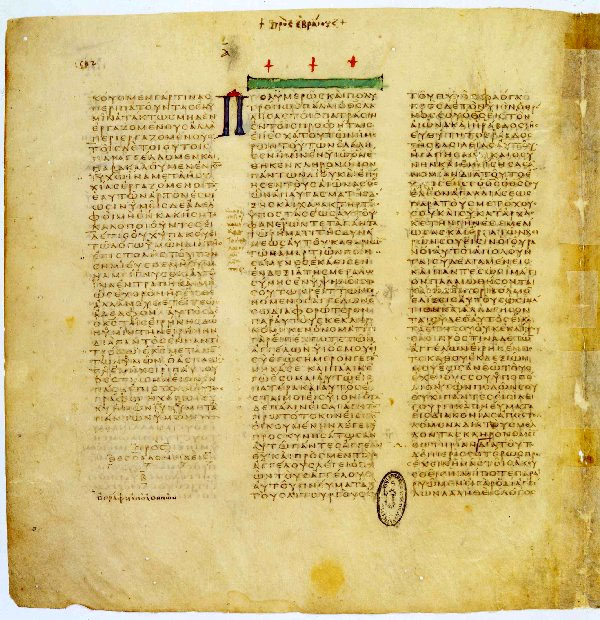
Open an English Bible and an edition of the Greek Septuagint side by side at Jeremiah 25 and they part company. The Hebrew continues with the cup of wrath for the nations (25:15–38) and the stories of chapters 26–45; the Greek turns straight to oracles against Elam, Egypt, Babylon and the rest, which the Hebrew keeps until chapters 46–51. Throughout the book the Greek also lacks words, verses and whole passages that the Hebrew has: 10:6–8 and 10, 33:14–26, most of 39:4–13, and much more.
In 1952–56, fragments of six Jeremiah scrolls were found in Qumran Caves 2 and 4. Several agree with the Masoretic Text. But 4QJer-b (and, by many accounts, the small fragment 4QJer-d) were reconstructed by their editors with the shorter form and order the Greek translated. Hebrew scribes, before the Christian era, copied both.
| Section | Hebrew (Masoretic) order | Greek (Old Greek) order | Note |
|---|---|---|---|
| Call and early oracles | 1:1–25:13 | 1:1–25:13 | Same order; the Greek shorter in many places |
| Oracles against the nations | 46–51 (at the end): Egypt, Philistia, Moab, Ammon, Edom, Damascus, Kedar/Hazor, Elam, Babylon | 25:14–31:44 (in the middle): Elam, Egypt, Babylon, Philistia, Edom, Ammon, Kedar, Damascus, Moab | Different position and different order |
| The cup of wrath | 25:15–38 | 32 (Greek numbering) | In the Greek it follows the oracles it summarizes |
| Narratives and promises | 26–45 | 33–51 (Greek numbering; 45 = Greek 51:31–35) | Same order, Greek numbers higher by seven |
| Historical appendix | 52 | 52 | The Greek lacks 52:27b–30 (the deportation totals), reported |
| Passage | Masoretic Text | Old Greek | What it shows |
|---|---|---|---|
| 10:6–11 | Satire and hymn alternate (vv. 6–8, 10 present) | No vv. 6–8, 10; v. 9 inside v. 5 | Shorter form also in 4QJer-b (reconstructed) |
| 8:10b–12 | Repeats 6:13–15 | No repetition | Doublets typical of the longer edition |
| 27:16–22 | Longer: temple vessels to be carried to Babylon "and there shall they be until the day that I visit them… then will I bring them up" | Shorter; lacks the promise of return (reported) | An expansion that adds hope, or an omission (debated) |
| 33:14–26 | Promise of the righteous Branch, David's line and the Levitical priests | Absent | The longest Masoretic plus; it reuses 23:5–6 |
| 39:4–13 | Zedekiah's flight and blinding; Nebuzaradan's orders | Largely absent | Material parallel to 52 and 2 Kings 25 |
| 51:44b–49a | Present | Absent (reported) | Within the Babylon oracle |
| 52:27b–30 | Deportations of the 7th, 18th and 23rd years (4,600 persons) | Absent (reported) | Material found only in Jeremiah's Hebrew |
| Qumran copy | Date (reported) | What survives | Edition |
|---|---|---|---|
| 4QJer-a (4Q70) | c. 200 BC, among the oldest biblical scrolls | Parts of chapters 7–22 | Masoretic type, with many corrections |
| 4QJer-b (4Q71) | 2nd century BC | Parts of 9:22–10:21 | Reconstructed with the shorter, Greek-type form of chapter 10 |
| 4QJer-c (4Q72) | late 1st century BC | Parts of chapters 4–33 | Masoretic type |
| 4QJer-d (4Q72a) | 2nd century BC | Parts of 43:2–10 | Reported to agree with the Greek in some shorter readings |
| 4QJer-e (4Q72b) | 2nd century BC | Parts of 50:4–6 | Too little to classify securely |
| 2QJer (2Q13) | 1st century AD | Parts of chapters 42–49 | Masoretic type, in Qumran scribal spelling |
Explanation 1: an earlier short edition, later expanded
The most widely held view (J. G. Janzen, 1973; E. Tov and many others) is that the Old Greek translates an earlier Hebrew edition, and that the Masoretic edition is a later, expanded and rearranged revision. The pluses of the Masoretic Text are often of recognizable kinds: fuller names and titles ("Jeremiah the prophet," "Nebuchadnezzar king of Babylon"), repeated passages (6:13–15 = 8:10–12), harmonizations with other books (39 with 52 and 2 Kings), and new promises (33:14–26). The relocation of the oracles against the nations to the end of the book also looks like an editorial decision. Supporters point to 4QJer-b as Hebrew evidence for the shorter edition.
Explanation 2: the shorter text lost material
Some scholars (for example J. R. Lundbom) argue that many Greek minuses arose by accident, especially by haplography (a copyist's eye skipping between similar words), in the Greek translator's Hebrew source or in translation, and that the Masoretic Text often preserves the older wording. On this view the shorter text is shorter for many different reasons, not because it represents one earlier edition.
Explanation 3: parallel growth
Others propose that both editions developed from a common earlier form along separate lines, each with its own additions and arrangement, so that neither is simply the ancestor of the other. Discussions of individual passages often combine these models: one plus may be a late addition, another minus an accident.
What the evidence can and cannot show
The evidence establishes that two forms of Jeremiah were copied in Hebrew before the Christian era; that the Greek is a translation of a shorter Hebrew form, not a free abbreviation of the Masoretic Text; and that the order of the book differed. It cannot establish, from the fragments alone, the full contents of any scroll: 4QJer-b's shorter chapter 10 is a reconstruction from fragments and line lengths, and 4QJer-d is very small. Nor can it settle which edition is "original": the book itself describes a scroll burned and rewritten with "many like words" added (36:32), an image many scholars apply to the book's growth (see "Baruch, Scrolls, and the Scribal World," release 4).
Why it matters
Jewish tradition preserved the longer Masoretic edition; the Greek-speaking churches read the shorter Greek, with Baruch and the Letter of Jeremiah attached; Jerome translated from Hebrew. Hebrews 8:8–12 quotes the new covenant passage from the Greek (Greek chapter 38). Readers today meet the Masoretic edition in most Bibles, sometimes with footnotes from the Greek. Knowing that Jeremiah existed in two editions helps readers understand why ancient quotations and modern footnotes differ, without treating either edition as a mistake.
What the evidence shows
- The Old Greek of Jeremiah is substantially shorter than the Masoretic Text. Estimates vary (roughly one-eighth to one-sixth); not a fixed measurement.Source: E. Tov, Textual Criticism of the Hebrew Bible (3rd ed., 2012), on the two editions of Jeremiah; J. Ziegler, Ieremias, Baruch, Threni, Epistula Ieremiae (Göttingen Septuagint XV, 1957)
- The Greek places the oracles against the nations after 25:13, in a different order.Source: J. Ziegler, Ieremias, Baruch, Threni, Epistula Ieremiae (Göttingen Septuagint XV, 1957)
- 4QJer-b is reconstructed with the shorter form of Jeremiah 10. DJD XV; reconstruction from fragments.Source: E. Ulrich et al., Qumran Cave 4.X: The Prophets (DJD XV, 1997): 4QJer-a to -e
- The Old Greek translates a shorter Hebrew edition. Widely held; some argue for many accidental losses.Source: J. G. Janzen, Studies in the Text of Jeremiah (1973); E. Tov, Textual Criticism of the Hebrew Bible (3rd ed., 2012), on the two editions of Jeremiah
- The Masoretic edition is a later expansion of the shorter one.Source: J. R. Lundbom, Jeremiah 1–20; 21–36; 37–52 (Anchor Yale Bible, 1999–2004)
- The Greek translator abridged the Masoretic Text. The shorter form is attested in Hebrew at Qumran.
- Either edition is the original Jeremiah.
More from this lesson
Why this matters to the rest of Scripture
- A scroll burned and rewritten, with many words added.
- The clearest passage for the two editions.
- The new covenant quoted from the Greek.
- Baruch; Letter of JeremiahBooks attached to Jeremiah in the Greek Bible.