"So Boaz took Ruth, and she was his wife… the LORD gave her conception, and she bare a son." The women say to Naomi: "Blessed be the LORD, which hath not left thee this day without a kinsman… he shall be unto thee a restorer of thy life, and a nourisher of thine old age: for thy daughter in law, which loveth thee, which is better to thee than seven sons, hath born him."
"And Naomi took the child, and laid it in her bosom, and became nurse unto it. And the women her neighbours gave it a name, saying, There is a son born to Naomi; and they called his name Obed: he is the father of Jesse, the father of David."
"Now these are the generations of Pharez: Pharez begat Hezron, and Hezron begat Ram, and Ram begat Amminadab, and Amminadab begat Nahshon, and Nahshon begat Salmon, and Salmon begat Boaz, and Boaz begat Obed, and Obed begat Jesse, and Jesse begat David."
The women's voices
The women of Bethlehem, who asked "Is this Naomi?" in chapter 1, now bless God and name the child. "A son born to Naomi" is the language of family restoration; Naomi is not his biological mother. Ruth is "better than seven sons": the highest praise in Israel.
The genealogy
| Name | Also found in |
|---|---|
| Perez | Genesis 38:29; 46:12 |
| Hezron, Ram, Amminadab | 1 Chronicles 2:5–10 |
| Nahshon | Numbers 1:7 (leader of Judah in the wilderness) |
| Salmah / Salmon | 1 Chronicles 2:11 (Salma); Matthew 1:4–5; Luke 3:32 |
| Boaz, Obed, Jesse, David | 1 Chronicles 2:12–15; 1 Samuel 16 |
The Hebrew spells the name Salmah (שַׂלְמָה) in 4:20 and Salmon (שַׂלְמוֹן) in 4:21; the Greek and Latin in the library use Salmon in both. Ten generations from Perez to David span the time from Egypt to the monarchy; genealogies are often selective, so missing generations are possible.
Rahab and Ruth in Matthew
Matthew 1:5 says "Salmon begat Booz of Rachab; and Booz begat Obed of Ruth." Ruth itself does not name Boaz's mother; the link to Rahab comes from Matthew and should be read as his testimony, not as information in Ruth. Matthew names four women before Mary: Tamar, Rahab, Ruth and "her that had been the wife of Urias." Luke's genealogy (3:23–38) is arranged differently.
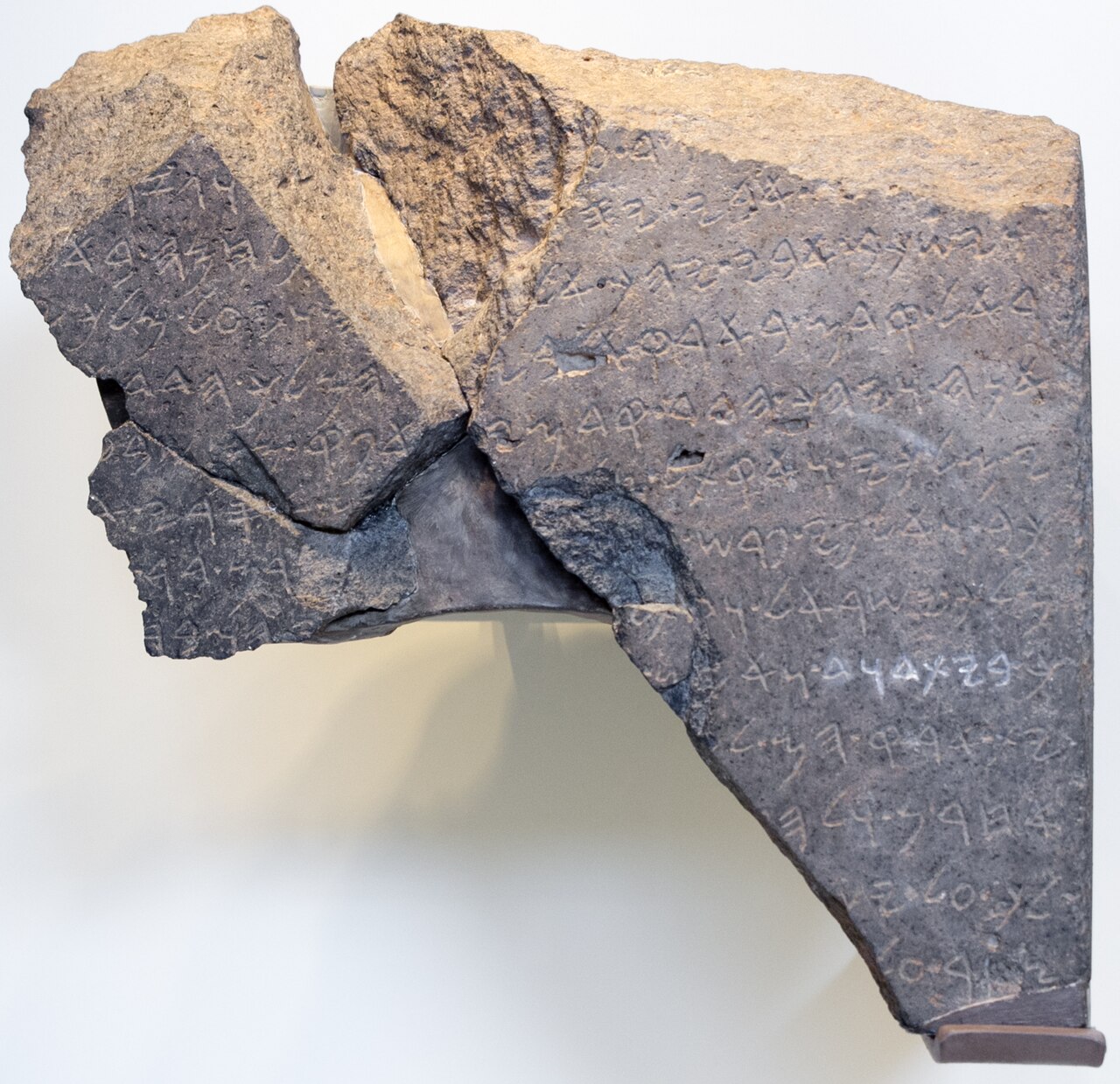
The Tel Dan Stele (9th century BC) mentions the "house of David," the earliest reference outside the Bible to David's dynasty. It says nothing about Ruth or Boaz.
The Case for the Biblical Account
Scripture's account
Obed's birth and the line from Perez to David (Ruth 4:13–22).
What evidence would we expect?
A dynasty of David; genealogies in Israel's records.
The discoveries
The Tel Dan Stele's "house of David"; parallel genealogies in 1 Chronicles 2, Matthew 1 and Luke 3.
Testing the discoveries
David's dynasty is attested; his ancestors are known only from biblical genealogies.
The strongest reconstruction
Ruth preserves a tradition of David's Moabite ancestry, which a later writer would hardly have invented.
What remains possible
Whether 4:18–22 is an appendix or integral; the completeness of the genealogy.
What the evidence shows
- The Tel Dan Stele mentions the house of David.
- Ruth was David's great-grandmother. Biblical genealogy; no outside record.
- Ruth names Rahab as Boaz's mother. That is in Matthew 1:5, not in Ruth.
- The genealogy has every generation.
Then and Later
Ruth's line, then and later
- GenesisTamar and Perez Tamar's risk preserves Judah's line.
- RuthRuth and Obed A Moabite widow becomes David's great-grandmother.
- SamuelDavid son of Jesse The shepherd from Bethlehem is anointed king.
- ChroniclesThe royal genealogy The same line, with Salma.
- MatthewJesus son of David Ruth and Rahab named in the Messiah's ancestry.
Continue the journey
Journey of a PassageRuth 4:20–21: Salmah or Salmon?Boaz's father is spelled Salmah (שַׂלְמָה) in 4:20 and Salmon (שַׂלְמוֹן) in 4:21 in the same Hebrew text.More from this lesson
Echoes Across Civilizations
Optional: how other ancient peoples told similar stories. Open one to compare, then come back to the lesson.
Outsiders in the family lineIsraelite (later) · Jewish (Second Temple and rabbinic) · Greek
How did Israel's Scriptures and its neighbors treat foreign women who joined a people?
- Israelite (later): Ezra and Nehemiah Possible historical contact
- Jewish (Second Temple and rabbinic): Conversion traditions Possible historical contact
- Greek: Citizenship laws Resemblance only
Why this matters to the rest of Scripture
- The birth of Perez.
- "Jesse the Bethlehemite."
- The line of David.
- Tamar, Rahab, Ruth in Jesus' genealogy.
- Luke's line through Boaz.