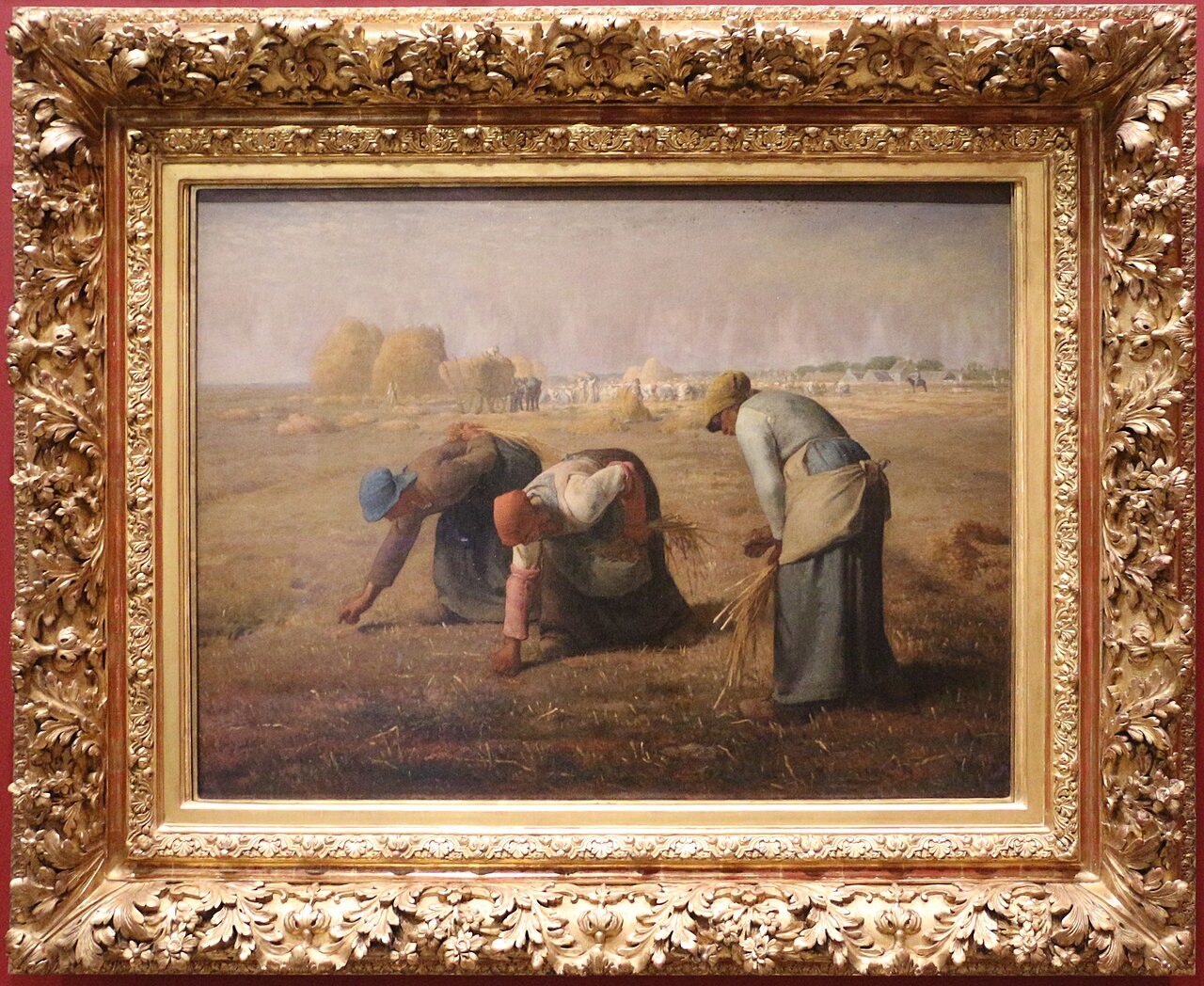
Extraordinary Generosity and the Two Harvests
"Blessed be he of the LORD, who hath not left off his kindness"
At mealtime Boaz says, "Come thou hither, and eat of the bread, and dip thy morsel in the vinegar." He hands her roasted grain; she eats until satisfied and has some left over. He commands his young men: "Let her glean even among the sheaves, and reproach her not: and let fall also some of the handfuls of purpose for her."
She gleans until evening, beats out what she gathered, "and it was about an ephah of barley." She brings it to Naomi, with the food she saved from lunch.
"Where hast thou gleaned to day?… blessed be he that did take knowledge of thee." "The man's name with whom I wrought to day is Boaz." "Blessed be he of the LORD, who hath not left off his kindness to the living and to the dead… The man is near of kin unto us, one of our next kinsmen [go'alim]." "So she kept fast by the maidens of Boaz to glean unto the end of barley harvest and of wheat harvest; and dwelt with her mother in law."
Whose kindness? (2:20)
The Hebrew "Blessed be he to the LORD, who has not abandoned his kindness" can refer to the LORD's kindness or to Boaz's. Both readings are grammatically possible, and the ambiguity may be deliberate: God's kindness comes through Boaz. The Vulgate makes it Boaz's ("the same kindness which he had shown to the living, he kept also to the dead"); the KJV leaves it open.
An ephah
An ephah was a dry measure; modern estimates vary widely (often given as about 20 liters, though the ancient standard was not fixed). However it is converted, it is far more than a gleaner normally gathered in a day.
Redeemers (go'alim)
A go'el was a close relative with duties to rescue family members: buying back land a relative had to sell (Leviticus 25:25), buying a relative out of debt slavery (25:47–49), and avenging blood (Numbers 35). Naomi calls Boaz "one of our redeemers," not the only one.
Two harvests
Barley through wheat harvest is roughly seven weeks, Passover to Shavuot. That is one reason Jews read Ruth at Shavuot.
The Case for the Biblical Account
Scripture's account
Boaz's generosity; Naomi recognizes a redeemer (Ruth 2:14–23).
What evidence would we expect?
Kinship redemption laws; harvest practice; dry measures.
The discoveries
Leviticus 25; Jeremiah 32's purchase of a relative's field; Iron Age storage jars and sickles; inscribed weights.
Testing the discoveries
The legal and agricultural world is documented; the episode is not independently attested.
The strongest reconstruction
A story that shows the go'el system and gleaning law at their most generous.
What remains possible
Whether 2:20 refers to God's or Boaz's kindness.
What the evidence shows
- Kinship redemption of land is a biblical legal institution. Leviticus 25; Jeremiah 32.
- An ephah can be converted to an exact modern weight.
- 2:20 refers to the LORD's kindness.Source: Sefaria source sheet on the ambiguity of Ruth 2:20 (teaching aid) ↗
Continue the journey
Echoes Across CivilizationsThe widow in the fieldDid other ancient peoples protect the poor, widows and strangers at harvest time?More from this lesson
Echoes Across Civilizations
Optional: how other ancient peoples told similar stories. Open one to compare, then come back to the lesson.
The widow in the fieldEgyptian · Judahite · Babylonian
Did other ancient peoples protect the poor, widows and strangers at harvest time?
- Egyptian: The Instruction of Amenemope, chapter 28 Possible historical contact
- Judahite: The Mesad Hashavyahu (Yavneh-Yam) ostracon Possible historical contact
- Babylonian: Royal claims to protect the widow and orphan Shared literary world
Why this matters to the rest of Scripture
- The redeemer buys back land.
- Jeremiah redeems a relative's field.
- "He that hath pity upon the poor lendeth unto the LORD."