The City Gate, the Land, the Sandal and the Marriage
"Ye are witnesses this day"
"Then went Boaz up to the gate, and sat him down there: and, behold, the kinsman of whom Boaz spake came by; unto whom he said, Ho, such a one! turn aside, sit down here." He takes ten elders: "Sit ye down here."
"Naomi, that is come again out of the country of Moab, selleth a parcel of land, which was our brother Elimelech's." "I will redeem it." "What day thou buyest the field of the hand of Naomi, thou must buy it also of Ruth the Moabitess, the wife of the dead, to raise up the name of the dead upon his inheritance." "I cannot redeem it for myself, lest I mar mine own inheritance: redeem thou my right to thyself."
"Now this was the manner in former time in Israel concerning redeeming and concerning changing… a man plucked off his shoe, and gave it to his neighbour." The redeemer draws off his shoe. Boaz: "Ye are witnesses this day, that I have bought all that was Elimelech's… Moreover Ruth the Moabitess, the wife of Mahlon, have I purchased to be my wife, to raise up the name of the dead upon his inheritance." "We are witnesses. The LORD make the woman that is come into thine house like Rachel and like Leah, which two did build the house of Israel… and let thy house be like the house of Pharez, whom Tamar bare unto Judah."
Redeemer and brother-in-law
| Land redemption (Leviticus 25) | Brother-in-law marriage (Deuteronomy 25) | Ruth 4 | |
|---|---|---|---|
| Who | The nearest relative | The dead man's brother | A relative, not a brother |
| What | Buys back family land | Marries the widow; first son carries the dead man's name | Acquires land and marries Ruth "to raise up the name of the dead" |
| Refusal | Not addressed | Widow removes his sandal and spits; public shame | He removes his own sandal and gives it to Boaz |
Ruth 4 combines duties that the Torah keeps separate. Explanations: a wider custom of levirate-like marriage within the clan; a combination of redemption and marriage specific to this case; or a literary blending of several institutions. Leviticus 25 does not command a redeemer to marry a widow.
The sandal
The narrator explains the custom as old ("in former time"), so the book was written when it was no longer practiced. In Ruth, the man himself hands over his sandal to confirm a transfer of rights; in Deuteronomy 25 the widow pulls off the sandal of the brother who refuses, as a public disgrace. The later Jewish ceremony of ḥalitzah develops from Deuteronomy, not from Ruth. Nuzi documents from Mesopotamia mention a shoe in land transactions; the comparison is debated.
The gate
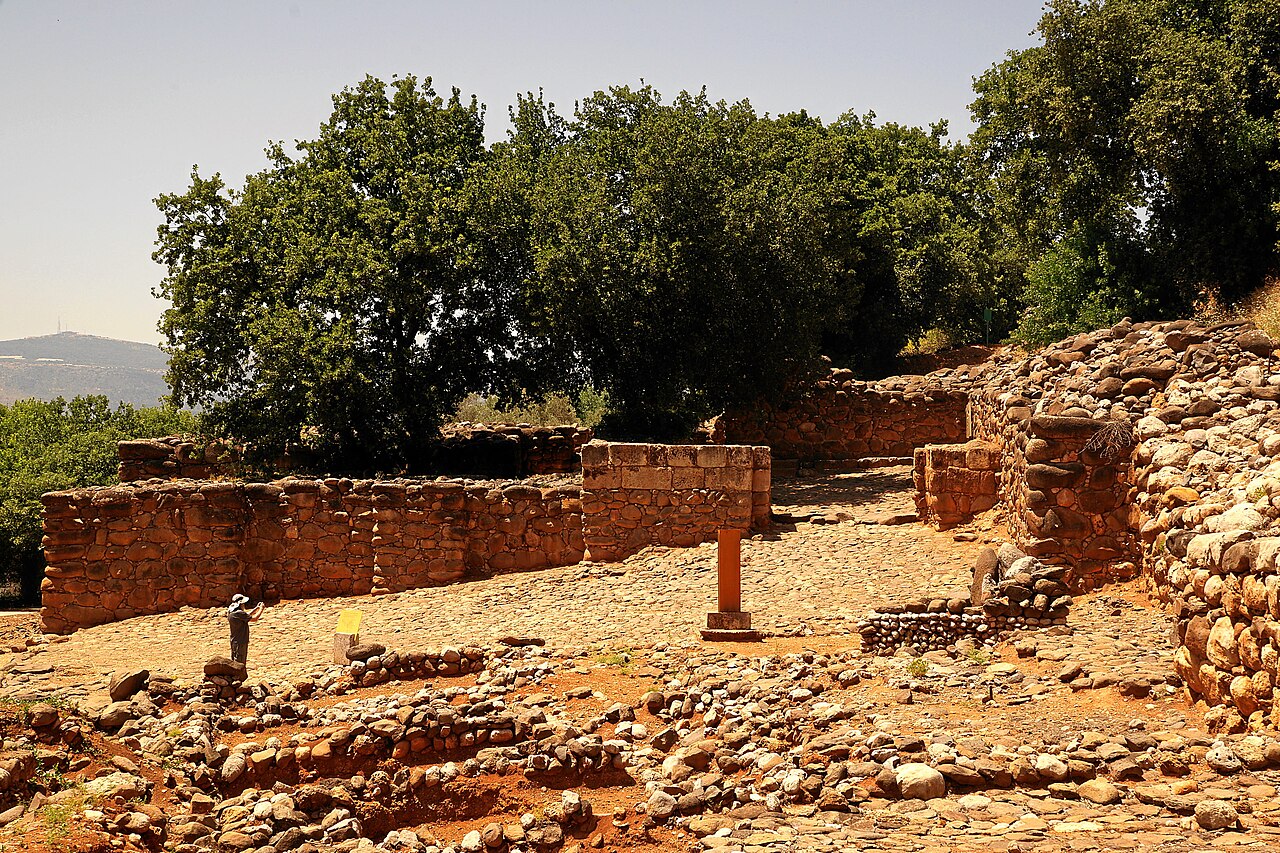
City gates were the place of trade, law and witnesses (Deuteronomy 21:19; 25:7; Amos 5:15; Proverbs 31:23). Excavated Iron Age gates at Gezer, Megiddo, Hazor and Tel Dan have chambers and benches. Bethlehem's ancient gate has not been excavated; any gate picture is a comparison.
I acquire, or you acquire? (4:5)
In the Hebrew of 4:5 the consonants read "I acquire" (ketiv) while the tradition reads "you acquire" (qere). The phrase "from Ruth" or "also Ruth" is a second difficulty. See the passage page.
The Case for the Biblical Account
Scripture's account
The legal hearing at the gate (Ruth 4:1–12).
What evidence would we expect?
Gate courts; land redemption; symbolic acts confirming transfers.
The discoveries
Excavated gate complexes with benches; Jeremiah 32's witnessed land purchase; Hittite and Middle Assyrian laws on widows marrying a husband's relative.
Testing the discoveries
The institutions fit; the hearing is known only from Ruth.
The strongest reconstruction
A realistic legal scene, explained for later readers, combining redemption and marriage.
What remains possible
The exact legal mechanism; the original wording of 4:5.
What the evidence shows
- Boaz was Ruth's brother-in-law. He is a relative, not a brother of Mahlon.
- The Ruth 4 sandal custom is the same as Deuteronomy 25's ceremony. Related symbolism, different act.
- The Hebrew of 4:5 has a ketiv/qere difference.Source: NET Bible, textual note on Ruth 4:5 ↗; Sefaria, Ruth 4:5–6 (Hebrew with ketiv and qere) ↗
- The ten elders reflect a fixed later quorum.
Continue the journey
Journey of a PassageRuth 4:5: "I acquire" or "you acquire"?In 4:5 the written Hebrew consonants read "I acquire" (ketiv) but the reading tradition says "you acquire" (qere).More from this lesson
Investigations
Optional deep dives: the ancient sources, the physical evidence, and every interpretation side by side, including unconventional ones, each labeled for what it is.
Redeemer or Brother-in-Law? The Law Behind Ruth 3–4Laws: documented · How they combine in Ruth: disputed
Was Boaz obliged to marry Ruth, and how does Ruth 4 relate to Leviticus 25 and Deuteronomy 25?
Boaz is a go'el, a kinsman-redeemer: a relative with a duty to buy back family land (Leviticus 25:25). Deuteronomy 25 defines a different duty, levirate marriage, for the dead man's brother. Boaz is not Mahlon's brother, yet Ruth 4 joins land redemption with marriage "to raise up the name of the dead." The sandal ceremony is also different from Deuteronomy's.
Open the full investigation →Echoes Across Civilizations
Optional: how other ancient peoples told similar stories. Open one to compare, then come back to the lesson.
A widow and her husband's familyHittite · Middle Assyrian · Israelite
Did other ancient laws provide for a widow to marry into her late husband's family?
- Hittite: Hittite Laws §193 Shared literary world
- Middle Assyrian: Middle Assyrian Laws A §§30, 33, 43 Shared literary world
- Israelite: Tamar and Judah Possible historical contact
Why this matters to the rest of Scripture
- Brother-in-law marriage and the sandal.
- Redeeming a relative's land.
- A witnessed purchase of family land.
- Tamar and the birth of Perez.