Era 9 · RestorationEcclesiastes
Investigation: Greek Ecclesiastes, a Different Kind of Translation
Word-for-word Greek, Aquila, and the meaning of mataiotes
When Jews in Alexandria began translating their Scriptures into Greek in the 3rd century BC, they started with the Torah. Other books followed over the next three centuries. Ecclesiastes may have been among the last, and its Greek looks very different from the rest.
Its translator followed the Hebrew word by word, even where the Greek became awkward. That style is typical of Aquila, a convert to Judaism who produced a new, very literal Greek version around AD 130.
| Verse | Hebrew (Masoretic) | Library's Greek (Giguet) | Kind of difference |
|---|---|---|---|
| 1:1 | king in Jerusalem | king of Israel in Jerusalem | Plus |
| 2:25 | more than I (mimmenni) | without his permission (apart from him) | Possible Hebrew variant (one letter) |
| 3:21 | the spirit that goes up (article) | whether the spirit goes up (question) | Same letters, different reading |
| 5:6 | before the messenger | before God | Interpretation or variant |
| 8:10 | forgotten | praised | Possible Hebrew variant (one letter) |
| 8:12 | a hundred (times) | since then | Possible Hebrew variant (one letter) |
| 11:9 | walk in the ways of your heart and the sight of your eyes | walk blameless… and not according to the sight of your eyes | Softening (manuscripts to be checked) |
| 12:5 | aviyonah | caper (kapparis) | Interpretation of a rare word |
Mataiotes
The Greek renders hevel by mataiotes (emptiness, futility) throughout, and havel havalim as mataiotes mataioteton. The image of breath is lost; the Latin vanitas and English "vanity" inherited the abstract sense. Romans 8:20 uses the same Greek word.
The Aquila question
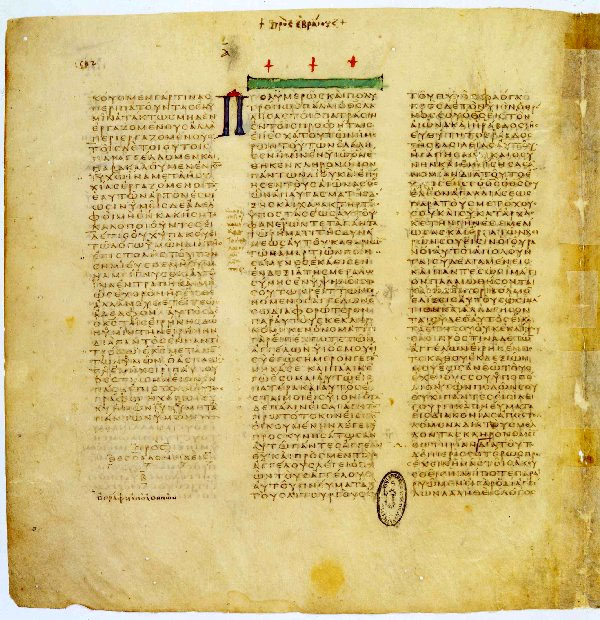
D. Barthélemy (Les devanciers d'Aquila, 1963) argued that Greek Ecclesiastes is an early edition by Aquila himself; others (e.g. J. K. Aitken, 2015; P. Pouchelle, 2020) prefer a translator of the same literalist school, perhaps in the 1st century AD. The Greek also appears in the great 4th–5th-century codices (Vaticanus, Sinaiticus, Alexandrinus). The Göttingen critical edition (P. J. Gentry, 2019) is the standard for C checks.
Not "the Septuagint" in one piece
It is common to call all Greek Old Testament books "the Septuagint." Each book has its own translator, date and style. Greek Ecclesiastes should not be dated to the 3rd century BC merely because the Greek Torah was.
The library's file
The library's Greek is Giguet's 1872 French translation of a printed Greek text. It is useful for locating differences (D check) but cannot show which Greek manuscripts read what. In this book Giguet's file is truncated in places (5:11; 6:9; 9:4) and has a probable misprint in 9:11 (paix for pain).
What the evidence shows
- Greek Ecclesiastes is unusually literal and shares features with Aquila's translation.Source: D. Barthélemy, Les devanciers d'Aquila (Brill, 1963); J. K. Aitken, "Ecclesiastes," in The T&T Clark Companion to the Septuagint (2015); P. Pouchelle, "Proverbs, Job, and Ecclesiastes in the Septuagint" (2020) ↗
- Aquila himself translated Greek Ecclesiastes.
- The library's Greek differs from the Masoretic Text at 2:25, 5:6, 8:10 and 8:12.Source: The site's library: Westminster Leningrad Codex, KJV, Clementine Vulgate, Giguet's French of the Greek
Continue the journey
Journey of a PassageEcclesiastes 3:11: "He hath set the world (or eternity) in their heart"One Hebrew word, ha-olam, read four ways: "eternity" (most modern versions), "the world" (KJV, the library's Greek, the Vulgate), "a sense of duration / past and future" (NRSV), or, with different vowels, "hiddenness / ignorance" (some scholars).More from this lesson
Why this matters to the rest of Scripture
- Mataiotes, the Greek word for hevel.
- Proverbs (Greek)A free translation, the opposite of Greek Ecclesiastes.