Banquets, Royal Power and Vashti
"Vashti refused to come at the king's commandment"
"Now it came to pass in the days of Ahasuerus, (this is Ahasuerus which reigned, from India even unto Ethiopia, over an hundred and seven and twenty provinces)." In the third year of his reign, sitting on his throne in Shushan the palace, he makes a feast for his princes, the army of Persia and Media, and the nobles, "when he shewed the riches of his glorious kingdom… many days, even an hundred and fourscore days."
Then a seven-day feast for all the people in Susa, in the court of the palace garden, with white, green and blue hangings, pillars of marble, couches of gold and silver on a pavement of porphyry and marble, and royal wine in golden vessels. "And the drinking was according to the law; none did compel." Vashti the queen makes a feast for the women in the royal house.
On the seventh day, "when the heart of the king was merry with wine," he commands Mehuman, Biztha, Harbona, Bigtha, Abagtha, Zethar and Carcas, the seven eunuchs, "to bring Vashti the queen before the king with the crown royal, to shew the people and the princes her beauty." "But the queen Vashti refused to come at the king's commandment… therefore was the king very wroth."
He consults the wise men who know the times, the seven princes of Persia and Media: Carshena, Shethar, Admatha, Tarshish, Meres, Marsena and Memucan. Memucan answers: Vashti has wronged not only the king but all the princes and peoples, for all wives will now despise their husbands. Let a royal decree be written "among the laws of the Persians and the Medes, that it be not altered," that Vashti come no more before the king, and let her royal estate go to another better than she.
Letters go to every province in its own script and to every people in its own language, "that every man should bear rule in his own house."
Ahasuerus and Xerxes
Hebrew Ahashverosh corresponds to Old Persian Xšayāršā, Greek Xerxes. Xerxes I reigned 486–465 BC; his third year is 483 BC. The identification is linguistic and widely accepted. The Greek Esther calls the king Artaxerxes, and the Alpha Text, Josephus and some later readers followed that, so the Greek and Hebrew stories do not name the same king. The identification does not confirm the events of the book.
India to Cush, 127 provinces
Xerxes' empire did reach from the Indus to Kush (Nubia): his own Daiva inscription from Persepolis lists the lands. Persian administration used about twenty to thirty satrapies; 127 "provinces" (medinot) may count smaller districts (Ezra and Nehemiah call Judah a medinah) or be a round literary number. Daniel 6:1 has 120 satraps.
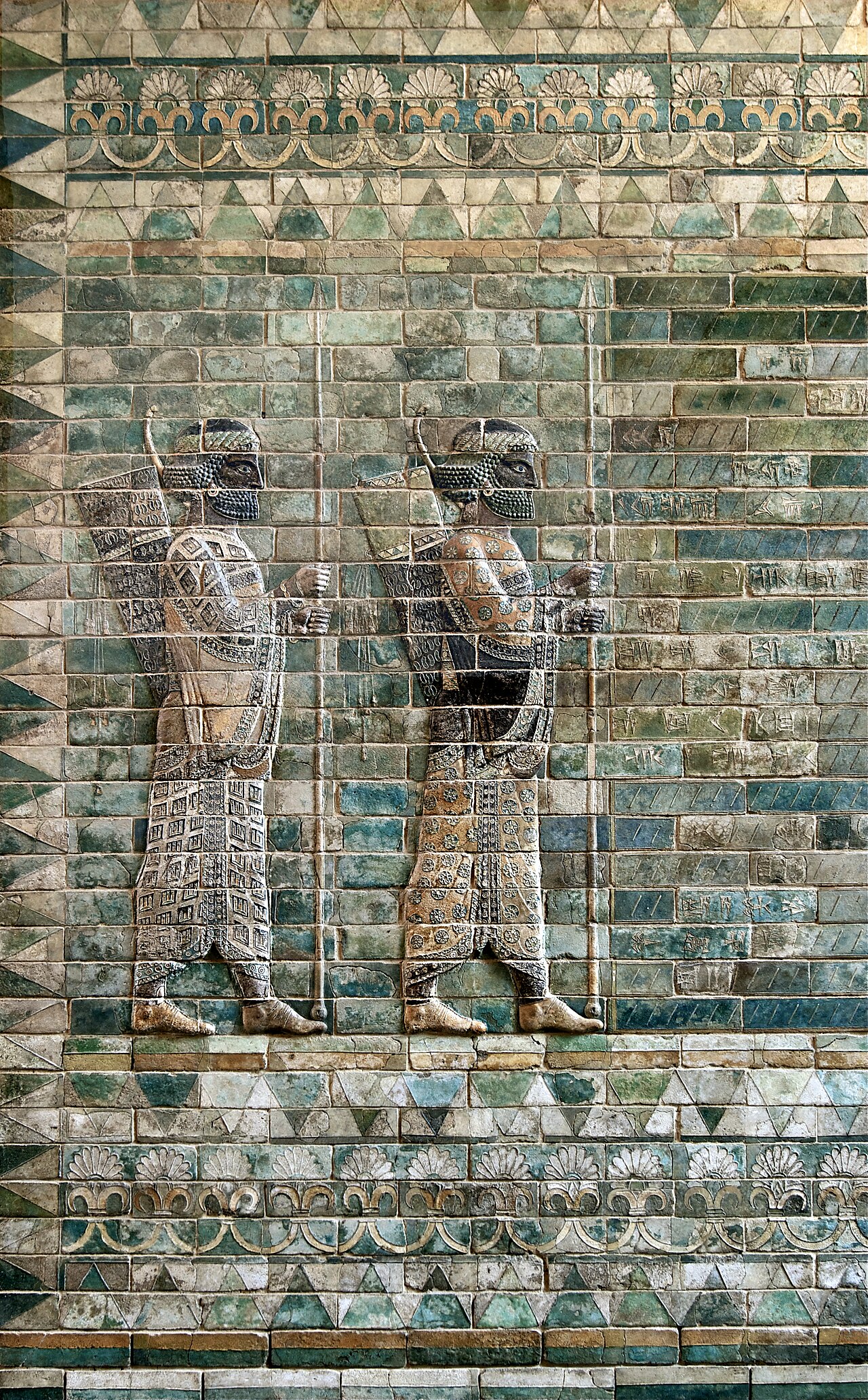
The palace at Susa
Darius I rebuilt Susa with a palace and a great audience hall (apadana) of 36 columns; French excavations since the 1850s (Dieulafoy, de Morgan, later Perrot) uncovered glazed-brick friezes now in the Louvre. Xerxes used the palace. The book's hangings, couches and colored pavement fit Persian luxury. No excavated room can be identified as the scene of this banquet.
"According to the law; none did compel"
1:8 has the king order that no one be forced to drink. Greek writers (Herodotus 1.133) describe Persian banquets and drinking customs. The library's Greek (Giguet) reads the opposite ("the meal was not according to the established law"), perhaps a different reading or translation of the same difficult phrase.
Why did Vashti refuse?
The text does not say. Later interpreters supplied reasons: rabbinic midrash (Megillah 12b) imagines she was ordered to appear wearing only the crown; others see modesty, dignity, or a political act. Feminist readers have made Vashti a model of refusal. The text records only her refusal and its result.
"That it be not altered"
Esther (1:19; 8:8) and Daniel (6:8, 12, 15) speak of "the laws of the Medes and Persians" that cannot be changed. No Persian source states such a rule; it may be a narrative motif. In the story it drives the plot: the king cannot cancel Haman's decree and must issue a second.
Persian women of the court
The Persepolis Fortification tablets show royal women (such as Irdabama and Irtashduna, a wife of Darius) owning estates, managing workers and travelling with their own staff. Royal women hosted banquets. This is real context; the tablets do not mention Vashti or Esther.
Vashti and Amestris
Herodotus names Xerxes' queen Amestris, mother of Artaxerxes I, and tells of her cruelty (9.108–113). Attempts to equate her with Vashti or Esther on the basis of the names have not won agreement; the investigation "Esther or Amestris?" sets out the arguments.
What the evidence shows
- Ahasuerus corresponds to the Persian name Xerxes.Source: Encyclopaedia Iranica, "Ahasuerus" ↗
- Xerxes I ruled from India to Kush.
- Excavations at Susa uncovered a Persian royal palace.Source: UNESCO World Heritage, Susa (no. 1455) ↗; Encyclopaedia Iranica, "Susa iii. The Achaemenid Period" ↗
- The banquet of Esther 1 is recorded outside the Bible.
- Persian law could never be revoked. A motif in Esther and Daniel; no Persian source.
Continue the journey
Journey of a PassageEsther 1:1: Ahasuerus, Xerxes or Artaxerxes?The Hebrew names the king Ahasuerus (Ahashverosh = Persian Xšayāršā, Xerxes).More from this lesson
Investigations
Optional deep dives: the ancient sources, the physical evidence, and every interpretation side by side, including unconventional ones, each labeled for what it is.
Esther or Amestris?Amestris: documented in Herodotus · Identification: unproven
Can Vashti or Esther be identified with Xerxes' queen Amestris?
Herodotus names Xerxes' wife Amestris, daughter of Otanes, mother of Artaxerxes I, and tells of her cruelty. Some have linked her name to Vashti or to Esther; others note she was queen throughout Xerxes' reign, which conflicts with both. The names alone cannot establish an identification.
Open the full investigation →Echoes Across Civilizations
Optional: how other ancient peoples told similar stories. Open one to compare, then come back to the lesson.
Persian banquets and royal womenPersian · Greek
What do Persian and Greek sources say about royal banquets and the women of the court?
- Persian: The Fortification tablets on royal women Possible historical contact
- Greek: Herodotus on Persian feasts and Amestris Resemblance only
Why this matters to the rest of Scripture
- The law of the Medes and Persians, which altereth not.
- Belshazzar's banquet.
- Shushan the palace, a generation later.