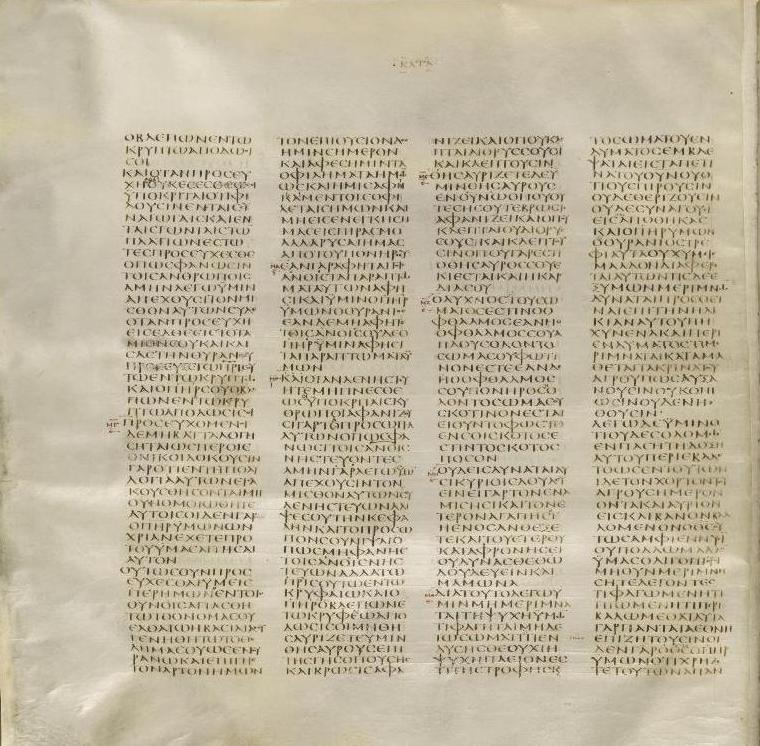
A: in the second year of Artaxerxes, Mordecai dreams of noise and thunder, two great dragons ready to fight, every nation preparing war against a righteous nation, and a little spring that becomes a great river. He then discovers the eunuchs' plot.
B: "The great king Artaxerxes writeth these things": a people "set against all men," following strange laws, are to be destroyed with their wives and children on the 14th of Adar.
C: Mordecai prays: "Thou knowest all things… that it was neither in contempt nor pride… that I did not bow down to proud Aman… that I might not prefer the glory of man above the glory of God." Esther, in mourning, prays: "O my Lord, thou only art our King: help me, desolate woman, which have no helper but thee… Thou knowest that I hate the glory of the unrighteous, and abhor the bed of the uncircumcised, and of all the heathen."
D: on the third day Esther, radiant, enters leaning on her maids; the king looks on her in fierce anger; she faints. "Then God changed the spirit of the king into mildness," and he holds her in his arms until she revives.
E: the counter-decree: Haman, a Macedonian, plotted to transfer the kingdom to the Macedonians; the Jews are "children of the most high and most mighty living God"; Haman's letters are not to be executed; the 13th of Adar is to be a day of joy. F: "God hath done these things": the dream explained, two lots, and the colophon.
| Addition | Greek position | Vulgate / KJV Apocrypha | In the library's Greek (Giguet)? |
|---|---|---|---|
| A: dream and first plot | Before 1:1 | 11:2–12:6 | No (data gap) |
| B: Haman's decree | After 3:13 | 13:1–7 | No |
| C: prayers of Mordecai and Esther | After 4:17 | 13:8–14:19 | One-line summary only (its 4:16) |
| D: Esther before the king | Replaces 5:1–2 | 15:1–16 | Yes (its 5:1–2) |
| E: counter-decree | After 8:12 | 16:1–24 | No |
| F: dream explained | After 10:3 | 10:4–11:1 | Yes (its 10:4–13) |
| Colophon | End | 11:1 | Yes (its 11:1) |
What they change
God is named; Mordecai becomes a visionary; Esther becomes a pious queen who keeps the dietary laws and hates her position; the decrees are given in full with Hellenistic rhetoric; the king's change of heart is God's act; Haman becomes a Macedonian traitor. Some scholars think the additions were written partly to answer questions raised by the Hebrew (no God, no prayer, a Jewish queen married to a gentile).
When and where
B and E are polished Greek, composed in Greek (Domazakis 2021 argues on vocabulary for the late 2nd or 1st century BC); A, C, D and F may go back to Hebrew or Aramaic. The colophon claims the translation reached Egypt from Jerusalem in the fourth year of a Ptolemy and Cleopatra.
Canon
The Council of Trent (1546) affirmed the additions as Scripture for Catholics (deuterocanonical); Orthodox churches read the Greek Esther with them; Luther and the Reformers placed them in the Apocrypha, and the 1611 KJV printed them there as "The rest of the chapters of the Book of Esther." Jewish Bibles have the Hebrew only.
A gap in the site's library
The library's French Greek (Giguet) lacks Additions A, B, C and E in the digital source the site uses; the site reads them from the Clementine Vulgate and the KJV Apocrypha ("AddEsth"). This is a data gap, not evidence that a Greek manuscript lacks them.
What the evidence shows
- The Greek Esther contains six additions not in the Hebrew.Source: S. White Crawford, "Additions to Esther," Eerdmans Dictionary of the Bible (2000) ↗
- Additions B and E were composed in Greek.Source: N. Domazakis, "On the Date of Composition of Additions B and E to LXX Esther," JSJ 52 (2021) ↗
- Catholic and Orthodox Bibles include the additions.
- "God changed the spirit of the king." Addition D.
Continue the journey
Journey of a PassageAdditions to Esther A–F (Vulgate and KJV Apocrypha 10:4–16:24): The six Greek additions, and where they sitThe Greek Esther has six blocks absent from the Hebrew: A (Mordecai's dream), B (Haman's decree), C (prayers), D (Esther before the king), E (the counter-decree), F (the dream explained) and a colophon.More from this lesson
Why this matters to the rest of Scripture
- Another dream at a foreign court.
- Daniel 3:24–90 (Greek)Prayers added to Daniel in Greek.