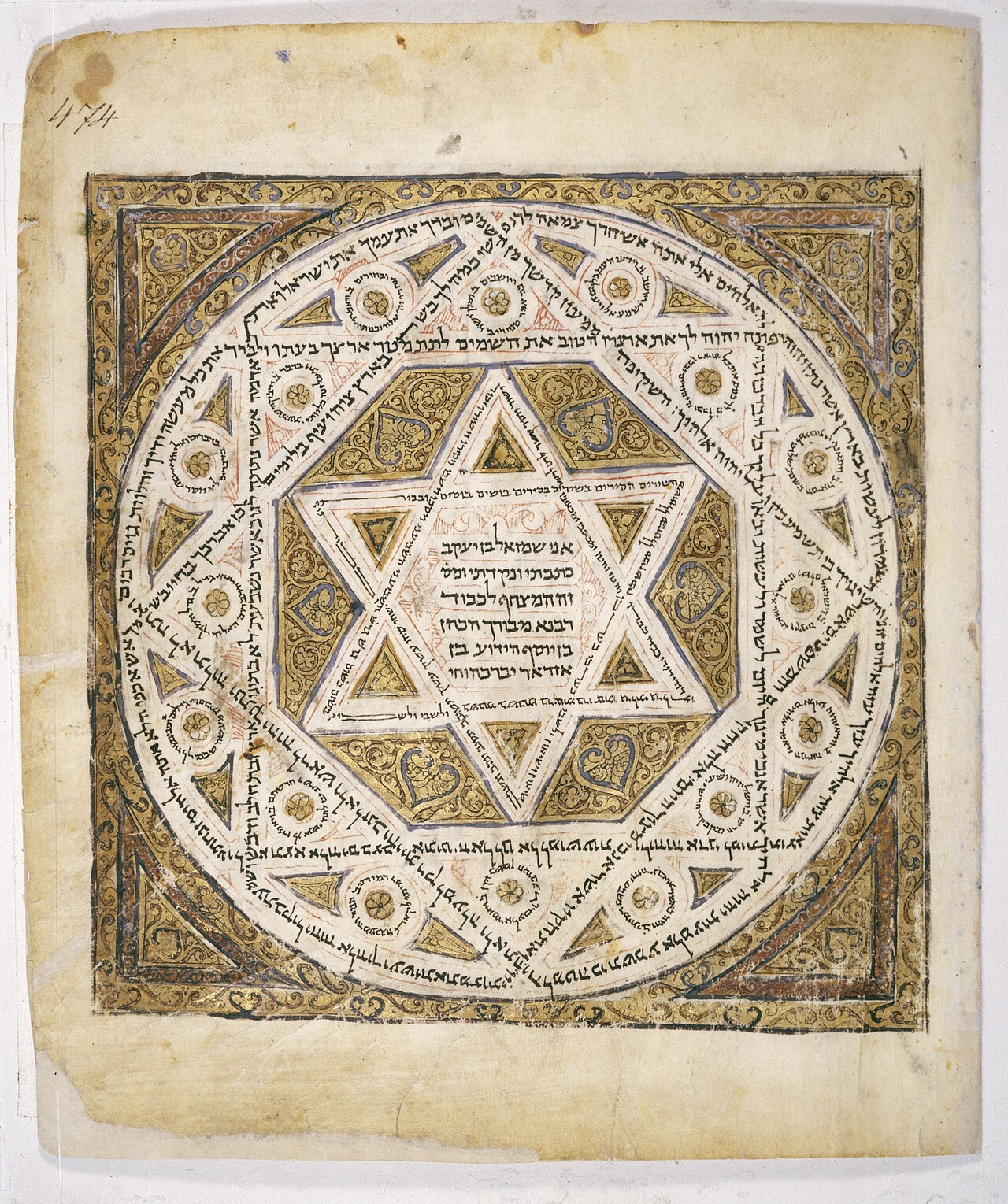
The Hebrew text of Esther, as in all medieval manuscripts and printed Hebrew Bibles, has 167 verses in ten chapters, no prayer and no name of God.
The Old Greek (OG), in the great codices Sinaiticus, Vaticanus and Alexandrinus, translates the Hebrew freely and adds about 107 verses in six blocks (A–F), naming God more than fifty times.
The Alpha Text (AT), preserved in a few medieval Greek manuscripts and once thought to be Lucian's revision, is about 20 percent shorter in the shared parts, has the additions in slightly different forms, and ends differently (it lacks most of 9:20–32 on the institution of Purim).
| Feature | Hebrew (MT) | Old Greek (LXX) | Alpha Text |
|---|---|---|---|
| Name of God | Never | Over 50 times | Many times |
| King's name | Ahasuerus | Artaxerxes | Ahasuerus (Assueros) |
| Additions A–F | None | All six | All six, different wording |
| Haman | Agagite | Bougaean; "Macedonian" (9:24, E) | Bougaean / Macedonian |
| Esther 2:7 | Mordecai took her as a daughter | Raised her to be his wife | Raised her to be his wife |
| Dead outside Susa (9:16) | 75,000 | 15,000 | 70,100 (reported) |
| Purim letters (9:20–32) | Full | Full | Much shorter |
| Colophon | None | Yes (Ptolemy and Cleopatra) | No |
What the site has checked
The site's Greek is Giguet's French translation of the Old Greek. Checked there: Artaxerxes (1:1), Bougaean (3:1), "to be his wife" (2:7), lot on 14 Adar (3:7), no crown on the horse (6:8), "circumcised and judaized" (8:17), plundered (its 9:9), 15,000 (its 9:15), Additions D and F and the colophon. The Alpha Text is not in the library; its readings are reported from scholarship (NETS translates both Greek texts in parallel).
Why the Greek is different
The OG translator expanded and interpreted, making God explicit and Esther observant. The AT may be (1) a revision of the OG, (2) an independent translation of a different, shorter Hebrew text, or (3) a mixture: a translation of a different Hebrew original later conformed to the OG and supplemented with its additions. Many scholars (Clines, Fox, De Troyer debate it) find evidence for a different Hebrew behind the AT's core.
Old Latin
The Old Latin, older than Jerome, has a form of Esther different from both Greek texts in places; Haelewyck argues it sometimes preserves the earliest Greek form. This is a scholarly reconstruction, not settled.
What the evidence shows
- The Hebrew Esther never names God; the Greek names him often.
- The Alpha Text is a translation of a different Hebrew text.
- The library's Greek reads 15,000 at 9:16. Via Giguet.
Continue the journey
Journey of a PassageAdditions to Esther A–F (Vulgate and KJV Apocrypha 10:4–16:24): The six Greek additions, and where they sitThe Greek Esther has six blocks absent from the Hebrew: A (Mordecai's dream), B (Haman's decree), C (prayers), D (Esther before the king), E (the counter-decree), F (the dream explained) and a colophon.More from this lesson
Why this matters to the rest of Scripture
- Daniel 3 (Greek)Another book with Greek additions: the Prayer of Azariah and Song of the Three.