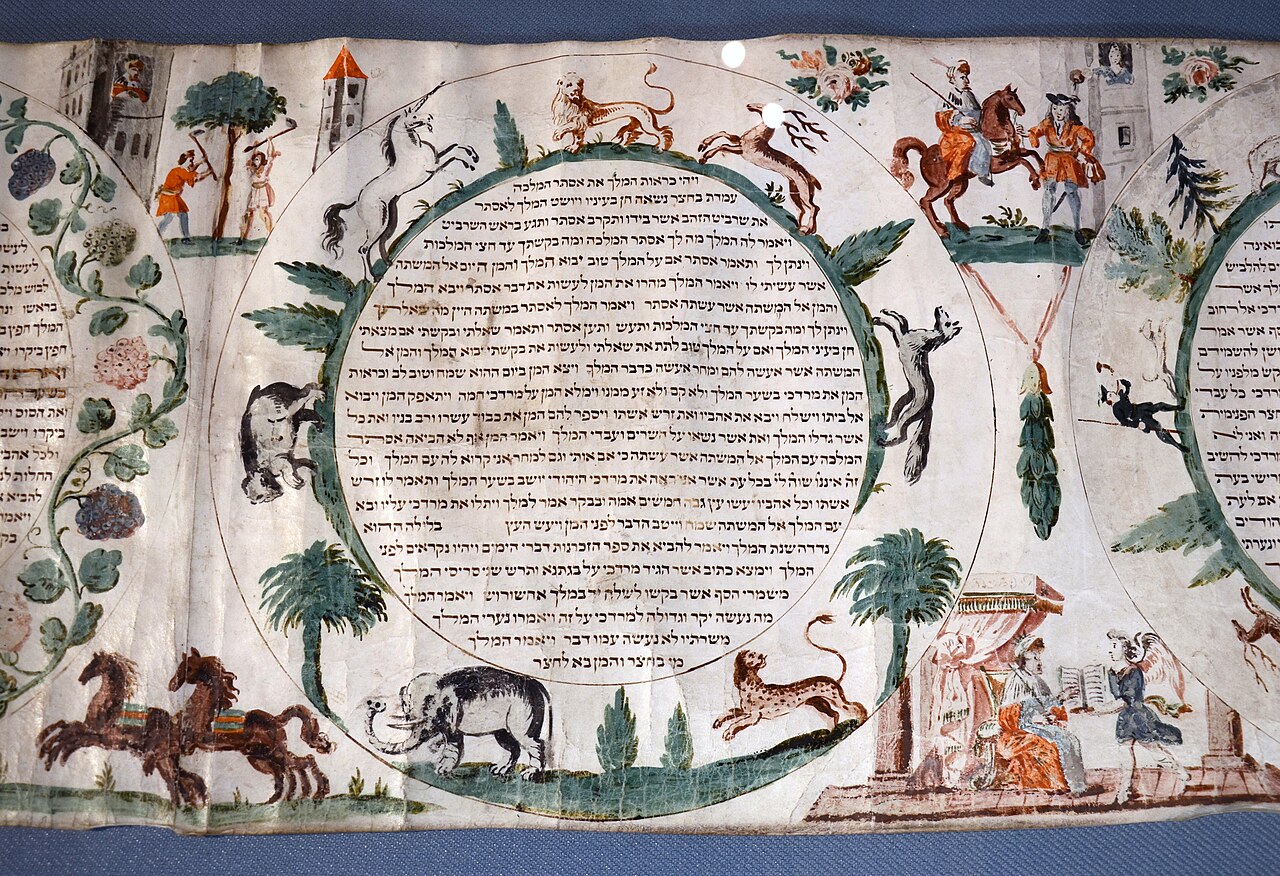
"Wherefore they called these days Purim after the name of Pur." The Jews in villages keep the 14th of Adar, the Jews of Susa the 15th, "as the days wherein the Jews rested from their enemies, and the month which was turned unto them from sorrow to joy."
Mordecai's letter makes them "days of feasting and joy, and of sending portions one to another, and gifts to the poor." Esther's letter confirms it, "and the decree of Esther confirmed these matters of Purim; and it was written in the book."
Pur and pūru
Pur is Akkadian pūru, "lot" or "die." A clay die from Assyria inscribed for the official Yahali calls itself his pūru, cast to fix the year's name. The Hebrew glosses the foreign word (3:7; 9:24). The Greek renders the festival "Phrouraí" or similar (library's Greek: "Phrurées").
Earliest outside evidence
2 Maccabees 15:36 (written c. 124 BC or later) says Judas Maccabeus' victory over Nicanor was celebrated on 13 Adar, "the day before Mordecai's day." Josephus (Antiquities 11.295) describes Purim. The Elephantine "Passover letter" (419 BC) is about Unleavened Bread, not Purim; it is not evidence of Purim. No Purim celebration is documented before the 2nd century BC.
Proposed origins
Older scholars proposed a Babylonian New Year festival (Mordecai = Marduk, Esther = Ishtar, Haman and Vashti = Elamite gods Humban and Mashti), or the Persian Farvardigan festival of the dead. These remain hypotheses with little direct evidence; the names are suggestive but not proof.
Then and Later
From the lot to the festival
- Esther 9Festival instituted 14 and 15 Adar, feasting, gifts to friends and the poor.
- 2nd c. BCMordecai's day Earliest outside reference.
- c. AD 200Mishnah Megillah Who reads the scroll, when, and how; cities walled since Joshua keep the 15th (Shushan Purim).
- TalmudMegillah 7a–7b Debates about Esther's sacred status; the saying that one should drink on Purim until one cannot tell "cursed be Haman" from "blessed be Mordecai."
- TodayPurim Megillah reading with noise at Haman's name, costumes, Purim plays, mishloah manot and matanot la-evyonim; the Fast of Esther on 13 Adar.
What the evidence shows
- Pur is the Akkadian word pūru, "lot."
- 2 Maccabees 15:36 is the earliest outside mention of Purim. As "Mordecai's day."
- Purim derives from a Babylonian festival.Source: Encyclopaedia Iranica, "Festivals vi–viii" (Purim and its proposed origins) ↗; TheTorah.com, "On the Origins of Purim and Its Assyrian Name" ↗
- The Elephantine Passover letter is evidence of Purim.
Continue the journey
Journey of a PassageEsther 3:7, 13; 9:24–26: Pur, the lot, and the 13th or 14th of Adar"They cast Pur, that is, the lot" to choose the day.More from this lesson
Investigations
Optional deep dives: the ancient sources, the physical evidence, and every interpretation side by side, including unconventional ones, each labeled for what it is.
Where Did Purim Come From?Pur = pūru: documented · Festival origin: unknown
Did Purim begin with the events of Esther, or adapt an older festival?
Esther explains Purim from Haman's lot (Akkadian pūru). The first outside mention is "Mordecai's day" in 2 Maccabees 15:36. Older scholars proposed origins in a Babylonian New Year or Persian festival, pointing to Mordecai/Marduk and Esther/Ishtar; these proposals lack direct evidence.
Open the full investigation →Echoes Across Civilizations
Optional: how other ancient peoples told similar stories. Open one to compare, then come back to the lesson.
Casting lots to choose a dayAssyrian · Israelite
How did ancient peoples use lots, and could a festival take its name from one?
- Assyrian: The die of Yahali Shared literary world
- Israelite: Urim and Thummim; lots for land and duty Resemblance only
Why this matters to the rest of Scripture
- The day before Mordecai's day.
- "The lot is cast into the lap; but the whole disposing thereof is of the LORD."
- "A feast of the Jews" (sometimes identified as Purim).