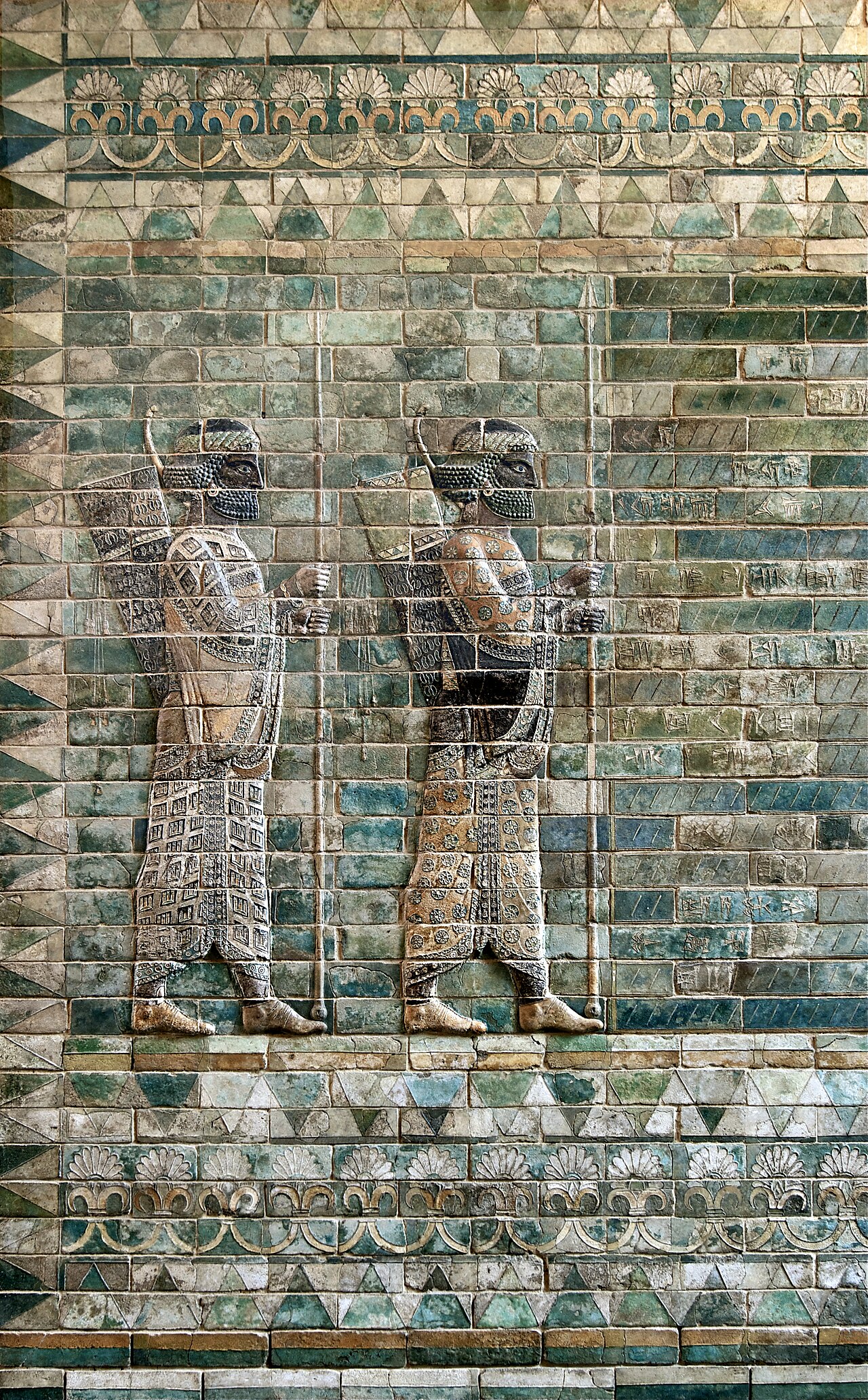
"After these things did king Ahasuerus promote Haman the son of Hammedatha the Agagite, and advanced him, and set his seat above all the princes that were with him." All the king's servants in the gate bow, "but Mordecai bowed not, nor did him reverence." Day after day they ask him why; he tells them he is a Jew.
"And when Haman saw that Mordecai bowed not… then was Haman full of wrath. And he thought scorn to lay hands on Mordecai alone… wherefore Haman sought to destroy all the Jews that were throughout the whole kingdom."
"In the first month, that is, the month Nisan, in the twelfth year of king Ahasuerus, they cast Pur, that is, the lot, before Haman from day to day, and from month to month, to the twelfth month, that is, the month Adar."
Haman tells the king: "There is a certain people scattered abroad and dispersed among the people in all the provinces of thy kingdom; and their laws are diverse from all people; neither keep they the king's laws: therefore it is not for the king's profit to suffer them." "If it please the king, let it be written that they may be destroyed: and I will pay ten thousand talents of silver." The king gives him his ring: "The silver is given to thee, the people also, to do with them as it seemeth good to thee."
On the thirteenth day of the first month the scribes write "to destroy, to kill, and to cause to perish, all Jews, both young and old, little children and women, in one day, even upon the thirteenth day of the twelfth month… and to take the spoil of them for a prey." The couriers go out in haste. "And the king and Haman sat down to drink; but the city Shushan was perplexed."
Agagite and Benjaminite
Haman is "the Agagite"; Mordecai is a Benjaminite descended from Kish. In 1 Samuel 15 Saul son of Kish spared Agag king of Amalek; Amalek is Israel's ancient enemy (Exodus 17:8–16; Deuteronomy 25:17–19). The story seems to replay that conflict, with Mordecai finishing what Saul failed to do. Whether Haman was literally descended from Agag, or "Agagite" is a literary label, cannot be known. The Greek calls him a "Bougaian" and later a "Macedonian."
Why would Mordecai not bow?
The text gives only "he was a Jew." Jews bowed to kings (2 Samuel 14:4) and officials (Genesis 42:6). Later interpreters suggested Haman claimed divine honor or wore an idol (Targum; Midrash). Greek Addition C has Mordecai pray that he refused so as not to give God's glory to a man. The Hebrew leaves it open.
The lot
Pur is an Akkadian word, pūru, "lot"; a cube-shaped die inscribed with the name of the Assyrian official Yahali (c. 9th century BC, Yale Babylonian Collection) calls itself a pūru, cast to choose the year's eponym. Lots chose days in Mesopotamian practice. The Hebrew explains the foreign word: "Pur, that is, the lot." The library's Greek (Giguet) has the lot fall on the 14th of Adar; the Hebrew decree (3:13) sets the 13th.
Ten thousand talents
A talent was about 30 kg of silver; 10,000 talents is about 300 tonnes, comparable to Herodotus' figure for the whole empire's annual tribute (14,560 Euboic talents, 3.95). It is deliberately enormous. Converting it to modern money is guesswork.
A people "scattered and dispersed"
Haman's accusation, a people with different laws who do not keep the king's laws, is the first classic description of antisemitism: a minority is called disloyal because it is different. Later Greek and Roman writers repeated it (compare Addition B; Josephus, Against Apion).
Seal and couriers
Persian officials sealed documents with royal and personal seals (thousands of seal impressions survive on Persepolis tablets); royal couriers relayed messages along the Royal Road, which Herodotus (8.98) admired. The decree's form fits Persian administration; the decree itself is known only from Esther.
Greek Addition B
The Greek inserts after 3:13 the text of Haman's decree in the king's name: a people "hostile to all," following strange laws, must be destroyed with wives and children on the 14th of Adar. Its polished Greek rhetoric (Domazakis 2021 dates Additions B and E to the 2nd–1st century BC on linguistic grounds) shows it was composed in Greek, not translated from a Persian original. The library's Greek (Giguet) lacks it; it appears in the Vulgate and KJV Apocrypha as 13:1–7.
What the evidence shows
- Pur derives from Akkadian pūru, "lot."Source: Encyclopaedia Iranica, "Festivals vi–viii" (Purim and its proposed origins) ↗
- Haman was a descendant of King Agag. Possibly a literary label.
- The 10,000 talents rivals the empire's annual tribute in Herodotus.
- Haman's decree survives outside Esther.
Continue the journey
Journey of a PassageEsther 3:1 (and Greek 9:24; Addition E): Agagite, Bougaean or Macedonian?The Hebrew calls Haman "the Agagite," recalling Agag of Amalek (1 Samuel 15).More from this lesson
Echoes Across Civilizations
Optional: how other ancient peoples told similar stories. Open one to compare, then come back to the lesson.
Letters of the Persian empireJewish (Egypt) · Persian
How do the Aramaic letters in Ezra compare with real letters of the Persian empire?
- Jewish (Egypt): Elephantine petition and memorandum Possible historical contact
- Persian: Letters of the satrap Arshama Possible historical contact
- Persian: Aramaic copy of the Behistun inscription Possible historical contact
Casting lots to choose a dayAssyrian · Israelite
How did ancient peoples use lots, and could a festival take its name from one?
- Assyrian: The die of Yahali Shared literary world
- Israelite: Urim and Thummim; lots for land and duty Resemblance only
Why this matters to the rest of Scripture
- Saul spares Agag the Amalekite.
- War with Amalek from generation to generation.
- Refusing to bow to the king's image.
- "The lot is cast into the lap."