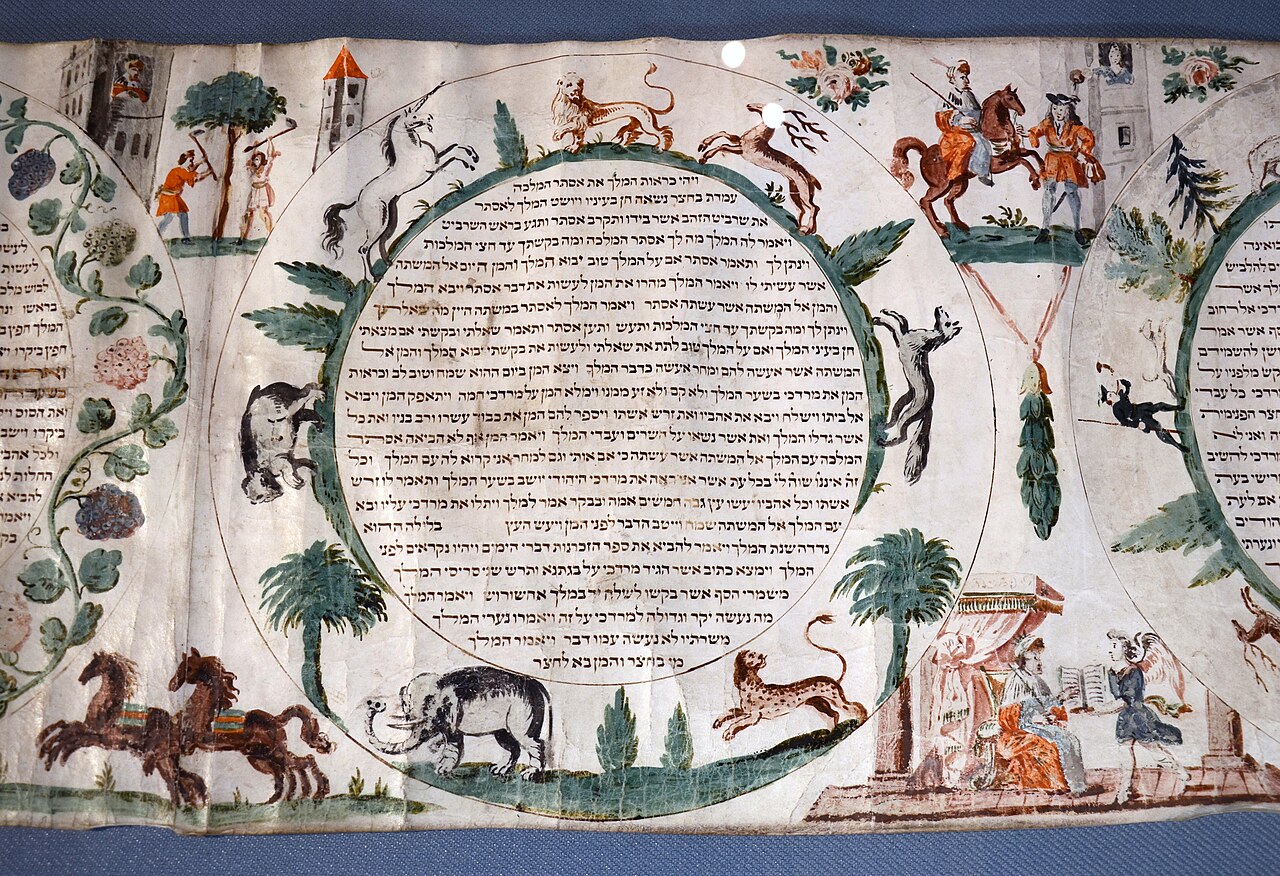
How Esther Came to Us
A scroll without God's name, two Greek books, no Qumran copy
Tradition (Talmud, Bava Batra 15a) says the Men of the Great Assembly wrote Esther; others credited Mordecai (9:20). The book names no author. Its Persian vocabulary and court detail suggest a writer familiar with the Persian empire; its Hebrew is late; and it is unknown to Ben Sira's list of heroes (c. 180 BC), which omits Esther and Mordecai. Most scholars date it between the 4th and 2nd centuries BC.
The Greek translation reached Egypt, according to its colophon, in the fourth year of a Ptolemy and Cleopatra (perhaps 114/113 BC or 78/77 BC).
1. Missing from Qumran
Of the roughly 230 biblical manuscripts from the Dead Sea Scrolls, none is Esther. Explanations: chance of survival (Esther is short; Chronicles has only one small fragment); the community's calendar, in which 14 Adar might fall on a Sabbath, or rejection of a festival not in the Torah; discomfort with a Jewish queen married to a gentile; or simple absence of interest. 4Q550, sometimes called "proto-Esther," is a set of Aramaic court tales set in Persia; it is not a copy of Esther.
2. Hebrew witnesses
The Aleppo Codex lost Esther in 1947; the Leningrad Codex (1008) has it and is the basis of the site's Hebrew. Esther is also copied as a separate scroll (megillah) for Purim; illustrated scrolls from Italy and the Netherlands (17th–18th centuries) are famous. The ten sons of Haman (9:7–9) are written in a special columned layout.
3. Greek witnesses
The Old Greek appears in Codex Sinaiticus, Vaticanus and Alexandrinus (4th–5th centuries); the Alpha Text in a few medieval manuscripts (e.g. 19, 93, 108, 319 in Göttingen numbering). A papyrus from Oxyrhynchus (P.Oxy. 4443, late 1st or early 2nd century AD) preserves part of Addition E and chapters 8–9. Critical edition: R. Hanhart, Göttingen Esther (1966, 2nd ed. 1983).
4. Latin
The Old Latin translated a Greek text; Jerome translated the Hebrew and then appended the Greek additions at the end with notes, which is why Catholic Bibles once numbered them 10:4–16:24. Modern Catholic Bibles (NAB, NJB) place them in their Greek positions, labeled A–F.
5. Canon
The Talmud records debate over whether Esther "defiles the hands" (is sacred; Megillah 7a), and that it was "said by the holy spirit." Some Christian lists omit it (Melito of Sardis, c. 170; Athanasius in 367 lists it among books to be read, not the canon); others include it. The Protestant Reformers kept the Hebrew Esther and moved the additions to the Apocrypha; Luther disliked the book.
6. Josephus and the Targums
Josephus (Antiquities 11.184–296) retells Esther including Additions B, C, D and E, showing he knew the Greek. The Aramaic Targums (Targum Rishon and Targum Sheni) expand the story with long legends; they are later interpretation.
7. What the site has checked
In the library: Hebrew (WLC), Giguet's French of the Old Greek (with gaps in Additions A, B, C, E), the Clementine Vulgate, the KJV with Apocrypha. Not checked: Hanhart's Greek editions, the Alpha Text directly, the Old Latin, P.Oxy. 4443, the Aleppo/Leningrad facsimiles, or Qumran catalogs beyond published summaries.
What the evidence shows
- No copy of Esther has been identified among the Dead Sea Scrolls.Source: S. White Crawford, "Has Every Book of the Bible Been Found Among the Dead Sea Scrolls?" Bible Review (1996) ↗; BAS Library, "Why Is Esther Missing from Qumran?" (Insight) ↗
- 4Q550 is a copy of Esther.Source: BAS Library, "The Text of Esther" (4Q550 and "proto-Esther") ↗
- The book was composed in the Persian period.
- Esther's status was debated in rabbinic sources.
- Jerome placed the Greek additions at the end of his Latin Esther.
Continue the journey
Journey of a PassageAdditions to Esther A–F (Vulgate and KJV Apocrypha 10:4–16:24): The six Greek additions, and where they sitThe Greek Esther has six blocks absent from the Hebrew: A (Mordecai's dream), B (Haman's decree), C (prayers), D (Esther before the king), E (the counter-decree), F (the dream explained) and a colophon.More from this lesson
Investigations
Optional deep dives: the ancient sources, the physical evidence, and every interpretation side by side, including unconventional ones, each labeled for what it is.
Why Is Esther Missing from Qumran?Absence: documented · Reason: unknown
Why has no copy of Esther been found among the Dead Sea Scrolls?
Every book of the Hebrew Bible except Esther (and, by some counts, Nehemiah) is represented among the Dead Sea Scrolls. Explanations range from chance survival to the community's calendar or theology. 4Q550, called "proto-Esther" by its editor, is an Aramaic collection of Persian court tales, not Esther.
Open the full investigation →Why this matters to the rest of Scripture
- Ben Sira's praise of the ancestors omits Esther and Mordecai.
- "Mordecai's day."