Era 6 · The First KingsSong of Songs
Investigation: The Egyptian Love Songs
Papyrus Chester Beatty I, Papyrus Harris 500 and the Cairo jar
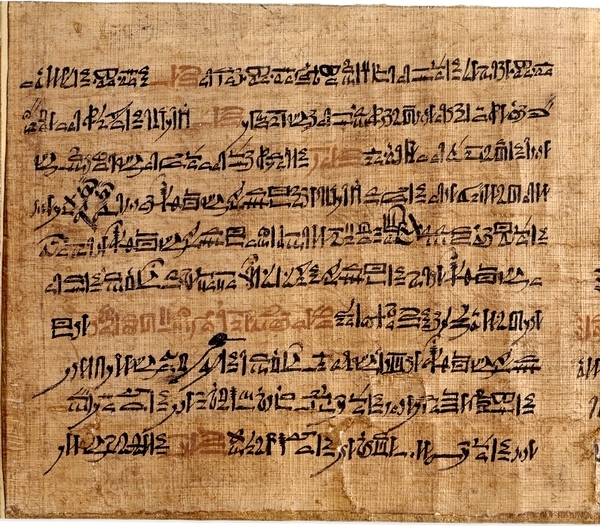
In a workmen's village on the west bank at Thebes, the scribes who decorated royal tombs also copied literature for their own pleasure. Among their papyri, later owned by the collector Alfred Chester Beatty, is a scroll whose back carries a cycle of love songs: seven stanzas in which a young man and a young woman praise and long for each other, each stanza beginning and ending with a play on its number.
Other collections survive on Papyrus Harris 500 (British Museum) and on a large pottery jar and ostraca from Deir el-Medina (in Cairo). They are about a thousand years older than most dates proposed for the Song.
| Collection | Material and place | Date | Notable features |
|---|---|---|---|
| Papyrus Chester Beatty I (verso) | Papyrus; Deir el-Medina, Thebes (Chester Beatty Library, Dublin) | 20th Dynasty, c. 1150 BC | A seven-stanza cycle in alternating voices; numbered wordplay; lovesickness |
| Papyrus Harris 500 | Papyrus; Thebes (British Museum EA 10060) | 19th Dynasty, c. 1300–1200 BC | Several song groups; garden scenes; the woman's voice prominent |
| The Cairo Love Songs | A large pottery jar and ostraca from Deir el-Medina (Egyptian Museum, Cairo) | Ramesside period | Songs in which the beloved is compared to plants; the lover's wish to be near her (as her maid, her ring, her laundryman) |
| Turin Love Songs | Papyrus fragment (Turin) | Ramesside period | Trees of a garden speak about the lovers |
Shared features
"Sister" and "brother" as terms of endearment (compare Song 4:9–12; 5:1–2); alternating female and male voices; lovesickness (Song 2:5; 5:8); gardens, orchards, pools and flowers; the beloved's body praised part by part; perfume, wine and fruit; the lover at the door; the wish to be close to the beloved's body (compare Song 8:1). Egyptian songs also have a strong woman's voice who speaks frankly of desire.
Differences
The Egyptian songs are mostly monologues, not dialogues; they mention Egyptian gods (Hathor, "the Golden One"); they lack the Song's refrains, its wilderness and mountain geography, its Solomon, and its climax about love and death (8:6–7). The Song's imagery is rooted in the land of Israel (En-gedi, Gilead, Lebanon, Carmel).
How close is the relationship?
Michael V. Fox's comparative study (1985) concluded that the Egyptian songs and the Song belong to a shared literary tradition of love poetry, probably transmitted through centuries of contact between Egypt and Canaan, but that the Song is a distinctively Israelite creation. Direct copying is not claimed by serious scholarship. The parallels are "contact" or "shared world" relationships, as the site's Echoes classify them.
Quotation and translation
The site describes and paraphrases the Egyptian songs; modern translations (Foster 1974; Fox 1985; Lichtheim; Simpson) are copyrighted. Exact museum numbers, dates and readings are a C check (S-C05).
What the evidence shows
- New Kingdom Egyptian love songs survive on papyri and pottery from Thebes and Deir el-Medina.Source: UCL Digital Egypt, "Love Songs" ↗; UCL Digital Egypt, "Manuscripts from Deir el-Medina" ↗
- Egyptian lovers call each other "sister" and "brother."Source: M. V. Fox, The Song of Songs and the Ancient Egyptian Love Songs (1985)
- The Song of Songs was copied from Egyptian love songs. A shared tradition is supported; direct copying is not.
Continue the journey
Journey of a PassageSong of Songs 1:9–11: A mare among Pharaoh's chariots"I have compared thee, O my love, to a company of horses in Pharaoh's chariots." The Hebrew susati is "my mare" (singular).More from this lesson
Echoes Across Civilizations
Optional: how other ancient peoples told similar stories. Open one to compare, then come back to the lesson.
Songs of love in the ancient worldEgyptian · Sumerian · Assyrian
Did other ancient peoples sing love poems like the Song of Songs?
- Egyptian: New Kingdom love songs (Papyrus Chester Beatty I verso, Papyrus Harris 500, the Cairo jar, Turin papyrus) Possible historical contact
- Sumerian: Songs of Inanna and Dumuzi Shared literary world
- Assyrian: Love lyric of Nabu and Tashmetu Resemblance only
Why this matters to the rest of Scripture
- Song of Songs 4:9–12; 5:1–2"My sister, my spouse."
- Solomon's marriage to Pharaoh's daughter: a link between Israel's court and Egypt.
- Another case of Egyptian literature and the Bible (Amenemope).