Era 6 · The First KingsSong of Songs
Song of Songs 4: A Garden Enclosed
Body-praise from eyes to breasts, a call from Lebanon, and the locked garden that opens
"Behold, thou art fair, my love; behold, thou art fair; thou hast doves' eyes within thy locks: thy hair is as a flock of goats, that appear from mount Gilead" (4:1). The black goats of the hills streaming down a slope: her dark hair falling. "Thy teeth are like a flock of sheep that are even shorn, which came up from the washing; whereof every one bear twins, and none is barren among them" (v. 2): white, matched, none missing.
"Thy lips are like a thread of scarlet… thy temples are like a piece of a pomegranate within thy locks. Thy neck is like the tower of David builded for an armoury, whereon there hang a thousand bucklers… Thy two breasts are like two young roes that are twins, which feed among the lilies" (vv. 3–5). "Until the day break… I will get me to the mountain of myrrh… Thou art all fair, my love; there is no spot in thee" (vv. 6–7).
"Come with me from Lebanon, my spouse, with me from Lebanon: look from the top of Amana, from the top of Shenir and Hermon, from the lions' dens, from the mountains of the leopards" (v. 8). "Thou hast ravished my heart, my sister, my spouse… with one of thine eyes" (v. 9). "How much better is thy love than wine!… Thy lips, O my spouse, drop as the honeycomb: honey and milk are under thy tongue" (vv. 10–11).
"A garden inclosed is my sister, my spouse; a spring shut up, a fountain sealed. Thy plants are an orchard (pardes) of pomegranates, with pleasant fruits; camphire, with spikenard, spikenard and saffron; calamus and cinnamon, with all trees of frankincense; myrrh and aloes… a fountain of gardens, a well of living waters, and streams from Lebanon" (vv. 12–15). She answers: "Awake, O north wind; and come, thou south; blow upon my garden, that the spices thereof may flow out. Let my beloved come into his garden, and eat his pleasant fruits" (v. 16).
Read 4:1–16 without labels: the praise of eyes, hair, teeth, lips, temples, neck and breasts; the call from Lebanon; the honey and milk; the garden and the fountain; and then a different voice calling the winds.
The Hebrew has no speaker names. Readers work out who is speaking from the grammar, which marks gender in "you" and "my" forms and in many verbs.
| Lines | Proposed voice | Clue in the Hebrew |
|---|---|---|
| 4:1–15 | The man | Feminine forms throughout ("you are fair," yafah; "my bride," kallah; "my sister"). |
| 4:16 | The woman (16b certainly; 16a probably) | "Let my beloved (dodi) come into his garden": she speaks of him. Some assign 16a ("awake, north wind") to the man. |
These labels are the site's editorial suggestion, following the grammar where it is clear. Where the grammar is not clear, the label says so. No ancient Hebrew manuscript carries them.
| Verses | What it says | What to notice |
|---|---|---|
| 4:1 | Doves' eyes behind the veil; hair like goats down Gilead | A wasf (Arabic term for a descriptive praise poem) begins. |
| 4:2 | Teeth like shorn ewes, all with twins | Whiteness and completeness. |
| 4:3 | Lips like scarlet thread; temples (or cheeks) like pomegranate halves | Color and shape. |
| 4:4 | Neck like David's tower with a thousand shields | Proud bearing; jewelry like shields on a tower. |
| 4:5 | Breasts like twin fawns among lilies | Softness and life. |
| 4:6–7 | Until the day breathes: to the mountain of myrrh; all fair, no flaw | Echoes 2:17; he answers her invitation. |
| 4:8 | Come from Lebanon: Amana, Senir, Hermon, lions' dens, leopards' mountains | The northern heights; danger and remoteness. |
| 4:9–11 | One glance ravishes him; love better than wine; lips of honey; scent of Lebanon | "My sister, my bride": terms of endearment. |
| 4:12 | Garden locked, spring locked, fountain sealed | Privacy and exclusivity. |
| 4:13–14 | Orchard (pardes) of pomegranates; henna, nard, saffron, calamus, cinnamon, frankincense, myrrh, aloes | A catalogue of luxury aromatics from many lands. |
| 4:15 | A garden fountain, a well of living water, streams from Lebanon | Life-giving water. |
| 4:16 | Awake, north wind; come, south wind; let my beloved come into his garden | Her invitation opens the locked garden. |
The wasf
Wasf is the Arabic name for a type of poem, known from Arab village weddings recorded in the 19th century, in which a bride or groom is praised part by part. Song 4:1–7, 5:10–16, 6:4–7 and 7:1–9 are often called wasfs. Egyptian love songs also praise the beloved's body part by part. The images compare effect rather than shape: hair moving like a flock flowing down a hillside, a neck carried proudly like a tower. Read literally, they become comic; read as poetry, they are vivid.
Gilead, Lebanon and Hermon
Gilead is the hill country east of the Jordan, famous for flocks and balm. Lebanon is the mountain range to the north, famous for cedars and snow-fed streams. Hermon (Senir in Amorite, Deuteronomy 3:9) is the highest mountain of the region, snow-capped most of the year. Amana is probably the Anti-Lebanon range or a peak in it (2 Kings 5:12 mentions a river Abana/Amana of Damascus). Lions and leopards lived in these mountains in antiquity. The site's Atlas marks the regions without pretending to pin a scene.
Pardes and the spices
Pardes (4:13), "orchard, park," is the Persian loanword also found in Ecclesiastes 2:5 and Nehemiah 2:8; its presence has been used to argue for a Persian-period date for at least this poem, though one word could also enter a text in later copying. The spice list includes Indian products (nard, calamus, cinnamon, aloes-wood), saffron from crocus, and Arabian frankincense and myrrh: goods that came by the incense routes and sea trade. No ordinary garden held them all; the list describes a dream garden.
As love poetry, chapter 4 is the man's longest praise of the woman, ending in the garden image that the woman herself completes. The locked garden is her body and her self: private, exclusive, fertile, and opened only by her invitation (v. 16). The poem celebrates desire with restraint: nothing is crude; everything is metaphor.
Ancient royal gardens (Assyrian, Persian) were enclosed parks with water channels and exotic trees, the original paradeisos. Egyptian love songs place lovers in gardens and orchards. Body-praise poems exist in Egyptian and later Arabic poetry. "Sister" and "bride" are endearments, as "sister" and "brother" are in Egyptian love songs; they do not mean the lovers were siblings.
Song of Songs Rabbah reads the enclosed garden of 4:12 as the chastity of Israel in Egypt (they kept their families intact), and the Targum reads the praise of 4:1–7 as praise of Israel's leaders and of the temple. The garden became an image of the people Israel set apart.
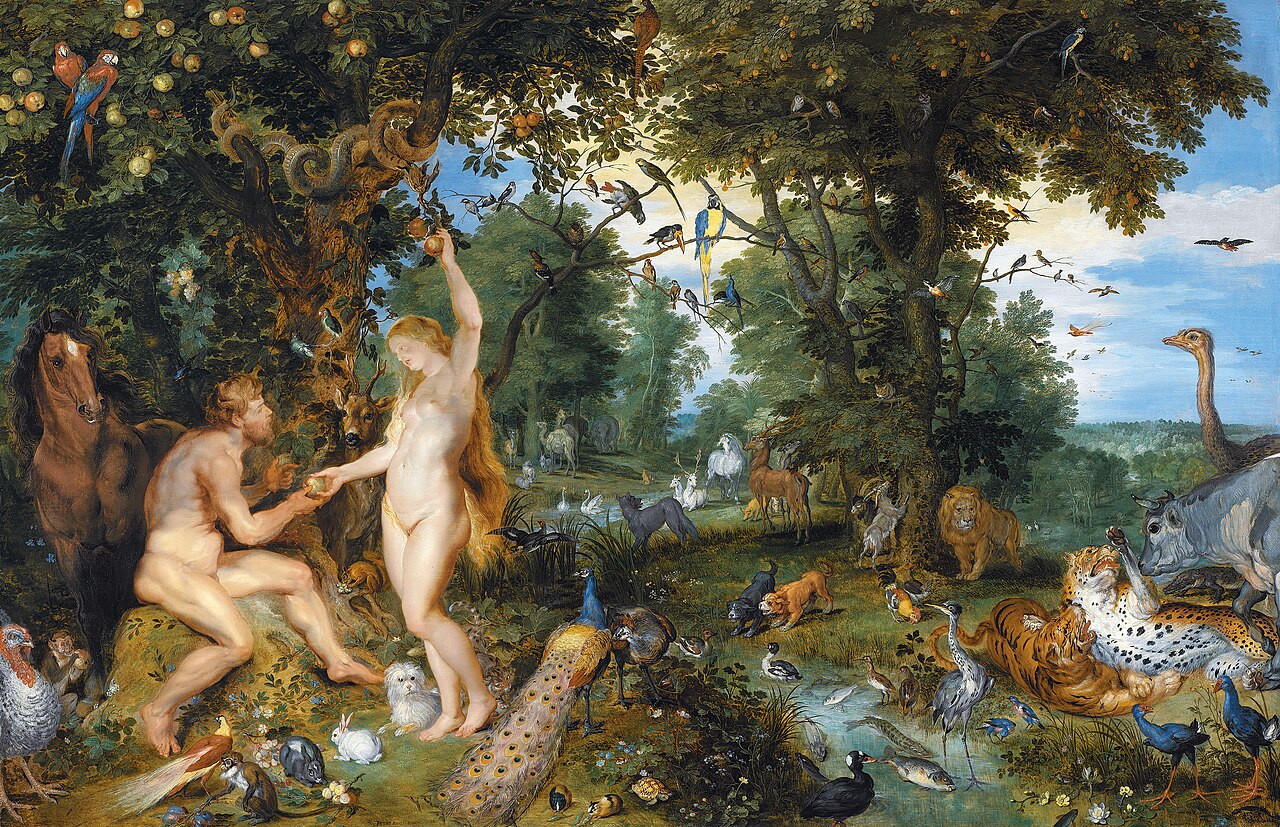
Medieval Christian art and devotion made the hortus conclusus (enclosed garden) and fons signatus (sealed fountain) of the Vulgate symbols of the Virgin Mary, a major theme of 15th-century painting. Earlier fathers read the garden as the church. These readings developed from the Latin wording; the Hebrew poem speaks of a woman and her lover.
Then and Later
The enclosed garden, then and later
- CompositionSong 4:12 "A garden inclosed… a fountain sealed": the beloved woman.
- c. 6th c. ADSong of Songs Rabbah Israel's faithfulness in Egypt.
- c. AD 390sJerome's Latin Hortus conclusus, fons signatus.
- 12th–16th c.Marian art The enclosed garden becomes a symbol of the Virgin Mary in hymns and paintings.The Song's Afterlife →
- TodayScholarship Read first as love poetry: privacy, exclusivity and invitation.
4:1: "within thy locks" or "behind your veil"?
Tsammah (4:1, 3; 6:7) is rare; it probably means a veil (as in Isaiah 47:2). The KJV took it as "locks" (hair). The library's Greek and the Vulgate render it "apart from what is hidden (within)" (Giguet: "sans parler de tes beautés cachées"), a modest paraphrase. The passage page sets out the readings.
"No spot in thee"
"Thou art all fair, my love; there is no spot (mum) in thee" (4:7). Mum is the word for a physical blemish disqualifying a priest or sacrifice (Leviticus 21–22). Ephesians 5:27 speaks of Christ presenting the church "not having spot"; Christian readers have long connected the two. In the Song the word is a lover's praise.
What the evidence shows
- Pardes (4:13) is a Persian loanword.
- Pardes proves the Song was written in the Persian period. One word can enter in later copying; it is evidence for a date, not proof.
- "Sister" in 4:9–12 means the lovers were siblings. An endearment, as in Egyptian love poetry.
- The Vulgate's hortus conclusus (4:12) became a symbol of the Virgin Mary in medieval Christianity.
Continue the journey
Journey of a PassageSong of Songs 4:1–7: Praise from eyes to breasts: veil, goats, towers, fawnsThe first praise poem (wasf): doves' eyes behind her tsammah (veil, or "locks" in the KJV), hair like goats on Gilead, teeth like shorn ewes, lips like scarlet thread, temples like pomegranate, neck like David's tower, breasts like twin fawns.More from this lesson
Echoes Across Civilizations
Optional: how other ancient peoples told similar stories. Open one to compare, then come back to the lesson.
Songs of love in the ancient worldEgyptian · Sumerian · Assyrian
Did other ancient peoples sing love poems like the Song of Songs?
- Egyptian: New Kingdom love songs (Papyrus Chester Beatty I verso, Papyrus Harris 500, the Cairo jar, Turin papyrus) Possible historical contact
- Sumerian: Songs of Inanna and Dumuzi Shared literary world
- Assyrian: Love lyric of Nabu and Tashmetu Resemblance only
Why this matters to the rest of Scripture
- The garden of Eden with its river: the archetypal garden.
- "Drink waters out of thine own cistern… let thy fountains be dispersed": the spring as wife.
- "Hermon… the Amorites call it Shenir."
- "Not having spot, or wrinkle": later Christian echo.
- Asaph, keeper of the king's pardes (forest, park).