Era 6 · The First KingsSong of Songs
Song of Songs 2: The Voice of My Beloved
A lily among thorns, a banner of love, spring's invitation and the little foxes
"I am the rose of Sharon, and the lily of the valleys" (2:1). She calls herself a common wildflower of the coastal plain. He turns it into praise: "As the lily among thorns, so is my love among the daughters" (v. 2). She answers in kind: "As the apple tree among the trees of the wood, so is my beloved among the sons. I sat down under his shadow with great delight, and his fruit was sweet to my taste" (v. 3).
"He brought me to the banqueting house, and his banner over me was love. Stay me with flagons, comfort me with apples: for I am sick of love. His left hand is under my head, and his right hand doth embrace me" (vv. 4–6). Then the refrain that will return twice more: "I charge you, O ye daughters of Jerusalem, by the roes, and by the hinds of the field, that ye stir not up, nor awake my love, till he please" (v. 7), or, in the Hebrew, "do not awaken love until it desires."
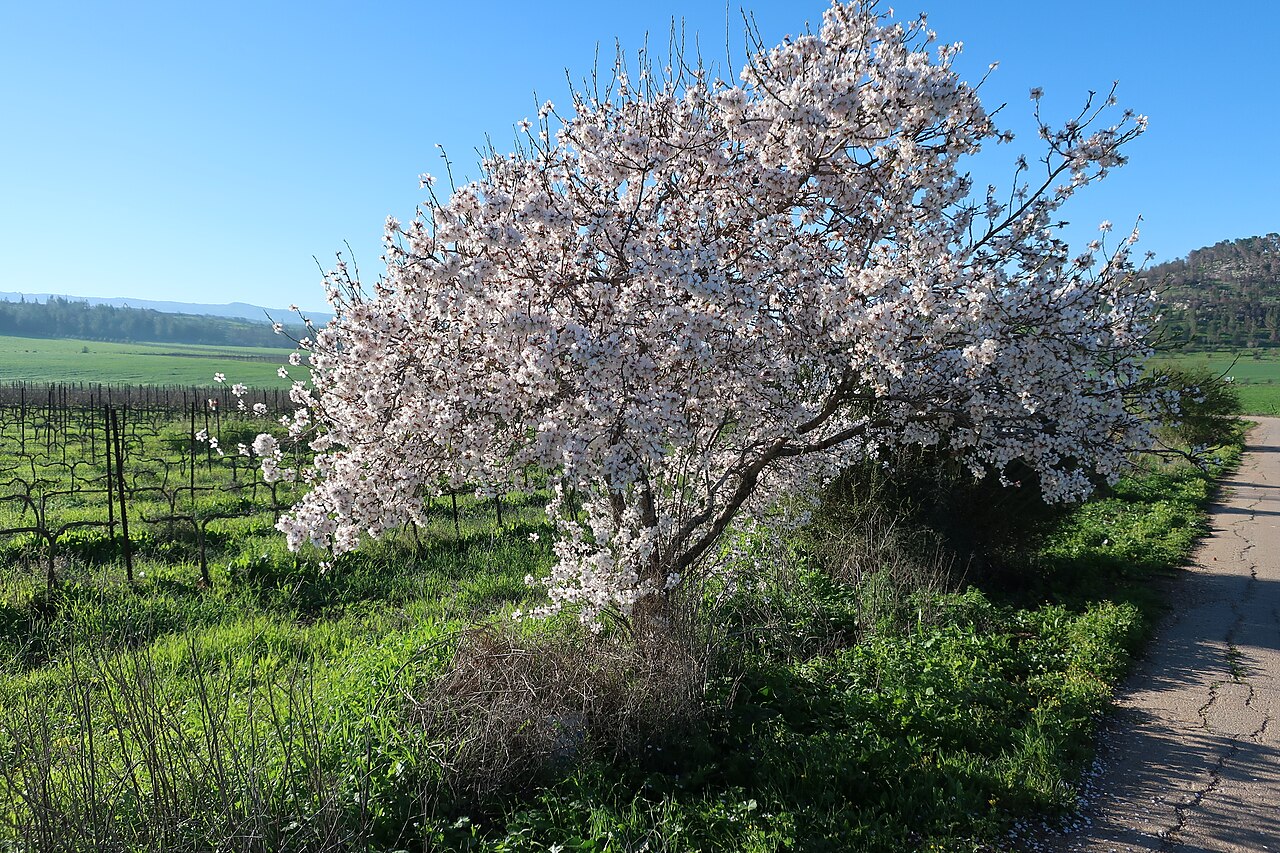
"The voice of my beloved! behold, he cometh leaping upon the mountains, skipping upon the hills. My beloved is like a roe or a young hart" (vv. 8–9). He stands behind the wall, looking through the lattice. "Rise up, my love, my fair one, and come away. For, lo, the winter is past, the rain is over and gone; the flowers appear on the earth; the time of the singing of birds is come, and the voice of the turtle (turtledove) is heard in our land; the fig tree putteth forth her green figs, and the vines with the tender grape give a good smell" (vv. 10–13).
"O my dove, that art in the clefts of the rock… let me see thy countenance, let me hear thy voice; for sweet is thy voice, and thy countenance is comely" (v. 14). "Take us the foxes, the little foxes, that spoil the vines: for our vines have tender grapes" (v. 15). "My beloved is mine, and I am his: he feedeth among the lilies. Until the day break, and the shadows flee away, turn, my beloved, and be thou like a roe or a young hart upon the mountains of Bether" (vv. 16–17).
Read 2:1–17 without labels: flower and thorns, apple tree, house of wine, embrace, the refrain, the leaping gazelle, the spring song, the dove in the rock, the foxes, the belonging, the parting.
The Hebrew has no speaker names. Readers work out who is speaking from the grammar, which marks gender in "you" and "my" forms and in many verbs.
| Lines | Proposed voice | Clue in the Hebrew |
|---|---|---|
| 2:1 | The woman | "I am" (ani) with feminine flower names; she describes herself modestly. |
| 2:2 | The man | "My darling" (ra'yati, feminine) among the daughters. |
| 2:3–7 | The woman | "My beloved" (dodi, masculine) among the sons; she addresses the daughters of Jerusalem. |
| 2:8–9 | The woman | "The voice of my beloved": she reports his coming. |
| 2:10–14 | The woman quoting the man | "My beloved spake, and said unto me" (v. 10); his words use feminine forms ("rise up… come away," feminine imperatives). |
| 2:15 | Unclear: the woman, the man, the brothers, or a chorus | Plural "take for us"; no gender marking identifies the speaker. |
| 2:16–17 | The woman | "My beloved is mine"; "turn, my beloved" (masculine imperative). |
These labels are the site's editorial suggestion, following the grammar where it is clear. Where the grammar is not clear, the label says so. No ancient Hebrew manuscript carries them.
| Verses | What it says | What to notice |
|---|---|---|
| 2:1–3 | Rose of Sharon and lily of the valleys; lily among thorns; apple tree among the trees | Plant names are uncertain (see Research). Mutual praise in matching images. |
| 2:4–6 | House of wine, banner of love, raisin cakes and apples, lovesick, the embrace | "Banner" (degel) is debated: banner, intention, or "look." |
| 2:7 | Refrain: I adjure you by the gazelles and the hinds: do not awaken love until it pleases | Repeated in 3:5 and (shortened) 8:4. |
| 2:8–9 | The beloved leaps over hills like a gazelle; looks through the lattice | Movement and playfulness. |
| 2:10–13 | Rise up, come away: winter past, flowers, birdsong, turtledove, figs, vines | A Levantine spring: rains end in March–April. |
| 2:14 | My dove in the clefts of the rock: let me see your face, hear your voice | Rock doves nest in cliff crevices. |
| 2:15 | Catch the little foxes that spoil the blossoming vines | A work song? A teasing image of rivals? A warning? (see Research) |
| 2:16–17 | My beloved is mine and I am his; until the day breathes, turn like a gazelle on the mountains of Bether | "Bether" is a place, "cleft," or "spices" (compare 8:14). |
The plants of 2:1–3
Chavatstselet ha-sharon ("rose of Sharon") is not a rose: the word appears elsewhere only in Isaiah 35:1 ("the desert shall… blossom as the rose"). Suggestions include a crocus, asphodel, narcissus or the sea daffodil (Pancratium maritimum) of the coastal Sharon plain. The library's Greek and the Vulgate render "flower of the field (or plain)." Shoshannah ("lily") may be a lily, a lotus or another bright flower; the word's Egyptian origin has been proposed. Tappuach ("apple") is uncertain: the true apple was probably rare in ancient Israel; apricot, quince or citron have been proposed. The Song's plants are real but their exact species are not, and English names are approximations.
Spring in the land
Verses 11–13 follow the season accurately: the winter rains end, wildflowers carpet the hills in March and April, migrating turtledoves arrive (Jeremiah 8:7 knows their seasons), the first green figs (pag) swell, and vines flower. The poem does not date an event; it uses the season everyone knew as the image of love's awakening.
Read as love poetry, the chapter is a lyric of desire and timing. The refrain (v. 7) is the Song's own wisdom: love should not be forced or hurried. The spring song (vv. 10–13) is one of the most admired poems in the Bible, and "my beloved is mine, and I am his" (v. 16) states the mutuality that runs through the book.
Egyptian love songs also use the lover's coming over the hills, the garden, the beloved as a gazelle, and the lovesick woman. The gazelle is common in ancient Near Eastern love imagery. The "little foxes" (more likely jackals or foxes generally) were real pests of vineyards; ancient farmers guarded vineyards from watchtowers (Isaiah 5:2).
The Targum reads 2:8–13 as the exodus: God "leaping over the mountains" to redeem Israel from Egypt in spring, at Passover; this is one reason the Song became the scroll read at Passover. The rabbis read 2:7 as an oath not to force the end of exile (Babylonian Talmud, Ketubot 110b–111a: the "three oaths"), a reading with major later consequences in Jewish debates about returning to the land.
Christian readers saw Christ as the "rose of Sharon" and "lily of the valleys" (a reading that gave English hymns their titles), though in the Hebrew the woman speaks those words of herself. Bernard and others read the "little foxes" as heresies or small sins that spoil the vineyard of the church or soul. These applications are later; the poem's own speaker in 2:1 is the woman.
The oath "by the gazelles"
The refrain swears "by the gazelles (tseva'ot) or by the hinds of the field (ayelot ha-sadeh)." The words sound like divine titles: tseva'ot echoes "(LORD of) hosts," and ayelot ha-sadeh echoes El Shaddai. Many scholars think the poem deliberately substitutes animal names for God's names, a playful or reverent avoidance. The library's Greek translates "by the powers and the forces of the field" (Giguet "par les puissances et les vertus de la campagne"), reading tseva'ot as "hosts, powers"; the Vulgate and KJV keep the animals. The Greek therefore preserves a trace of the divine-sounding sense.
Who "awakens" whom?
The Hebrew ha-ahavah is "love" (abstract): "do not awaken love until it pleases." The KJV has "my love, till he please" and the Vulgate "the beloved (feminine), until she wishes," making it a person sleeping; Giguet's French also has "ma bien-aimée." The abstract reading is now most common: love has its own time.
Mountains of "Bether"
Bater is "to cut" (Genesis 15:10, the cut pieces of the covenant). "Mountains of Bether" may be a place name (the Vulgate keeps Bether), "cleft mountains" (the library's Greek: "ravines"), or a variant of the "mountains of spices" in 8:14. Some read it as an erotic image. No location is identified; the site's Atlas does not place it.
What the evidence shows
- The "rose of Sharon" is a rose. The flower is unidentified; Greek and Latin have "flower of the field."
- The refrain's "gazelles" and "hinds of the field" echo divine names. Widely argued; the Greek reads "powers."Source: J. C. Exum, Song of Songs: A Commentary (Old Testament Library, 2005); The site's library: Westminster Leningrad Codex, KJV, Clementine Vulgate, Giguet's French of the Greek
- The Targum reads 2:8–13 as the exodus. C check on the Targum text.Source: Targum of the Song of Songs (Aramaic; date debated, often placed in the 7th–8th centuries)
- In 2:1 the woman, not the man, says "I am the rose of Sharon." The following verse (2:2) answers her with a feminine address.
Continue the journey
Journey of a PassageSong of Songs 2:1–3: The "rose of Sharon" and the lily"I am the rose of Sharon, and the lily of the valleys": the woman speaks of herself (the next verse answers her with a feminine address).More from this lesson
Investigations
Optional deep dives: the ancient sources, the physical evidence, and every interpretation side by side, including unconventional ones, each labeled for what it is.
Does the Song of Songs Name God?Divine name in 8:6: disputed · Superlative reading: well supported · Two-word Masoretic tradition: reported, C check · Divine-name echoes in 2:7: plausible
The Song never uses "God" or "the LORD." But its climax calls love's fire shalhevetyah, a word that may end in Yah, the short name of the LORD. Is God named once, at the heart of the poem, or not at all?
The Song of Songs, with Esther, is one of two biblical books that seem never to name God. The exception may be in 8:6: "the coals thereof are coals of fire, shalhevetyah." If -yah is the divine name, the phrase is "a flame of the LORD"; if it is a superlative, "a mighty flame." The Masoretic Text writes it as one word; a medieval Masoretic tradition is reported to have written two; the Greek and Latin have no divine name; modern translations divide. The oath "by the gazelles (tseva'ot) and the hinds of the field" (2:7; 3:5) also sounds like divine titles. The evidence is real on both sides.
Open the full investigation →Why this matters to the rest of Scripture
- The only other chavatstselet: the desert blossoming.
- Israel blossoming "as the lily," with the scent of Lebanon.
- The song of the vineyard, guarded and spoiled.
- "The turtle and the crane… observe the time of their coming."
- Bater, the cut pieces of the covenant ceremony.