Era 6 · The First KingsSong of Songs
Song of Songs 7: I Am My Beloved's
Feet to hair in praise, the palm tree, and "his desire is toward me"
"How beautiful are thy feet with shoes, O prince's daughter! the joints of thy thighs are like jewels, the work of the hands of a cunning workman. Thy navel is like a round goblet, which wanteth not liquor: thy belly is like an heap of wheat set about with lilies" (7:1–2). The praise now rises from the feet, as if watching her dance.
"Thy two breasts are like two young roes that are twins. Thy neck is as a tower of ivory; thine eyes like the fishpools in Heshbon, by the gate of Bath-rabbim: thy nose is as the tower of Lebanon which looketh toward Damascus. Thine head upon thee is like Carmel, and the hair of thine head like purple; the king is held in the galleries" (vv. 3–5), that is, caught in her tresses.
"How fair and how pleasant art thou, O love, for delights! This thy stature is like to a palm tree, and thy breasts to clusters of grapes. I said, I will go up to the palm tree, I will take hold of the boughs thereof" (vv. 6–8). "And the roof of thy mouth like the best wine for my beloved, that goeth down sweetly" (v. 9): in mid-line the voice turns to hers.
"I am my beloved's, and his desire is toward me" (v. 10). "Come, my beloved, let us go forth into the field; let us lodge in the villages. Let us get up early to the vineyards; let us see if the vine flourish… there will I give thee my loves. The mandrakes give a smell, and at our gates are all manner of pleasant fruits, new and old, which I have laid up for thee, O my beloved" (vv. 11–13).
Read 7:1–13 without labels: the dance-praise from feet to hair, the palm tree, the wine of her mouth, the turn of voice, the declaration, the invitation to the fields, the mandrakes.
The Hebrew has no speaker names. Readers work out who is speaking from the grammar, which marks gender in "you" and "my" forms and in many verbs.
| Lines | Proposed voice | Clue in the Hebrew |
|---|---|---|
| 7:1–9a | The man | Feminine forms ("how beautiful are your feet," "O daughter of a prince"). |
| 7:9b | The woman | "For my beloved (dodi)": the voice switches inside the verse. |
| 7:10–13 | The woman | "I am my beloved's"; masculine imperatives "come, my beloved." |
These labels are the site's editorial suggestion, following the grammar where it is clear. Where the grammar is not clear, the label says so. No ancient Hebrew manuscript carries them.
| Verses | What it says | What to notice |
|---|---|---|
| 7:1 | Feet in sandals, O prince's daughter; thighs' curves like jewels by a craftsman | Hebrew 7:2. Bat-nadiv: noble daughter. |
| 7:2 | Navel a rounded bowl never lacking mixed wine; belly a heap of wheat fenced with lilies | Fertility and abundance at harvest. |
| 7:3 | Breasts like twin fawns | Repeats 4:5. |
| 7:4 | Neck an ivory tower; eyes the pools of Heshbon by the gate of Bath-rabbim; nose the tower of Lebanon facing Damascus | Real places used as images of beauty and stateliness. |
| 7:5 | Head like Carmel; hair like purple; a king held captive in the tresses | Rehatim: tresses or water-troughs; KJV "galleries." |
| 7:6–7 | How fair, love, with delights; stature like a palm, breasts like clusters | The date palm: tall, graceful, fruitful. |
| 7:8 | I will climb the palm and take its fruit; breasts like grape clusters; breath like apples | Desire stated directly. |
| 7:9 | Mouth like the best wine… going down smoothly for my beloved, gliding over lips of sleepers | Speaker switch; the end of the verse is difficult. |
| 7:10 | I am my beloved's, and his desire (teshuqah) is for me | Teshuqah occurs only here and in Genesis 3:16; 4:7. |
| 7:11–12 | Come, let us go to the fields and villages, rise early to the vineyards; there I will give you my love | She sets the place and the time. |
| 7:13 | The mandrakes give fragrance; at our doors every choice fruit, new and old, stored for you | Mandrakes: a plant linked with fertility (Genesis 30:14–16). |
Heshbon, Carmel and Damascus
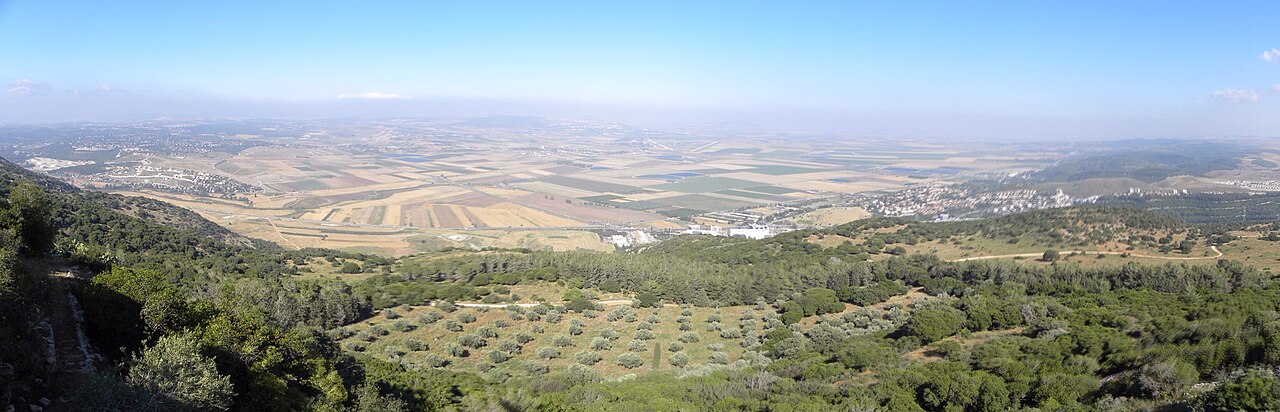
Heshbon (Tell Hesban in Jordan) was a Moabite and Amorite city east of the Jordan (Numbers 21:25–30); its excavations found a large Iron Age reservoir, and ancient pools fit the image of eyes like still water. "Bath-rabbim" ("daughter of many") is probably a gate name, unknown otherwise. Mount Carmel, the green ridge above the Mediterranean, stands for a proud head. Damascus is the Aramean capital; "the tower of Lebanon which looketh toward Damascus" may be a mountain peak or a watchtower. These are images; none is a find connected with the poem.
Mandrakes
Duda'im (7:13; Genesis 30:14–16) is usually identified as the mandrake (Mandragora officinarum), a low Mediterranean plant with yellow, fragrant fruit ripening in spring and a forked root, long believed to aid fertility and love. The word sounds like dodim, "love-making." The identification is traditional and probable, not certain.
As love poetry, chapter 7 is the Song's most openly sensual sequence, balanced by the woman's assured voice in vv. 10–13. Her invitation sets the scene in the countryside and the spring, at her initiative: "there will I give thee my loves."
Dance and body-praise belong together in Near Eastern wedding traditions recorded in later centuries; ancient Egyptian love poems also praise the beloved's limbs and compare her to trees and fruit. Palm-tree imagery for a woman is widespread (the name Tamar means "date palm").
The Targum turns the praise of 7:1–9 into praise of Israel's pilgrims, leaders and Sanhedrin; Song of Songs Rabbah reads "I am my beloved's" as Israel's devotion. The Jewish reading consistently turns the body into the people's institutions.
Christian writers read the dancing bride as the church adorned with virtues, the palm tree as the cross ("I will go up to the palm tree"), and 7:10 as the soul's surrender to Christ. Origen's and Gregory of Nyssa's commentaries develop the bride's ascent through virtues.
Teshuqah: Genesis 3:16 reversed?
Teshuqah, "desire, longing," appears only three times in the Hebrew Bible: Genesis 3:16 ("thy desire shall be to thy husband, and he shall rule over thee"), Genesis 4:7 (sin's desire for Cain) and Song 7:10 ("his desire is toward me"). In the Song, desire is the man's for the woman, with no ruling. Many readers see a deliberate reversal of the Genesis curse. Whether the poet knew Genesis 3 in its present form, or the word was simply available, is unprovable; the canonical contrast is real either way. The library's Greek has epistrophe ("turning"), the Vulgate conversio, close to the Greek of Genesis 3:16 (apostrophe).
7:9 and the voice switch
"Your mouth like the best wine, going (down) for my beloved smoothly, gliding over the lips of sleepers" (7:9; Hebrew 7:10). "For my beloved" shows the woman has taken over the sentence. The last phrase (dovev siftei yeshenim) is difficult; the Greek and some versions read "my lips and teeth" (Giguet: "qui plaît à mes dents et à mes lèvres"), which may reflect a different Hebrew text (shinnayim, "teeth," for yeshenim, "sleepers"). The KJV's "causing the lips of those that are asleep to speak" follows one interpretation of the Hebrew. The passage page compares them.
What the evidence shows
- Teshuqah occurs only in Genesis 3:16, 4:7 and Song 7:10.
- Song 7:10 deliberately reverses Genesis 3:16. A strong canonical reading; authorial intent unprovable.
- The library's Greek of 7:9 reads "teeth and lips" where the Hebrew has "lips of sleepers."Source: The site's library: Westminster Leningrad Codex, KJV, Clementine Vulgate, Giguet's French of the Greek
- Duda'im are mandrakes. Traditional and probable.
Continue the journey
Journey of a PassageSong of Songs 7:1–9 (Hebrew 7:2–10): From feet to hair: Heshbon, Damascus, Carmel and the palmPraise rising from her sandaled feet to her hair; real places as images (the pools of Heshbon, the tower of Lebanon facing Damascus, Carmel); the palm tree and its clusters; and at the end of v.More from this lesson
Why this matters to the rest of Scripture
- Genesis 3:16; 4:7The other uses of teshuqah.
- Rachel and Leah bargain over mandrakes.
- Heshbon, city of Sihon.
- The daughters of Shiloh dance in the vineyards.
- "The righteous shall flourish like the palm tree."