Era 6 · The First KingsSong of Songs
Song of Songs 8: Love Is Strong as Death
A wish for public love, the seal on the heart, the flame, the little sister, Solomon's vineyard and an open ending
"O that thou wert as my brother, that sucked the breasts of my mother! when I should find thee without, I would kiss thee; yea, I should not be despised" (8:1). A brother could be kissed in the street; a lover could not. "I would lead thee, and bring thee into my mother's house… I would cause thee to drink of spiced wine of the juice of my pomegranate" (v. 2). The embrace and the refrain return (vv. 3–4).
"Who is this that cometh up from the wilderness, leaning upon her beloved? I raised thee up under the apple tree: there thy mother brought thee forth" (v. 5).
"Set me as a seal upon thine heart, as a seal upon thine arm: for love is strong as death; jealousy (passion) is cruel as the grave (Sheol): the coals thereof are coals of fire, which hath a most vehement flame. Many waters cannot quench love, neither can the floods drown it: if a man would give all the substance of his house for love, it would utterly be contemned" (vv. 6–7). The flame at the end of v. 6 is shalhevetyah: "a mighty flame," or "the flame of Yah," the LORD.
"We have a little sister, and she hath no breasts: what shall we do for our sister in the day when she shall be spoken for? If she be a wall, we will build upon her a palace of silver: and if she be a door, we will inclose her with boards of cedar" (vv. 8–9). She answers: "I am a wall, and my breasts like towers: then was I in his eyes as one that found favour (shalom, peace)" (v. 10).
"Solomon had a vineyard at Baal-hamon; he let out the vineyard unto keepers; every one for the fruit thereof was to bring a thousand pieces of silver. My vineyard, which is mine, is before me: thou, O Solomon, must have a thousand, and those that keep the fruit thereof two hundred" (vv. 11–12). "Thou that dwellest in the gardens, the companions hearken to thy voice: cause me to hear it. Make haste, my beloved, and be thou like to a roe or to a young hart upon the mountains of spices" (vv. 13–14).
Read 8:1–14 without labels: the wish for public kisses, the mother's house, the refrain, the figure from the wilderness, the seal and the flame, the brothers and the little sister, Solomon's vineyard, the voice in the gardens, the gazelle.
The Hebrew has no speaker names. Readers work out who is speaking from the grammar, which marks gender in "you" and "my" forms and in many verbs.
| Lines | Proposed voice | Clue in the Hebrew |
|---|---|---|
| 8:1–4 | The woman | "O that you were like a brother to me" (masculine address); the refrain to the daughters. |
| 8:5a | A chorus, or the daughters | "Who is this (zot) coming up… leaning on her beloved?" |
| 8:5b–7 | The woman | "I awakened you" (masculine you); "set me as a seal" (masculine imperative). |
| 8:8–9 | The brothers ("we") | "We have a little sister." |
| 8:10 | The woman (or the sister) | "I am a wall" (feminine first person). |
| 8:11–12 | The woman, or the man | "My vineyard, which is mine": often taken as the woman (her vineyard, 1:6); some assign to the man. |
| 8:13 | The man | "You who dwell in the gardens" (feminine participle). |
| 8:14 | The woman | "Flee, my beloved" (masculine imperative). |
These labels are the site's editorial suggestion, following the grammar where it is clear. Where the grammar is not clear, the label says so. No ancient Hebrew manuscript carries them.
| Verses | What it says | What to notice |
|---|---|---|
| 8:1–2 | If only you were my brother: kisses in public, the mother's house, spiced wine, pomegranate juice | Public affection between unmarried lovers was censured. |
| 8:3–4 | His left hand under my head; refrain: do not awaken love | Third refrain (without the gazelles). |
| 8:5 | Who comes up from the wilderness leaning on her beloved? Under the apple tree I awakened you | Echo of 3:6; birth and awakening. |
| 8:6 | Set me as a seal on heart and arm; love strong as death, passion hard as Sheol; its flames, a shalhevetyah | The book's summit (see the passage page and the investigation). |
| 8:7 | Many waters cannot quench love; all a house's wealth for love would be scorned | Love cannot be overwhelmed or purchased. |
| 8:8–9 | The brothers' little sister: wall or door? silver battlements or cedar boards | Protection, control, and the question of her readiness. |
| 8:10 | I am a wall; my breasts like towers; in his eyes I found peace (shalom) | She claims her own maturity. |
| 8:11–12 | Solomon's vineyard at Baal-hamon, let out for a thousand silver; my own vineyard is before me | Wealth against self-possession. |
| 8:13 | You who dwell in the gardens, companions listen: let me hear your voice | Recalls 2:14. |
| 8:14 | Flee, my beloved, like a gazelle on the mountains of spices | Recalls 2:17; the book ends in motion. |
Seals
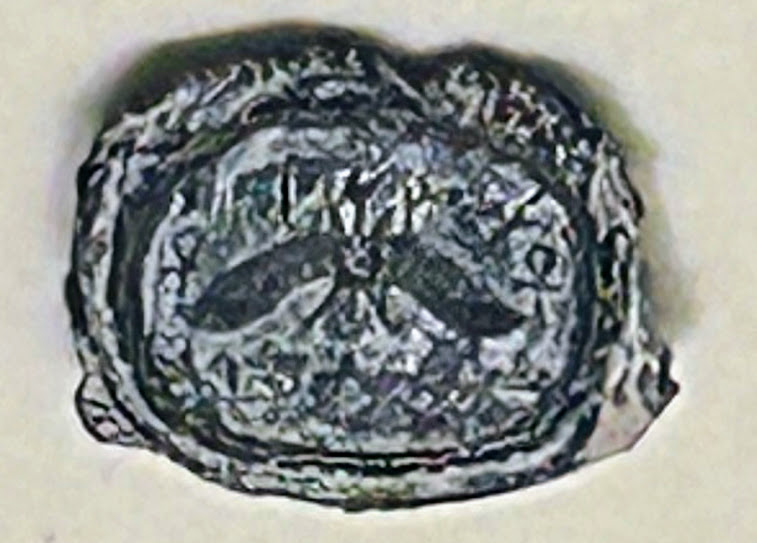
A seal (chotam) was a person's signature: an engraved stone, worn on a cord around the neck (Genesis 38:18) or as a ring on the hand (Jeremiah 22:24; Haggai 2:23), pressed into clay to mark ownership and authority. Hundreds of Iron Age Hebrew seals and seal impressions (bullae) survive, including the bulla of King Hezekiah found in Jerusalem in 2009. "Set me as a seal upon thine heart" asks to be worn close, as identity and as a sign of belonging. No seal is connected with the lovers; the images are of the custom.
Vineyards and the price of love
Solomon's vineyard is let out to keepers who each pay a thousand pieces of silver (8:11; compare Isaiah 7:23: "a thousand vines at a thousand silverlings"). Baal-hamon ("lord of a multitude") is otherwise unknown; the Vulgate translates both names ("the peaceful one had a vineyard in that which has peoples"). The woman's answer, "my vineyard, which is mine, is before me," returns to 1:6 ("mine own vineyard have I not kept"): she now keeps her own vineyard, herself. Verse 7 has already said that love cannot be bought with a whole house's wealth.
As love poetry, 8:6–7 is the Song's thesis: love is as strong as death, as unyielding as Sheol, a fire no flood can put out, and beyond price. The chapter then returns to family (the brothers), wealth (Solomon's vineyard) and the lovers' voices, and ends without closure. Many readers find that open ending fitting for a poem about desire.
Love compared with death and fire, and the motif of waters that cannot drown it, have parallels in Egyptian and later poetry; "many waters" (mayim rabbim) is also biblical language for chaotic floods (Psalm 29:3; 93:4). Engraved seals worn on the heart or arm are well documented in Israel and Egypt.
Jewish tradition read 8:6 as Israel's plea to God after exile: "set me as a seal" (Targum: on God's heart, as on the high priest's breastplate); "strong as death" became the measure of Israel's love for God, even to martyrdom (the rabbis linked Song 1:3 and 8:6 with dying for the sanctification of God's name). The "little sister" of 8:8 was read in the midrash as Abraham, or as Israel before Sinai.
Christian readers saw in 8:6–7 the love of Christ stronger than death (his passion and resurrection) and the love of the martyrs; the verse is widely used in Christian weddings. Medieval mystics (Richard of St Victor, John of the Cross) made "strong as death" a description of mystical love. The open ending was read as the church's longing for Christ's return (compare Revelation 22:17, 20).
Then and Later
"Strong as death," then and later
- CompositionSong 8:6–7 Love strong as death; a flame no flood can quench.
- 1st c. BC – 1st c. ADGreek "Its flames": no divine name.The Greek Song →
- Late antiquityRabbis and Targum Israel's love for God, even to martyrdom; "set me as a seal on your heart."
- c. 390sVulgate "Fortis est ut mors dilectio."
- 12th–16th c.Mystics Richard of St Victor, John of the Cross: love's union with God.
- 1611KJV "A most vehement flame": the superlative reading.
- TodayWeddings and translations Among the most read wedding texts; modern Bibles debate "the flame of the LORD."Love Stronger Than Death →
Shalhevetyah: "flame of the LORD"?
The last word of 8:6 is one word in the Leningrad Codex: shalhevetyah. The ending -yah can be (1) the short form of the divine name, Yah, as in Hallelu-yah, giving "a flame of Yah" (the LORD's flame); or (2) a way of forming a superlative, "a mighty flame," in the way that "mountains of God" (Psalm 36:6) means "mighty mountains." A further question is whether the word should be divided as two words, shalhevet-yah; medieval Masoretic lists report that the Ben Asher and Ben Naphtali traditions differed on exactly this (reported; C check). The KJV took the superlative ("a most vehement flame"); the NRSV and ESV print "a raging flame" with "the flame of the LORD" in the margin, and the NET Bible discusses both. The library's Greek (Giguet: "ce sont ses flammes") and the Vulgate ("lamps of fire and of flames") have no divine name. So it is wrong to say flatly that God is never named in the Song, and wrong to say flatly that he is: the one possible occurrence is here, inside a word whose grammar is disputed. See the dedicated investigation.
8:8–10: the little sister
The brothers' plans ("if she be a wall… if she be a door") can be read as protection of her chastity or as control over her marriage (compare the brothers of 1:6). Her reply, "I am a wall, and my breasts like towers," asserts that she is mature and in command of herself, and "then was I in his eyes as one that found peace." The text gives no age, and it is not a rule about women's bodies; it is a scene of family authority and a young woman's answer to it.
What the evidence shows
- Shalhevetyah (8:6) may contain the divine name Yah. The ending may be divine or superlative; the word division is also disputed.Source: NET Bible, note on Song 8:6 ↗
- The library's Greek and the Vulgate of 8:6 contain no divine name.Source: The site's library: Westminster Leningrad Codex, KJV, Clementine Vulgate, Giguet's French of the Greek
- Medieval Masoretic traditions differed on writing shalhevetyah as one word or two. Reported in Masoretic lists (Ben Asher / Ben Naphtali); C check (S-C02).
- The Song ends without a wedding or narrative closure.
- Baal-hamon is a known location. Unidentified; the site's Atlas does not place it.
Continue the journey
Journey of a PassageSong of Songs 8:1–4: "O that thou wert as my brother": public loveShe wishes he were like a brother, so she could kiss him in the street without being despised, and bring him to her mother's house.More from this lesson
Investigations
Optional deep dives: the ancient sources, the physical evidence, and every interpretation side by side, including unconventional ones, each labeled for what it is.
Does the Song of Songs Name God?Divine name in 8:6: disputed · Superlative reading: well supported · Two-word Masoretic tradition: reported, C check · Divine-name echoes in 2:7: plausible
The Song never uses "God" or "the LORD." But its climax calls love's fire shalhevetyah, a word that may end in Yah, the short name of the LORD. Is God named once, at the heart of the poem, or not at all?
The Song of Songs, with Esther, is one of two biblical books that seem never to name God. The exception may be in 8:6: "the coals thereof are coals of fire, shalhevetyah." If -yah is the divine name, the phrase is "a flame of the LORD"; if it is a superlative, "a mighty flame." The Masoretic Text writes it as one word; a medieval Masoretic tradition is reported to have written two; the Greek and Latin have no divine name; modern translations divide. The oath "by the gazelles (tseva'ot) and the hinds of the field" (2:7; 3:5) also sounds like divine titles. The evidence is real on both sides.
Open the full investigation →Why this matters to the rest of Scripture
- Genesis 38:18; Jeremiah 22:24; Haggai 2:23Seals worn on a cord or as a ring.
- "I have graven thee upon the palms of my hands."
- Psalm 29:3; 93:4"Many waters" as the floods of chaos.
- "A thousand vines at a thousand silverlings."
- "The Spirit and the bride say, Come… Even so, come": later Christian echo of the open ending.
- Nothing, not death, can separate from the love of God: a Christian echo of 8:6–7.