Era 6 · The First KingsProverbs
Investigation: What Did Ancient Education Look Like?
Fathers and mothers, scribal schools, abecedaries and the literacy debate
"My son, hear the instruction of thy father, and forsake not the law of thy mother" (1:8). "Hear, ye children, the instruction of a father… For I was my father's son… He taught me also" (4:1–4). The voice of chapters 1–9 is a parent's, and the book ends with a mother's teaching (31:1).
In Egypt, instructions were also addressed to "my son," but the son was often a pupil: the Egyptian "house of life" trained scribes by copying classics like Kemit, Khety and Amenemope on writing boards and ostraca. In Mesopotamia the edubba ("tablet house") taught Sumerian proverbs as copying exercises, many of which survive on school tablets.
| Evidence | Date | What it shows | What it does not show |
|---|---|---|---|
| 'Izbet Sartah abecedary | c. 12th–11th century BC | Someone practising the alphabet | A school |
| Tel Zayit abecedary | 10th century BC | Alphabet carved on a stone in the Shephelah | Who wrote it |
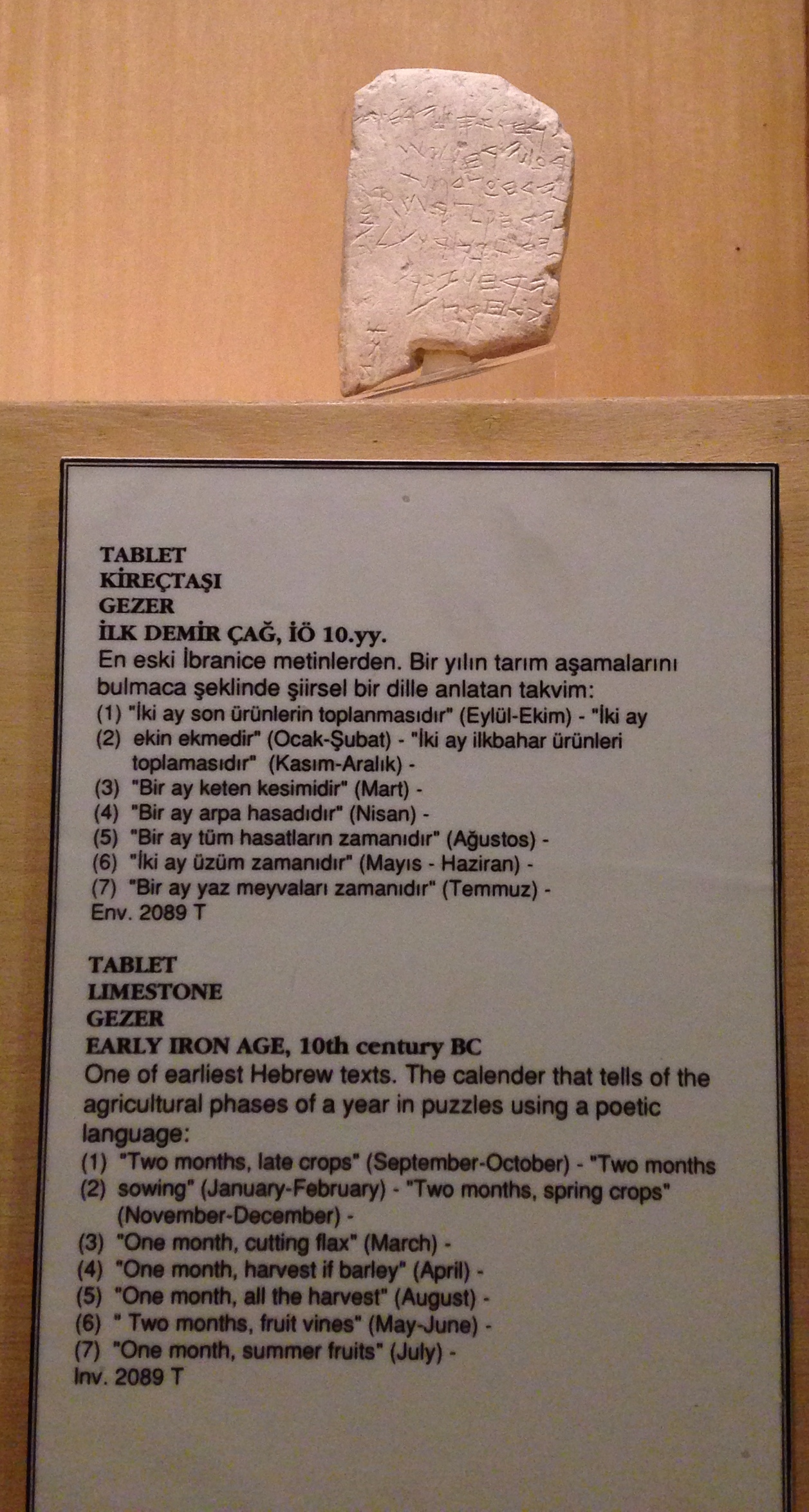
| Gezer Calendar | 10th century BC | A short text listing agricultural months; possibly a writing exercise | That it is a school text (debated) |
| Kuntillet 'Ajrud inscriptions and abecedaries | c. 800 BC | Writing practice at a way-station | Formal schooling |
| Arad ostraca | c. 600 BC | Military letters; a 2016 study of the handwriting suggested at least six writers in a remote fort | General population literacy |
| Lachish letter 3 | c. 588 BC | A junior officer protests "I have never needed anyone to read a letter to me" | How common his skill was |
| Sirach 51:23 | c. 180 BC | "Lodge in my house of instruction (beit midrash)": the first explicit Jewish school | Earlier practice |
Ahiqar
The Story and Proverbs of Ahiqar, an Aramaic text preserved on 5th-century BC papyri from the Jewish garrison at Elephantine in Egypt, is a wise Assyrian courtier's teaching to his nephew, with sayings close to Proverbs: "Withhold not thy son from the rod" (compare 23:13); warnings about the king's anger and about speech. It shows that Jews in the Persian period read international wisdom like Proverbs' own (C check against Porten–Yardeni).
Schools in Israel?
Scholars divide. Some (A. Lemaire, D. M. Carr) argue for scribal schools or apprenticeship at the royal court and temple from the monarchy, pointing to abecedaries, standardized scripts and numerals, and the scribal figures in Kings and Jeremiah (Shaphan, Baruch). Others think teaching happened mainly in families and in small groups of professional scribes. Proverbs fits both settings: family instruction (1–9) and court training (22:17–24:22; 25:1). There is no excavated "Proverbs classroom."
Literacy
How many people could read in Judah? Estimates range from a small elite to a broader minority. The 2016 study of the Arad ostraca (Faigenbaum-Golovin and colleagues, PNAS) argued for wider literacy among military officials around 600 BC; others caution against generalizing. Deuteronomy 6:9 (writing on doorposts) and Isaiah 28:9–10 ("precept upon precept," possibly mocking alphabet drills) are literary evidence that writing and teaching were familiar ideas.
Mothers as teachers
Proverbs names the mother as teacher (1:8; 6:20; 31:1–9). Women's role in passing on wisdom is attested in the Bible (the wise women of Tekoa and Abel, 2 Samuel 14; 20) and implicit in household instruction everywhere. Egyptian and Mesopotamian instruction texts are almost all father to son.
What the evidence shows
- Abecedaries from Iron Age Israel and Judah have been found.
- Formal scribal schools existed in monarchic Judah.
- The Elephantine Ahiqar papyri contain sayings close to Proverbs. C check against the edition.
- Proverbs names the mother as a teacher.
Continue the journey
Journey of a PassageProverbs 25:1: "Copied out by the men of Hezekiah""These are also proverbs of Solomon, which the men of Hezekiah king of Judah copied out (he'tiqu)." The only editorial note in Proverbs that names a later king.More from this lesson
Why this matters to the rest of Scripture
- "Thou shalt teach them diligently unto thy children."
- The wise woman of Tekoa.
- Baruch the scribe writes at Jeremiah's dictation.