Era 6 · The First KingsProverbs
Investigation: Who Actually Wrote Proverbs?
Solomon, the wise, Hezekiah's men, Agur, Lemuel's mother and an unnamed poet
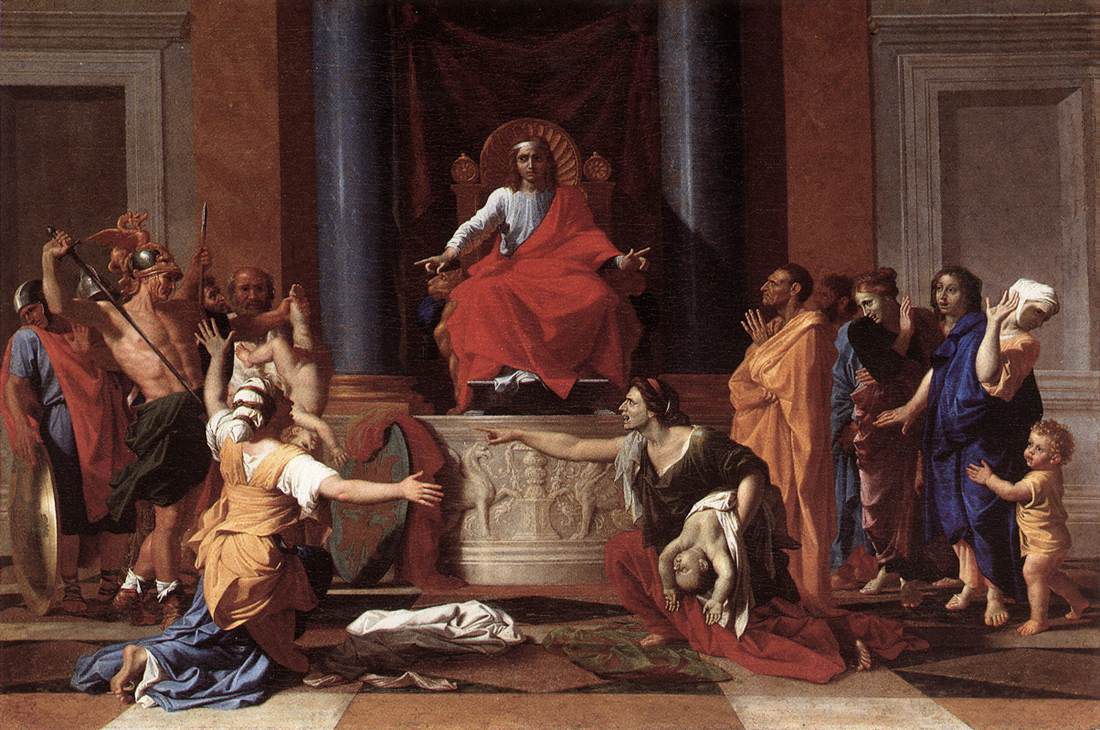
"And God gave Solomon wisdom and understanding exceeding much… And he spake three thousand proverbs: and his songs were a thousand and five… And there came of all people to hear the wisdom of Solomon" (1 Kings 4:29–34). Israel remembered Solomon as the wise king, as it remembered David as the singer and Moses as the lawgiver.
So the book opens with his name. But turn its pages and other voices speak: "Incline thine ear, and hear the words of the wise" (22:17); "These things also belong to the wise" (24:23); "The words of Agur" (30:1); "The words of king Lemuel, the prophecy that his mother taught him" (31:1). And at 25:1 an editor steps forward: these too are Solomon's proverbs, "which the men of Hezekiah king of Judah copied out," two and a half centuries after Solomon.
| Section | Heading | Claimed source | Form |
|---|---|---|---|
| 1:1–9:18 | "The proverbs of Solomon the son of David, king of Israel" (1:1) | Solomon (as title of the whole book) | Long instructions; Woman Wisdom |
| 10:1–22:16 | "The proverbs of Solomon" (10:1) | Solomon | 375 two-line sayings |
| 22:17–24:22 | "The words of the wise" (22:17) | Unnamed sages | Instructions; close to Amenemope (22:17–23:11) |
| 24:23–34 | "These things also belong to the wise" | Unnamed sages | Short appendix |
| 25:1–29:27 | "Proverbs of Solomon, which the men of Hezekiah… copied out" | Solomon, via Hezekiah's scribes | Sayings, many comparisons |
| 30:1–33 | "The words of Agur the son of Jakeh" | Agur (perhaps of Massa) | Questions, prayer, numerical sayings |
| 31:1–9 | "The words of king Lemuel… that his mother taught him" | Lemuel's mother | Royal instruction |
| 31:10–31 | (no heading) | Anonymous | Alphabetic acrostic |
Solomon and wisdom
The Bible's portrait of Solomon as sage (1 Kings 3:9–28; 4:29–34; 10:1–9) fits a well-known ancient pattern: kings as patrons of wisdom and scribal culture (Egyptian instructions were often attributed to kings or viziers: Merikare, Amenemhat, Ptahhotep). Archaeology of the 10th century BC in Jerusalem is debated, and no inscription of Solomon has been found. A royal court with scribes at that date is plausible; its scale is disputed.
Traditional view
Jewish tradition credits Solomon with Proverbs, Song of Songs and Ecclesiastes. The Talmud says "Hezekiah and his colleagues wrote (edited) Isaiah, Proverbs, the Song of Songs and Ecclesiastes" (Bava Batra 15a), recognizing editorial work. Avot de-Rabbi Nathan (A 1) says Proverbs, the Song and Ecclesiastes were once "hidden away" until the men of Hezekiah interpreted them. Many conservative scholars (for example A. E. Steinmann, B. K. Waltke) defend Solomon as author of 1–24 and the sayings of 25–29, with Agur, Lemuel's mother and the poet of 31:10–31 as other authors, and Hezekiah's scribes as editors.
Critical view
Many scholars (M. V. Fox, R. N. Whybray and others) see 10:1–22:16 and 25–29 as the oldest parts, containing sayings from the monarchy (some possibly very old, some from Hezekiah's time), 22:17–24:22 as adapted from Egyptian instruction, and 1–9 as a later introduction (Persian period, 5th–4th centuries BC), on the grounds of style, vocabulary, the developed figure of Woman Wisdom and themes shared with Persian-period literature. The book reached its final shape by the 3rd–2nd centuries BC, when it was translated into Greek. Others date 1–9 earlier.
Points of agreement
Both sides agree: the book is composite; the headings are ancient; 25:1 implies editing in Hezekiah's time; Agur and Lemuel were probably not Israelites or not otherwise known; the sayings themselves are mostly undatable. The disagreement is about how much goes back to Solomon personally and when chapters 1–9 were written.
What would change the picture
An inscribed collection of sayings from Iron Age Judah, a Hebrew manuscript of Proverbs older than the 1st century BC, or a datable external reference to the book. None is currently known. The site therefore writes "sayings attributed to Solomon" and reports the debate. Two small Qumran fragments are the oldest Hebrew copies: 4Q102 (4QProv-a, reported to preserve parts of 1:27–2:1) and 4Q103 (4QProv-b, reported to preserve parts of 13:6–9, 14:5–13, 14:31–35 and 15:1–8, 19–31), 1st century BC – 1st century AD. Their wording is close to the Masoretic Text. Exact ranges are a C check against DJD XVI.
What the evidence shows
- Proverbs names several contributors besides Solomon.
- Bava Batra 15a credits Hezekiah and his colleagues with writing (editing) Proverbs.
- Solomon composed the sayings of 10:1–22:16 and 25–29. Traditional; not independently verifiable.
- Proverbs 1–9 was composed in the Persian period.Source: M. V. Fox, Proverbs 1–9 (Anchor Yale Bible 18A, 2000)
- Proverbs 1–9 is Solomonic.Source: A. E. Steinmann, "Proverbs 1–9 as a Solomonic Composition," JETS 43 (2000): 659–674 ↗
Continue the journey
Journey of a PassageProverbs 1:1: "The proverbs of Solomon": a title over many collectionsThe book opens "The proverbs (mishle) of Solomon the son of David, king of Israel." All the library's witnesses agree on the wording.More from this lesson
Why this matters to the rest of Scripture
- Solomon's wisdom and 3,000 proverbs.
- The men of Hezekiah.
- "He set in order many proverbs."