Era 4 · Covenant and WildernessLeviticus
Gifts of Grain and Shared Meals
The grain offering and the peace offering
"When any will offer a meat offering unto the LORD, his offering shall be of fine flour; and he shall pour oil upon it, and put frankincense thereon." (The KJV's "meat" meant food; the Hebrew minchah means a gift or tribute.) A handful is burned on the altar as a memorial; the rest belongs to the priests.
It may be baked in an oven, cooked on a griddle, or fried in a pan, but never with leaven or honey. "And every oblation of thy meat offering shalt thou season with salt… the salt of the covenant of thy God." At harvest, the first ripe ears are roasted and offered.
The peace offering, shelamim, can come from the herd or the flock, male or female. The fat around the inner organs and the kidneys is burned: "all the fat is the LORD's." The priest receives the breast and the right thigh. The worshiper and his household eat the rest, the same day for a thanksgiving offering, within two days for a vow or a freewill offering.
"It shall be a perpetual statute for your generations… that ye eat neither fat nor blood."
Frankincense
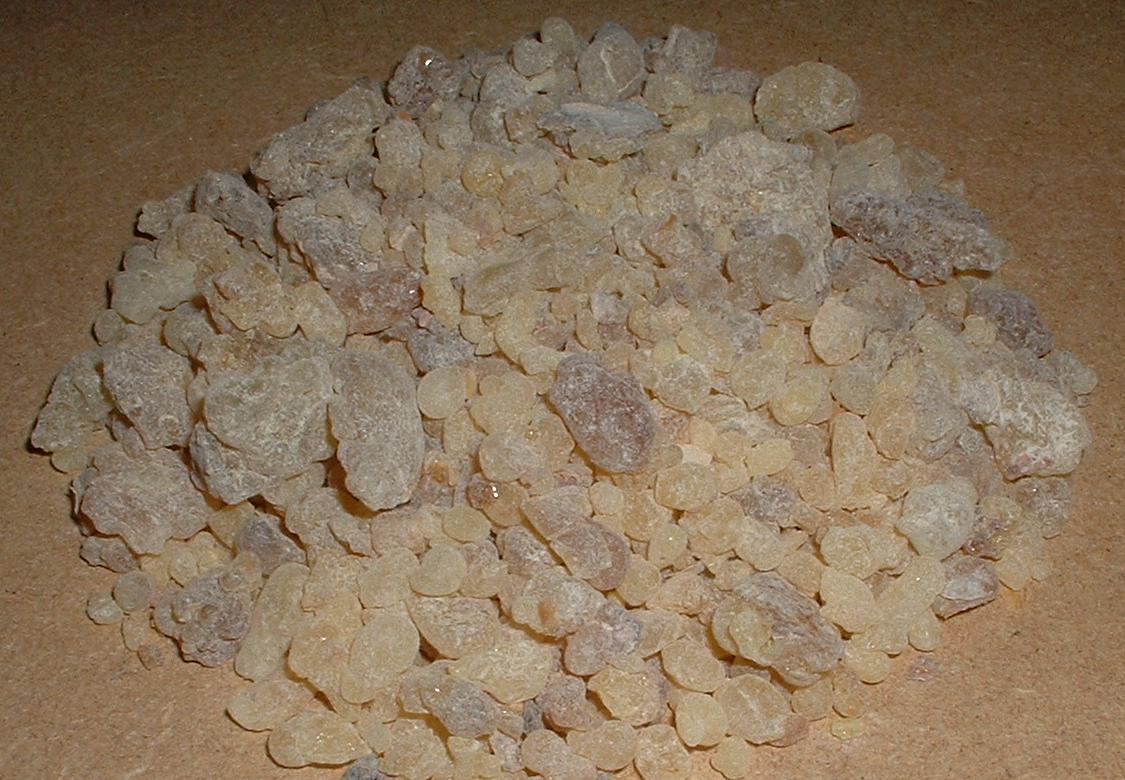
Frankincense is a resin from Boswellia trees that grow in southern Arabia and the Horn of Africa. Bringing it to Israel required the long-distance incense trade along the Arabian caravan routes. At the Judahite shrine at Arad, chemical analysis of residue on one of the two altars found frankincense mixed with animal fat, which helped it burn: direct physical evidence of frankincense used in Judahite worship in the 8th century BC.
The salt of the covenant
Salt preserves, and in the ancient Near East sharing salt sealed friendship and agreements. "A covenant of salt" means a lasting covenant (Numbers 18:19; 2 Chronicles 13:5). Persian officials said they "ate the salt of the palace" to express loyalty to the king (Ezra 4:14).
Why no leaven or honey?
Leaven and fruit honey (date syrup) both ferment. Interpreters have suggested that fermentation suggested decay, or that both were common in Canaanite offerings. Leviticus gives no reason. Leavened bread and honey could be brought as first fruits, but not burned on the altar (2:11–12).
Meat as a rare feast
Most Israelites rarely ate meat. Animals were wealth, kept for milk, wool and work. A peace offering, especially at a festival or to keep a vow, was often the occasion when a family ate meat at all, shared with the priest and with guests (Deuteronomy 12:18). Archaeologists find animal bones at shrines from feasts like these.
The Case for the Biblical Account
Scripture's account
Laws for the grain offering and the peace offering, a shared sacrificial meal (Leviticus 2–3; 7:11–36).
What evidence would we expect?
Incense trade and frankincense use; sacrificial meals; priests' portions; the same offering names elsewhere in Israel's world.
The discoveries
Frankincense on the Arad altar; Ugaritic šlmm offerings; priests' portions in the Marseille Tariff and in 1 Samuel 2:13–16; bowls inscribed for the priests at Arad.
Testing the discoveries
These finds date from the monarchy (8th century BC) and later, not the wilderness period. They show the practices existed in Israel and Judah.
The strongest reconstruction
The grain and peace offerings describe real practices of Israelite worship: incense, cereal gifts, and communal meals with priestly portions.
What remains possible
That these practices go back to Sinai, or that their written form reflects later Temple practice.
The priests' share, abused
1 Samuel 2:13–17 tells how Eli's sons sent a servant with a three-pronged fork to take meat from the pot, and demanded raw meat before the fat was burned. The story assumes the rules of Leviticus 3 and 7: the fat belonged to God first, and the priest's portion was fixed. Their contempt "for the offering of the LORD" was their great sin.
What the evidence shows
- Frankincense residue was found on an altar at the Judahite shrine of Arad.Source: E. Arie, B. Rosen and D. Namdar, "Cannabis and Frankincense at the Judahite Shrine of Arad," Tel Aviv 47:1 (2020) ↗
- Ugaritic rituals included šlmm offerings, the same word as Israel's peace offerings.Source: D. Pardee, Ritual and Cult at Ugarit (2002): offerings named šrp (burnt) and šlmm (peace offerings)
- Covenant meals and shared salt sealed agreements in the ancient Near East.
- God welcomes thanksgiving and freewill gifts.
Continue the journey
Connected elsewhere in ScriptureHannah's Song and Eli's Sons1 Samuel 2:12–17: Eli's sons and the priests' portion.More from this lesson
Why this matters to the rest of Scripture
- Eli's sons and the priests' portion.
- "A covenant of salt for ever."
- "Every sacrifice shall be salted with salt."
- Gold, frankincense and myrrh for the child Jesus.
- "I will offer to thee the sacrifice of thanksgiving."
- "The sacrifice of praise… the fruit of our lips."