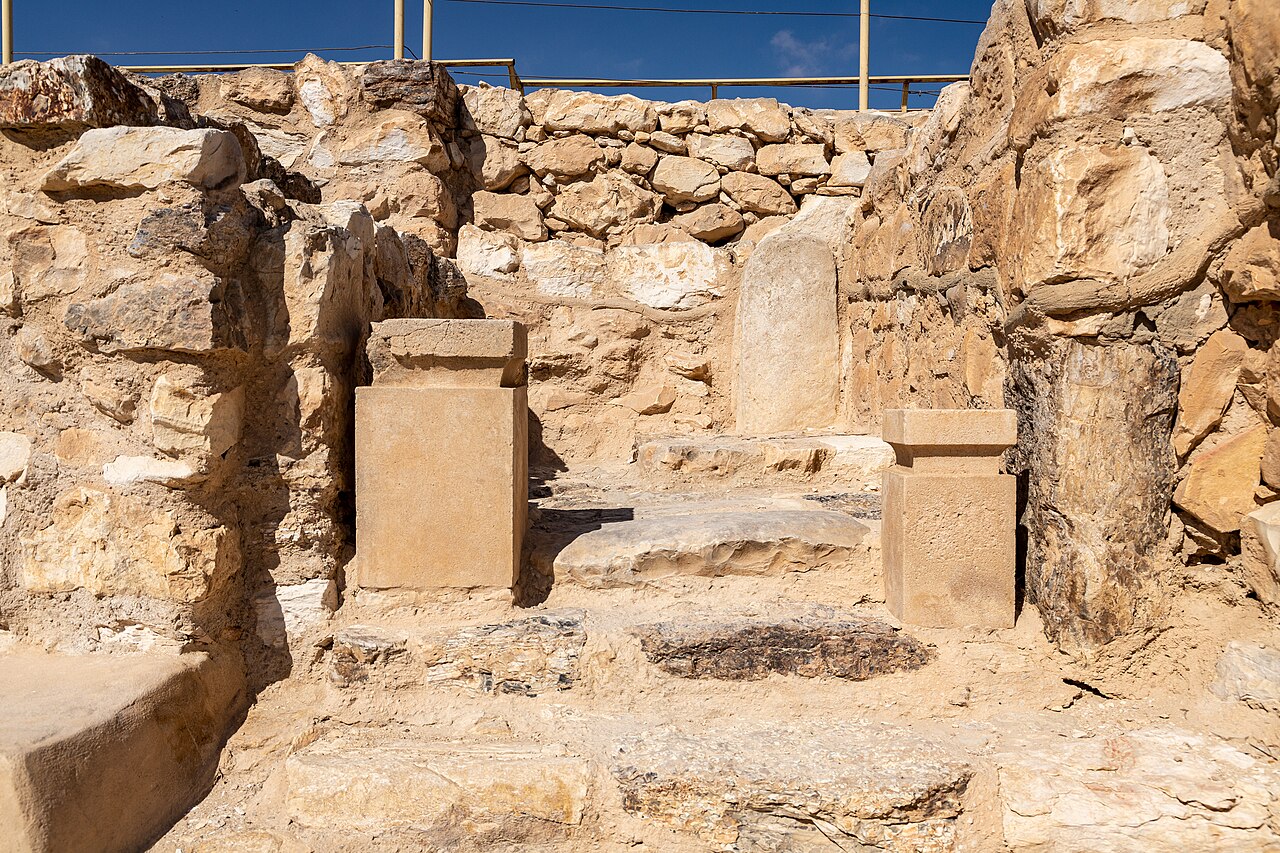
Any Israelite who slaughters an ox, lamb or goat in the camp or outside it, "and bringeth it not unto the door of the tabernacle of the congregation, to offer an offering unto the LORD… blood shall be imputed unto that man; he hath shed blood." Sacrifices are no longer to be offered "unto devils" (literally, goat-demons) in the open field.
No one, Israelite or foreigner living among them, may eat blood. "For the life of the flesh is in the blood: and I have given it to you upon the altar to make an atonement for your souls: for it is the blood that maketh an atonement for the soul." A hunter who kills a deer or a bird must pour out its blood and cover it with dust.
A new section: the Holiness Code
Since August Klostermann (1877), scholars have called Leviticus 17–26 the Holiness Code (H), because of its repeated refrain "Ye shall be holy: for I the LORD your God am holy." It extends holiness from the priests and sanctuary to the whole people and the whole land: family, farming, business, justice. Many scholars think H was written by a different priestly circle from Leviticus 1–16 (P); Israel Knohl argued that H is later and edited P. See How Leviticus Came to Us.
Leviticus 17 and Deuteronomy 12
Can you eat meat away from the sanctuary?
- Leviticus 17:3–4
- No. Every ox, lamb or goat killed must be brought to the tabernacle as a peace offering.
- Deuteronomy 12:15, 20–21
- Yes. "If the place… be too far from thee, then thou shalt kill of thy herd… and thou shalt eat in thy gates." Only sacrifices go to the central sanctuary.
Traditional interpreters explain the difference by setting: in the wilderness camp the tabernacle was always near, while Deuteronomy looks forward to a large land where it would be far away. Critical scholars often see two different laws, from different periods or circles, about sacrifice and slaughter. The Bible presents both.
A longer verse
In Leviticus 17:4, the Samaritan Pentateuch, the Septuagint and a Dead Sea Scroll (4QLev-d) contain a longer text than the standard Hebrew, adding: "to make it a burnt offering or a peace offering to the LORD, to be accepted, as a sweet savour, and slaughters it outside." Follow the passage to compare all the witnesses.
The Case for the Biblical Account
Scripture's account
All slaughter must be offered at the sanctuary; eating blood is forbidden; blood atones on the altar (Leviticus 17).
What evidence would we expect?
A blood prohibition in early sources; draining of blood in slaughter practices; textual traditions of this chapter.
The discoveries
The blood prohibition already in Genesis 9:4 and in 1 Samuel 14:32–34; Qumran manuscripts of Leviticus 17; the Jerusalem council's rule for Gentiles (Acts 15:20, 29).
Testing the discoveries
The textual evidence is strong and shows a longer form of 17:4 in several ancient witnesses. Archaeology cannot test the blood prohibition directly.
The strongest reconstruction
The blood prohibition is one of the oldest and most persistent elements of Israel's food laws, carried into both rabbinic Judaism and the early church.
What remains possible
Whether Leviticus 17 and Deuteronomy 12 reflect different settings or different stages of the law.
What the evidence shows
- The Samaritan Pentateuch, the Septuagint and 4QLev-d have a longer text in Leviticus 17:4.Source: E. Tov, Textual Criticism of the Hebrew Bible, 3rd ed. (2012)
- Leviticus 17–26 is a distinct literary unit (the Holiness Code).Source: J. Stackert, "The Holiness Legislation and Its Pentateuchal Sources," in The Strata of the Priestly Writings (2009); Oxford Bibliographies, "Priestly Code / Holiness Code"
- The Holiness Code was written after Leviticus 1–16.
- "It is the blood that maketh an atonement for the soul."
Continue the journey
Journey of a PassageLeviticus 17:4: A longer law in three ancient witnessesIn the standard Hebrew text, Leviticus 17:4 is a single sentence.More from this lesson
Why this matters to the rest of Scripture
- "Flesh with the life thereof, which is the blood thereof, shall ye not eat."
- Slaughter away from the sanctuary.
- Saul's soldiers eat meat with the blood.
- Gentile Christians asked to abstain from blood.
- "Without shedding of blood is no remission."